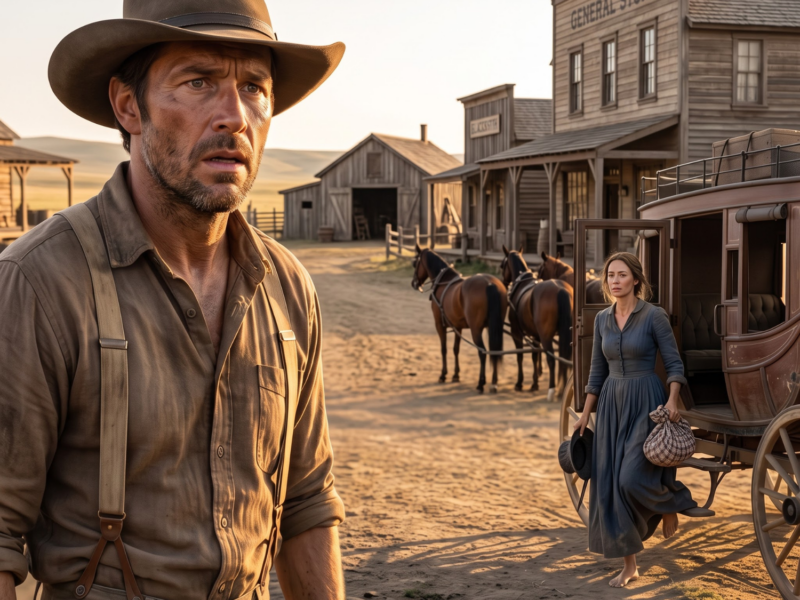
Lone Rancher Expected a Farmhand But a Barefoot Widow Stepped Off the Stagecoach
THE INK AND THE GHOST
By October, the blistering heat surrendered to a creeping, biting frost.
The ranch had changed. The modifications were small, almost invisible, but Caleb felt them. Fresh thyme and rosemary hung drying near the kitchen stove. The parlor windows, nailed shut for years, were opened on warm afternoons to let the breeze clear the stale air. A woven rug appeared over the scuffed floorboards by the front door.
One evening, Caleb returned from chopping wood to find Eliza sitting at the dining room table. A kerosene lamp burned brightly between them. She had Caleb’s ranch ledger open.
“Your accounts are a mess,” she said, not looking up, dipping a pen into an inkwell.
Caleb hung his coat by the door. “They make sense to me.”
“You listed three calves under feed expenses,” she pointed out, tapping the page. “And you paid the blacksmith twice in June.”
“The calves ate enough to be a feed expense,” Caleb grunted, pouring a cup of coffee.
“That is not how accounts work.” She tried to hide a smile, but Caleb saw the edge of it. It did strange things to his chest.
He walked over and looked over her shoulder. Her handwriting was flawless. Elegant, sweeping cursive that belonged to an educated woman, not a desperate farmer’s wife who claimed she could barely read the stagecoach schedule.
“You have a fine hand,” Caleb noted softly.
Eliza froze. She realized her mistake. The pen hovered over the paper. “My… my mother was a schoolteacher. Before she died.”
Caleb didn’t press. He walked away, but the puzzle of Eliza Bennett grew more complex.
Later that night, unable to sleep, Caleb walked out to the kitchen for water. He noticed a sliver of light beneath the door of the blue room.
He moved silently down the hall.
Through the cracked door, he saw Eliza. She wasn’t sleeping. She was sitting at the small desk, the leather ledger from her carpetbag open in front of her. She was copying names from it onto a separate sheet of paper.
Caleb narrowed his eyes. The pages of her ledger weren’t filled with farm expenses. They were filled with banking codes, property deeds, and foreclosure records. Red ink stamped across the margins.
He stepped back, his floorboard creaking loudly.
The light in the blue room instantly extinguished.
The next morning, Caleb found Eliza in the barn. She was brushing down his roan gelding.
“What’s in the book, Eliza?” Caleb asked, leaning against the stall door.
Eliza didn’t stop brushing. “I don’t know what you’re talking about.”
“I saw it. The bank ledger. Samuel didn’t just borrow money for bad seed, did he?”
Eliza stopped. She rested her forehead against the horse’s warm flank. “You shouldn’t ask questions, Caleb. For your own safety.”
“You brought it into my house. That makes it my business.”
She turned around, her hazel eyes blazing with a mixture of fear and defiance. “The bank in Nebraska… they weren’t just foreclosing on bad loans. They were falsifying the contracts after they were signed. They altered the interest rates, added phantom clauses. They targeted farms that sat on the proposed route for the new Union Pacific rail spur. They stole our land, Caleb. They stole my neighbor’s land. They drove two men to suicide.”
“And Samuel found out.”
“Samuel found the shadow ledger,” she whispered. “He broke into the banker’s office the night before we left. He took it to prove what they did. To take it to a federal judge in Cheyenne. But they realized it was missing. They sent their collector after him.”
“The men who killed him.”
“Yes,” Eliza said, a tear finally escaping, tracking through the dust on her cheek. “I have the proof to put the men who ruined us in federal prison. But I don’t know how to get it to a judge without getting a bullet in my back.”
Caleb stepped into the stall. He reached out, his thumb gently wiping the tear from her cheek. She didn’t flinch away.
“We’ll figure it out,” Caleb promised.
That evening, as they sat in the parlor, the silence felt different. It wasn’t empty. It was shared.
Eliza was sewing a torn curtain. Caleb was oiling his rifle.
“Why did you leave this room empty?” Eliza asked suddenly, gesturing to the parlor.
Caleb’s hands stopped moving over the steel barrel. He looked into the cold fireplace. He didn’t answer for a long time.
“My wife,” Caleb said, his voice cracking like dry wood. “Sarah. She loved this room. Used to read by the fire.”
Eliza put her sewing down.
“Winter of ’82,” Caleb continued, staring at a ghost in the corner. “Fever swept through the valley. It took my son first. Thomas. He was five.”
Eliza covered her mouth.
“Sarah lasted three days after him. The doctor couldn’t make it through the snowdrifts.” Caleb looked down at his hands. “I buried them on the hill out back. After that… I decided losing nothing was easier than keeping something. You don’t have to watch empty rooms die.”
Eliza stood up. She walked across the room and sat on the arm of his chair. She didn’t offer pity. She offered presence. She placed her small, calloused hand over his large, scarred one.
“I found a wooden horse under the bed in my room,” she whispered.
“It was his,” Caleb choked out, the grief of four years finally breaching the dam.
“It’s beautiful. You should put it on the mantle.”
The next morning, the wooden horse sat on the mantle. Beside it was a small, blue knitted scarf Eliza had made from leftover wool.









