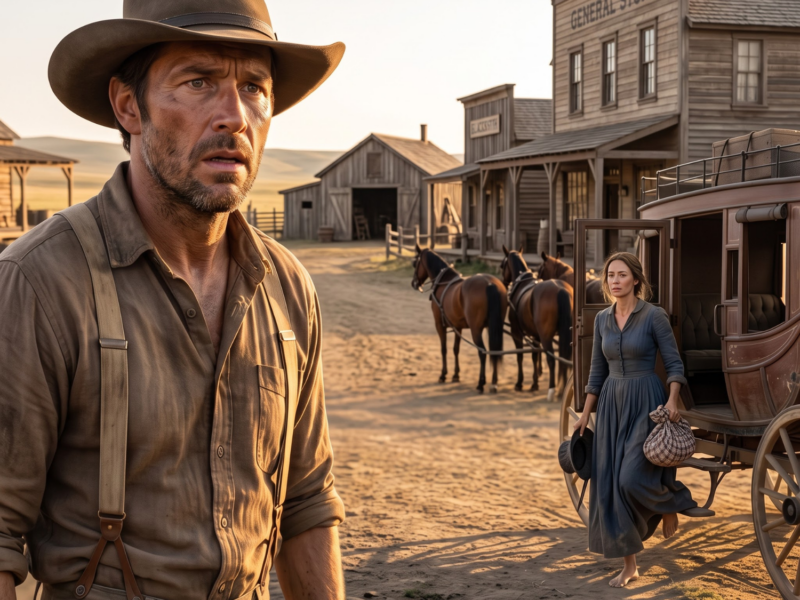
Lone Rancher Expected a Farmhand But a Barefoot Widow Stepped Off the Stagecoach
THE BLUE ROOM
The ride to Dry Creek took three hours through a landscape the summer had burned to the color of old rope. Eliza sat upright, her spine rigid despite the wagon’s violent jolts.
Caleb pointed out the boundaries of his isolation. “North pasture. The dry creek bed. Cottonwoods mark the house.”
“That barn needs work,” Eliza said, her eyes scanning the sagging roofline.
“It does.”
“The windmill sounds uneven.”
“It is.” She was observant. Too observant for a grieving widow who had just lost everything.
When they arrived, Caleb carried her trunk up the porch steps and pushed open the front door. The house was immaculate but dead. Dust motes danced in the shafts of dying sunlight. They passed a dining room where six chairs stood around a large oak table. Only one chair showed signs of use; the floorboards beneath it were scuffed. The others were ghosts.
Caleb kicked open a door at the end of the hall. He set the trunk down inside.
Eliza stopped in the doorway. She looked at the faded blue curtains, the perfectly made narrow bed, the small washstand.
“You said there was a bunkhouse,” she said, her voice dropping.
“The roof leaks. There are mice in the walls. This room is empty.”
Eliza stepped inside. Her eyes tracked the precise fold of the quilt, the lack of dust on the mirror, a small indentation on the rug where a rocking chair might have once sat.
“It does not look empty,” she said softly.
Caleb’s jaw clenched. “It is now.” He turned and walked out before she could see the fracture in his expression.
The next morning, Caleb woke in darkness. It was his routine. The heat was a beast that slept until dawn, and he preferred to work while it rested.
But as he pulled on his boots, a sound shattered the morning silence.
Thwack.
He grabbed his revolver, moving silently to the window.
In the gray, pre-dawn light, Eliza stood by the woodpile. She was splitting kindling. She wore the new boots, stiff and oversized on her feet. Her hands were wrapped in torn strips of cloth, gripping the heavy axe. She didn’t swing wildly. She used short, leveraged, controlled strokes.
Caleb walked out onto the porch, holstering his gun. “You should let your feet heal.”
Eliza didn’t stop swinging. “They can heal while I work.”
“You always this stubborn?”
She lifted another piece of wood, bringing the blade down cleanly. “My husband used a kinder word.”
“What word?”
“Useful.”
Over the next six days, Eliza proved the word was an understatement. She fed the chickens, cleaned the tack, and repaired the rusted hinges on the grain shed. She possessed a quiet, terrifying efficiency.
On the fourth day, Caleb watched her from the barn loft. A massive, ill-tempered mare had cornered her near the water trough, spooked by a rattlesnake coiled in the shade. Caleb rushed for the ladder, his heart in his throat.
By the time he hit the dirt floor, the snake was dead—its head crushed by a rusted horseshoe Eliza had thrown with deadly accuracy. She was standing perfectly still, one hand resting on the trembling mare’s neck, murmuring in a low, rhythmic cadence until the animal lowered its head.
She wasn’t a farmer’s wife. Not just a farmer’s wife.
That night, Caleb walked past her door. It was slightly ajar. Through the crack, he saw her sitting on the edge of the bed. She had the carpetbag open in her lap. She wasn’t pulling out clothes. She had peeled back the lining of the bag, retrieving a thick, leather-bound ledger. She stared at it in the lamplight, her expression carved from pure dread.
She looked up at the door. Caleb stepped back into the shadows, his pulse quickening. He heard the unmistakable, metallic click of a deadbolt sliding into place.
On the seventh day, Caleb found her in the barn, rubbing oil into a bridle.
“You can stay,” he said.
She continued rubbing the leather. “For the season?”
“For the season.”
Her hand stopped. She didn’t look up. “What wages?”
He named the amount he had offered Samuel. It was generous for a man. It was unheard of for a woman.
Her eyes finally lifted to his. “You don’t have to do that.”
“It is the wage for the work,” Caleb said gruffly, turning to leave.
“Mr. Mercer.”
He stopped.
“Thank you.”
That evening, when Caleb came in from washing up, he stopped dead in the kitchen doorway. The dining room table was set. Two plates. Two forks.
Caleb stared at the second plate. It felt like a threat. It felt like a promise. He stood there for ten seconds, the silence heavy, before he finally pulled out his chair and sat down.









