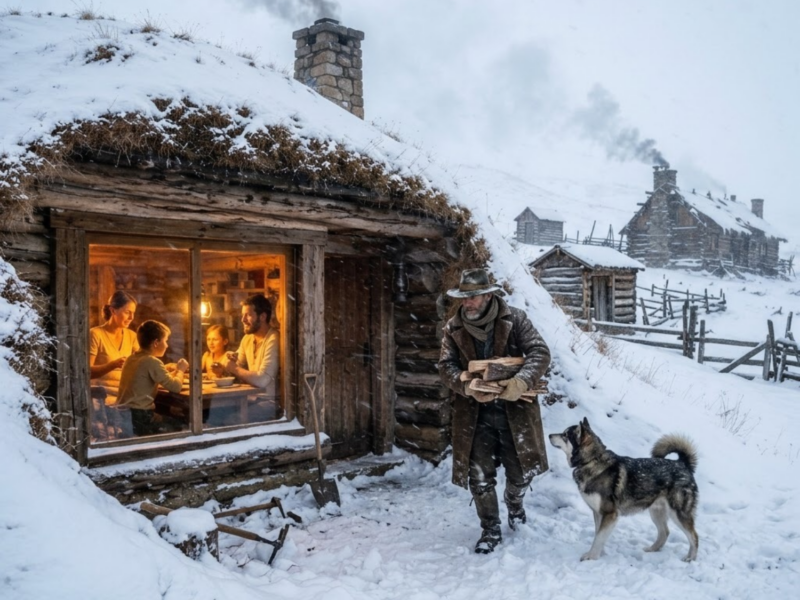
Settlers Mocked His Hillside Cabin But His Family Stayed Warm While Neighbors Froze
Settlers Mocked His Hillside Cabin But His Family…
Settlers Mocked His Hillside Cabin But His Family Stayed Warm While Neighbors Froze
The assessor sat his horse and pronounced the house a grave.
It was September 1899, on the wind-scoured prairies of Fort Yates, Emmens County, North Dakota. The autumn wind came down off the plains like an unsheathed blade, flattening the tall grass and carrying with it the first bitter promise of winter. A crowd of men stood along a south-facing slope, watching one man dig.
His name was Vassel Colomatz. He was not felling timber. He was carving a hole into the hillside terrace, shifting tons of earth at a time, and the settlers watching him could not make sense of it. Silus Vance, who had survived three brutal Dakota winters in a drafty timber frame that leaked air like a sieve, shook his head in disbelief.
Elias Thorne, whose above-ground sod house required constant, back-breaking repairs as the rain washed away its roof, laughed out loud at the sight of it. Who builds a mound of dirt instead of cutting down trees?
Then Harmon Wickersam rode up.
The Emmens County land assessor sat his horse with a leather-bound ledger braced against the saddle horn. His eyes narrowed at the ragged excavation, and he did not laugh. Wickersam saw a threat to order itself.
“A cabin partly buried in a hillside,” he told the gathered men, his voice carrying the bureaucratic weight of the federal government, “is nothing more than a burrow—a grave for a living family. It does not qualify as a dwelling under the Homestead Act of 1862.”
He pulled a fountain pen from his wool coat and made a sharp, dark notation in the ledger. “I am telling the land office in Bismarck that this is a subterranean storage pit, not a habitation.”
That was the official verdict: foolish, primitive, doomed. And yet the man with the spade kept digging, which raises the fundamental question this story must answer: What did this Bukovinian farmer understand about thermal mass and subterranean coupling that the frontier experts and the legal assessors had completely missed?
Before we trace the science, we must understand the man. Vassel Colomatz was not a timber baron from the pine-rich frontiers of the East. He was not a traditional prairie sodbuster, nor was he a New England carpenter trained in the geometric precision of balloon framing and mill lumber. Vassel was a zlyanka builder from Bukovina, Ukraine.
His hands knew the weight of dense clay, the moisture of deep loess, the structural arch of rootbound earth, and the specific gravity of packed soil. He understood dirt not as a nuisance to be scraped away and cursed, but as the most powerful, forgiving building material on the planet. Around Chernivtsi, the zlyanka was a proven architectural marvel: a semi-subterranean dwelling that allowed families to survive harsh, biting European winters on almost no fuel. Generations had built them; generations had thrived in them.
Vassel had carried that quiet, generational knowledge across the Atlantic Ocean, along with his wife, Oxana, and their two children, Ivan and Lesia. They had already endured one Dakota winter in a temporary, conventional clapboard shanty. The memory of that suffering was permanently etched into Vassel’s bones.
The cold of the Dakotas was not merely weather; it was a physical entity, a predatory force that systematically probed every structural weakness. The first winter had shown him the absolute inadequacy of standard frontier construction. It had been so violently cold that it altered the physical properties of ordinary materials.
A neighbor’s steel plowshare cracked cleanly at the coulter on the very first draw through the frozen topsoil. Inside the local church, the ink froze solid in the pastor’s baptismal register before the first bell finished ringing. In Vassel’s own temporary shanty, a heavy wool cap left hanging on a wooden peg near the drafty door froze so stiff with condensed moisture that it cracked down the crown when Oxana tried to pull it down.
Vassel watched all of it with a builder’s cold, calculating eye.
The standard American prairie cabin was an exercise in thermal defiance, and it was failing. He rejected the box before he ever broke ground on his claim. A conventional cabin was simply a box sitting on top of the ground: four walls, a roof, and every square inch of it exposed to the open air. It featured roughly 1,500 square feet of exterior surface area, radiating precious interior heat directly into the freezing Dakota sky.
That was the design. That was the fundamental flaw. And the wind found every single weakness.
On the open prairie, a north wind blowing at forty miles per hour does not simply flow past a cabin; it strips it. This is forced convection, and it operates exponentially. Every gust drives the exterior wall temperature plummeting downward, and the greater the gap between the inside warmth and the outside cold, the faster the heat escapes.
That thermal gap has a name: Delta T.
Inside a conventional cabin, a settler fought desperately to hold 65 degrees Fahrenheit. Outside, the ambient air sat at 30 degrees below zero. That created a Delta T of 95 degrees—95 degrees of thermal gradient, aggressively pushing heat outward through 1,500 square feet of wall in every direction at once.
Heat always moves from warm to cold, and the steeper the gradient, the harder it pushes. The walls of those frontier cabins—thick logs chinked with mud and horsehair, packed tight by human hands—offered an insulating value of roughly R-4. R-4. It was barely better than a single pane of glass in a modern window.
And the settlers expected that fragile barrier to hold back a 95-degree thermal gradient while a 40-mile-per-hour wind hammered the exterior. It couldn’t. It never could.
To compensate, the settler did the only thing he could: he fed the fire. A standard cast-iron stove in a conventional cabin burned through an astonishing two cords of wood every single week during a hard cold snap. Two cords a week meant constant stoking, day and night. Someone always had to be awake, always chopping, always feeding the iron box just to keep the interior a few degrees above freezing.
And even then, it fought them. The stove’s heat rose straight to the ceiling and stayed trapped there, while the floor remained freezing. The warm air at the top and the freezing air at the bottom began to cycle against each other, producing relentless drafts—freezing air sweeping across the floor, curling around ankles, even with every door and window sealed tight with rags and tallow.
The neighbors knew this miserable cycle well. Silus Vance and Elias Thorne spent their entire winters trapped inside it: gather fuel, chop wood, feed the fire, repeat until spring. They weren’t living; they were merely holding the line against a relentless enemy.
Vassel Colomatz looked at that math and flatly refused it. He rejected the American box. He picked a natural terrace on his clay-loam claim that faced due south, picked up his spade, and started digging.
Related Articles

They Mocked the Widow’s Dirt Cellar—Then the Freeze Left Every Cabin Cold but Hers Warm
They Mocked the Widow’s Dirt Cellar—Then the Freeze Left Every Cabin Cold but Hers Warm…

A Homeless Veteran and His German Shepherd Inherited a Ridge No One Wanted — 35 Feet In, They Found
Chapter 1 / 7 A Homeless Veteran and His German Shepherd Inherit… A Homeless Veteran…

Neighbors Laughed When He Built A Cabin Inside An Old Barn—Until It Kept His Home 35 Degrees Warmer
Chapter 1 / 8 Neighbors Laughed When He Built A Cabin Inside An… Neighbors Laughed…

His Sod House Had No Woodpile in January – Until the Trains Stopped and the Town Came Begging
Chapter 1 / 10 His Sod House Had No Woodpile in January – Until t……

She Built Her Cabin Over the Woodshed and Never Burned Wet Wood Again
Chapter 1 / 8 She Built Her Cabin Over the Woodshed and Never Bu… She…

The Duke Abandoned Her on Their Wedding Day—Years Later, He Discovered What He Had Lost
Chapter 1 / 7 The Duke Abandoned Her on Their Wedding Day—Years… The Duke Abandoned…

He Wedged a Tiny A Frame Into a Crevice Before Winter and His Family Slept at 75°F While Town Hit
Chapter 1 / 7 He Wedged a Tiny A Frame Into a Crevice Before Win……

He Was Too Old to Ride—So He Bought the Ruined Ranch and Found the Room Behind the Fireplac
Chapter 1 / 5 He Was Too Old to Ride—So He Bought the Ruined Ran……

Settlers Laughed at His Underground Heat Recovery Duct — Until It Kept His Cabin 71°F Warmer
Chapter 1 / 9 Settlers Laughed at His Underground Heat Recovery… Settlers Laughed at His…

A Navy SEAL Built a Home Inside a Mountain—Then His Dog Warned Him Before the Storm
Chapter 1 / 5 A Navy SEAL Built a Home Inside a Mountain—Then Hi… A…