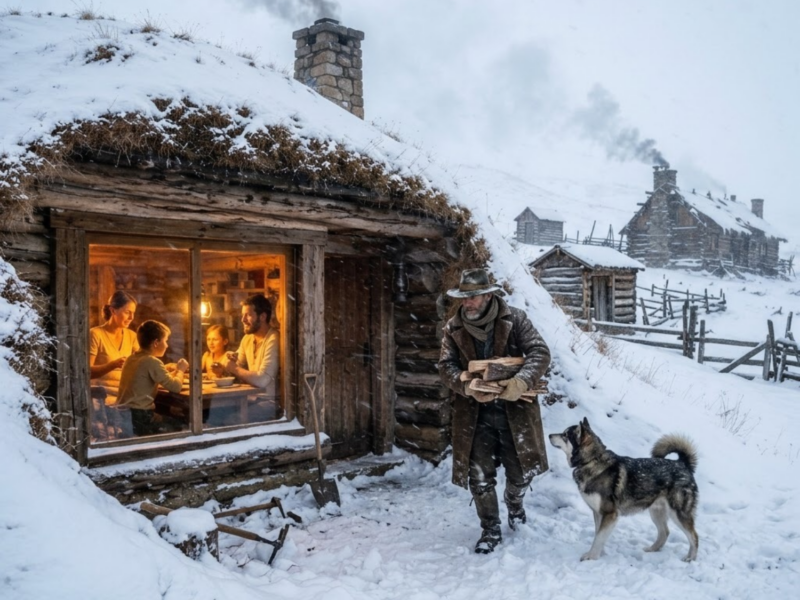
Settlers Mocked His Hillside Cabin But His Family Stayed Warm While Neighbors Froze
The Thirteen Nights
The cold did not arrive like ordinary weather; it arrived like a final judicial verdict.
In late January, a severe polar outbreak rolled down out of the Arctic and settled like a heavy lead blanket over the Dakota plains—a meteorological event that regional histories would write about for generations. For thirteen consecutive nights, the ambient air temperature held steady at 38 degrees below zero Celsius. Not a brief dip, not an evening snap—thirteen unrelenting nights of deep, systemic freeze.
Then the wind came.
It screamed across the flat prairie at 65 kilometers per hour straight out of the north, stripping the protective snow cover off the ground and leaving the frozen soil bare and exposed to the killing air. The windchill pushed the effective temperature into a range where human flesh freezes solid in minutes.
Inside the conventional cabins of the settlement, the suffering was total and absolute. Silus Vance spent three sleepless days and nights huddled beside his stove, watching in despair as three of his prized calves froze to death while standing upright in a poorly sealed outbuilding. Elias Thorne ran out of cordwood entirely and started breaking apart his own furniture—feeding chair seats and table legs into his firebox just to keep his family from slipping into fatal hypothermia.
Even the small, everyday things succumbed to the cold. The kerosene in the settlers’ lamps began to gel, the flames shrinking and turning a strange, oxygen-starved blue. And the wind kept hunting, hammering the timber walls, finding every microscopic gap in the chinking, and driving invisible blades of freezing air straight into the living spaces.
The Colomatz family experienced none of it.
While the prairie above them screamed in a blinding whiteout of blowing ice, the interior of the hillside cabin was profoundly, peacefully quiet. A meter and a half of dense loess swallowed the acoustic violence of that 65-kilometer-per-hour wind howl.
The air inside was warm, heavy with the comforting smell of wood smoke and drying herbs. The potbellied stove radiated a gentle, consistent heat. The earthen-backed walls were warm to the touch, preventing any aggressive convection loops or cold drafts sweeping across the floor.
Outside, the storm raged on without mercy. Inside, the family simply waited it out in quiet comfort. Thirteen nights, and not a single one of them spent fighting the cold.









