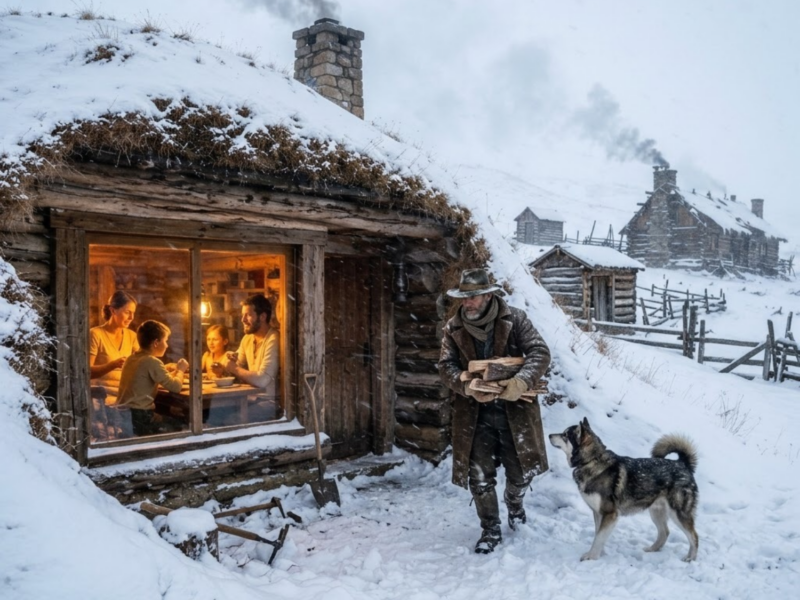
Settlers Mocked His Hillside Cabin But His Family Stayed Warm While Neighbors Froze
The Thermal Battery
The secret to what happened next is buried in the physics of the earth itself.
The earth beneath the frost line never freezes. Down far enough, the ground holds a temperature that barely fluctuates throughout the entire year, reflecting the region’s annual average rather than the violent meteorological swings of any given week. In the Dakota territory, that deep earth temperature sits right around nine degrees Celsius (about 48 degrees Fahrenheit). Summer, winter, blizzard, or calm—it stays right there.
Vassel didn’t fight that constant; he plugged straight into it.
Consider the mathematics of exposure. A conventional prairie cabin had roughly 140 square meters of exterior surface area exposed to the open, freezing air. Every wall, every inch of roof, was bleeding heat into the wind.
Vassel’s zlyanka exposed only about 14 square meters—the south wall, and nothing else. That represented a staggering 90 percent reduction in surface area engaged in battle with the sky. The other 32 square meters of his exterior envelope weren’t fighting anything; they were coupled directly to the massive thermal inertia of the earth.
When the outside air dropped to 38 degrees below zero, the dense loess packed against his north, east, and west walls didn’t drop with it. It stayed near that stable subterranean baseline of nine degrees. He wasn’t heating a wooden box surrounded by killing air; he was heating a sanctuary surrounded by mild, stable ground.
Let us run the heat loss calculations. A conventional cabin in those severe conditions bled somewhere between 25,000 and 30,000 BTUs every single hour, requiring a roaring, non-stop fire just to hold the line against hypothermia.
Vassel’s cabin, shielded by tons of packed loess and completely protected from the scouring north wind, lost a mere 4,000 BTUs per hour. That is a six- to seven-fold difference in energy loss under the exact same winter sky, on the exact same prairie. One house was a losing race against physics; the other had already won.
Furthermore, the south wall did more than just minimize heat loss; it actively gained solar energy. During the winter months, the sun hangs low in the southern sky. Vassel had recessed his window on purpose. The low-angle light reached deep into the room past the glass, striking the heavy earthen floor and the dense log walls. The thermal mass absorbed that solar energy all day, releasing it slowly into the living space long after dark—passive solar engineering executed decades before modern architects coined the term.
Because the thermal losses were so minimal, the fire didn’t need to be a monster. Vassel ran a standard cast-iron potbellied stove, but he didn’t run it at a roaring draft. A few thick splits of oak in the morning burned down to a slow, steady bed of coals that easily held the interior at a comfortable 26 degrees Celsius (nearly 80 degrees Fahrenheit) day and night.
He burned roughly one-sixteenth of the firewood his neighbors consumed. One-sixteenth.
The mathematical case was settled. The structure worked on paper, and it worked in theory. But paper doesn’t freeze, and theory doesn’t strip the snow off the ground and drive gale-force winds through every microscopic seam in a wall.
The ultimate test was coming. And when it arrived, it would test them for thirteen straight nights.









