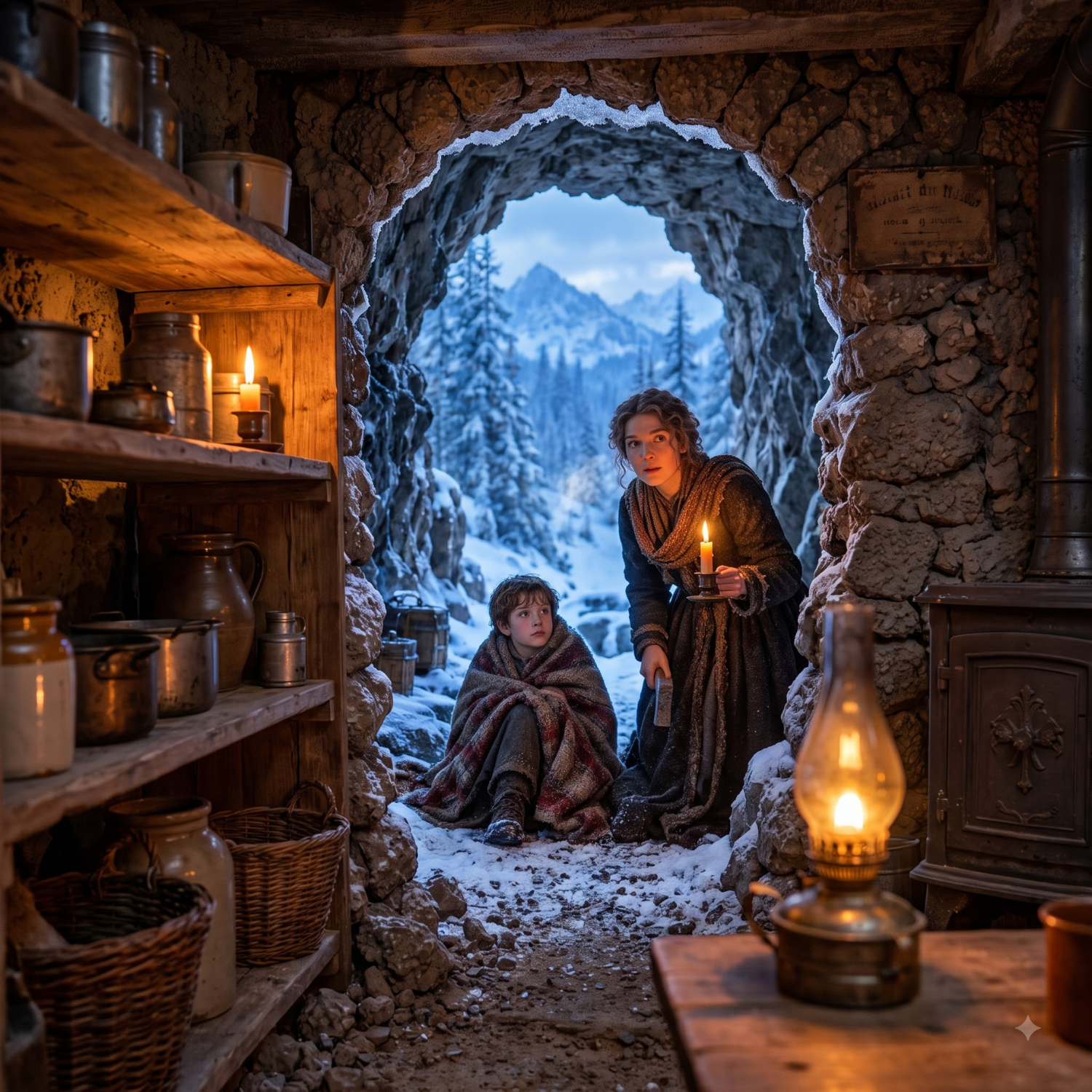
She Carried Her Sick Son Into a Mountain Cave—Then an Old Hammer Revealed a Hidden Home
The First Fire
Martha carried Samuel inside, the sudden absence of the wind feeling like a physical release.
Twenty feet beyond the narrow entrance, the passage widened into a surprisingly dry, rounded chamber protected from the worst of the storm. The air here was dead and still. She gently laid Samuel on the flat stone floor, quickly bundling him in the driest blanket she had.
She needed a fire immediately, or the boy would not survive the hour.
She ran back to the entrance, tearing dead, brown needles from the lower pine branches. She gathered deadwood, though most of it was slick with snow. Using her husband’s hunting knife, she brutally split the damp sticks lengthwise, shaving away the wet exterior until she reached the pale, dry wood inside.
Her hands were shaking violently as she struck the first match against a stone. It flared brilliantly, then died instantly in the damp air.
She swore softly, a prayer and a curse combined.
She struck the second match. It caught. Martha protected the tiny, fragile flame with cupped hands, her body curled around it like a shield, until the dry pine shavings caught. She fed it splinters, then twigs, then the split wood, until a weak, sputtering fire began burning against the cavern wall.
Only after Samuel was pulled close to the radiant heat did Martha allow herself to examine the cave.
The dancing orange light revealed a space roughly fifteen feet across. The ceiling was low and uneven. But as the light flickered, Martha noticed something that made her frown.
One wall of the cave looked strangely straight.
It lacked the organic, chaotic curves of the rest of the cavern. It was flat, vertical, and unnaturally sheer. Through a thin, dark crack beside it came the same faint, steady current of air she had felt outside.
Something existed inside Blackstone Mountain.
But Samuel groaned, a weak, rattling sound in his chest, and the mystery of the wall vanished from her mind. Mysteries could wait. The creeping, lethal cold could not.
Martha grabbed her knife and rushed back to the entrance, hacking down thick green pine boughs. She dragged them inside and stacked them thickly beneath Samuel, creating an insulated bed that separated his fragile body from the freezing, heat-sapping stone floor.
His clothes were dangerously damp from the journey. She stripped off his heavy coat, hung it on a stick near the fire to dry, and wrapped him tightly in the remaining blanket.
Next, she needed water. Fever demanded hydration.
Martha packed the heavy iron cooking pot with clean snow from the entrance and set it near the flames. The reality of winter survival was a brutal arithmetic. A full pot of snow melted down to barely two cups of water. She filled it again. And again.
Every cup of water required heat. Every fire required wood. And almost every piece of wood outside was wet and frozen.
Martha sat by the fire, methodically splitting branches lengthwise, exposing their dry centers before feeding them to the flames. It was exhausting, repetitive labor.
Samuel woke long enough to drink a cup of the lukewarm water. He looked at her with glassy, unfocused eyes. Minutes later, he violently vomited the water onto the stone floor, his small body wracked with dry heaves.
Martha stared at the wasted water sinking into the dust. She wanted to scream. She wanted to lie down and cry until she fell asleep.
Instead, she cleaned the floor with a rag and began melting another pot of snow.
By midnight, the terrifying reality of their situation had crystallized in her mind. Cold, thirst, and hunger were separate, deadly enemies, but defeating any one of them consumed the exact same limited resource: wood.
Water consumed wood. Heat consumed wood. Cooking consumed wood. Gathering wood consumed Martha’s strength, which required food, which required cooking, which required wood. It was a closed, shrinking circle.
She divided their meager food into small portions and placed tomorrow’s rations in a separate pile on a rock. Samuel would eat first, whenever his stomach could hold it. She would eat whatever remained.
Outside, the wind howled, and snow began collecting heavily across the cave entrance, sealing them in.
Then, over the roar of the storm, Martha heard something.
Tap.
She raised her head, her hand moving instinctively to the handle of her knife.
Tap.
The sound was distinct. Metallic. And it came from the unnaturally straight wall at the back of the cave.
Martha lifted a burning, thick stick from the fire and approached the wall cautiously. She held the makeshift torch high. Nothing moved in the shadows. She pressed her bare palm against the stone. It was freezing cold.
Tap.
Samuel stirred behind her. “Mama? I’m here.”
Martha hurried back to him, smoothing his damp hair. “I know, Sammy. I’m right here.”
“What was that noise?” he whispered.
“Probably just the mountain settling,” she lied smoothly.
She did not believe her own answer for a second.
Before dawn, Samuel’s fever spiked. He began shivering violently, his teeth chattering so hard she feared he would break them. Martha looked at the small, precious pile of dry branches she had hoarded for the next day.
She did not hesitate. She put two thick pieces on the fire. Keeping him alive through this night mattered infinitely more than tomorrow.