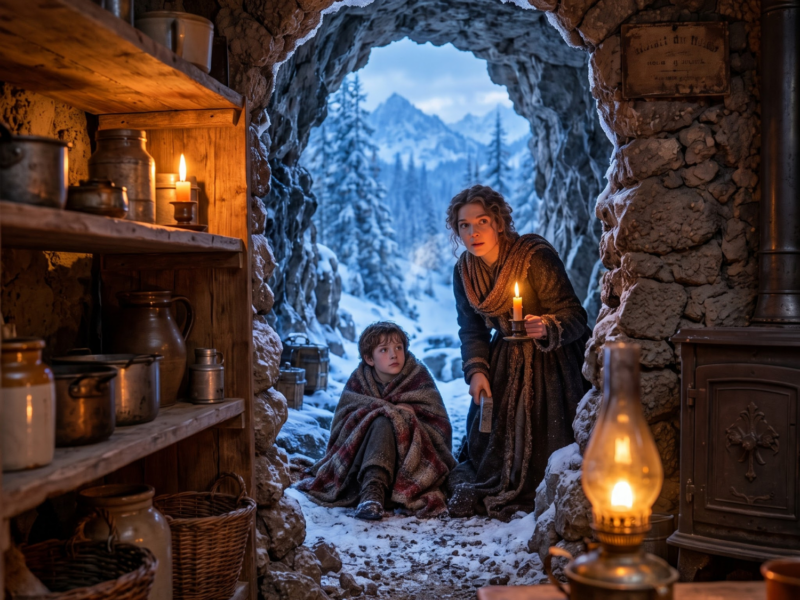
She Carried Her Sick Son Into a Mountain Cave—Then an Old Hammer Revealed a Hidden Home
The Journal of Caleb Voss
Martha spent the rest of the day inventorying their new world.
The hidden home was a marvel of pioneer survivalism. It contained thick blankets, cast-iron cookware, well-oiled tools, a small crock of precious salt, several jars of dried beans, a dozen tallow candles, and empty storage barrels.
The firewood stacked by the stove was enough for perhaps two weeks if they rationed it carefully.
It was infinitely better than the freezing outer cave. But Martha knew the brutal math of the mountains. It was not enough wood for a full winter.
She moved their meager supplies inside the chamber and spent an hour carefully rebuilding the loose stones of the false wall from the inside, leaving only a small, camouflaged gap for ventilation.
The outer cave became their camouflage. The hidden chamber became their fortress.
Over the next two days, the steady, dry heat of the iron stove worked its magic. Samuel’s fever slowly broke. For the first time in nearly a week, he sat up and asked for food.
Martha wept silently as she cooked a portion of the dried beans until they were soft and mashable. He ate eagerly and asked for another bowl. She gave him half, knowing they had to ration carefully.
Their greatest problem, however, remained water.
Melting snow on the iron stove consumed too much of their precious dry fuel. Every pot of water cost them hours of warmth.
Then, while organizing the workbench, Martha found it.
Tucked beneath a loose floorboard was a small, leather-bound journal. The name Caleb Voss was written elegantly inside the front cover.
Many of the pages were severely water-damaged, the ink bled into illegible smears. Others had faded almost completely with time. But Martha read through the surviving pages by candlelight, searching for anything useful.
One surviving sentence near the middle of the book caught her attention, underlined twice:
The spring passage must remain clear before hard freeze.
Below the text was a crude, hand-drawn map of the cavern system, but the bottom half of the page had rotted away.
Farther into the journal, near the end, another distinct line survived:
Eastern passage reaches old trapper trail below Miller Ridge. Keep it clear if the main mouth closes.
Miller Ridge. That was miles away, on the other side of the mountain.
Martha stood up and began searching the rear wall of the chamber. She ran her hands over the cold stone. Nothing. She moved the heavy wooden cabinets, straining her back. Nothing. She tapped the stone with the hammer. Solid.
She sat back on her heels, frustrated.
Then, Samuel, sitting on the bed, pointed toward the floorboards near the back corner. “Mama. That stone’s wet.”
Martha looked. He was right. A narrow, dark line of moisture crossed the stone just beyond the edge of the wooden floor.
She followed the dampness behind the sleeping platform and discovered a vertical gap in the rock face, hidden entirely by the shadows. It was barely wide enough for a child to squeeze through.
Martha tried to turn her shoulders, but the rock pinched her tight. She could not fit.
Samuel stood up, dropping his blanket. “I can do it.”
“No,” Martha said instantly, grabbing his arm. “You’ve been terribly sick.”
“I’m better, Mama,” he insisted, his jaw setting with a stubbornness that reminded her so fiercely of his father. “I can fit.”
Martha hesitated, looking at the dark crack, then at her dwindling wood supply. She tied the hemp rope securely around Samuel’s narrow waist, keeping the coil in her hands. She lit a candle and handed it to him.
“If you feel scared, or if it gets too tight, you pull the rope twice, and I will pull you back immediately. Do you understand?”
Samuel nodded bravely and squeezed into the dark fissure.
Martha fed the rope out slowly. Ten feet. Fifteen feet.
Suddenly, the rope stopped moving.
“Samuel?” Martha called out, panic seizing her throat.
Silence.
“Samuel!” she yelled, pulling the rope taut.
“I hear water, Mama!” his voice echoed back, distorted by the stone.
Moments later, the rope went slack, and Samuel wriggled backward out of the crack. His hands were wet, and he was grinning ear to ear.
Working together, they used Caleb’s pry bar and hammer to widen the entrance, chipping away at the softer limestone until Martha could just barely squeeze her shoulders through.
Beyond the narrow passage, the cave opened into a small, echoing grotto. Clear, freezing water emerged directly from the black stone wall and collected in a natural, perfectly smooth basin before disappearing into a crack in the floor.
An underground spring.
Martha filled the heavy cooking pot to the brim without burning a single piece of wood. Samuel carried a smaller tin container back to the stove. They drank until their stomachs ached, the water tasting of pure, cold stone.
That night, Martha read the rest of Caleb’s journal. It contained another stark warning:
When clouds bury the western ridge and birds disappear from the valley, severe winter weather usually follows within three days.
The next morning, Martha opened the false wall and looked out the cave entrance. The western ridge had vanished behind a wall of bruised, purple clouds.
She looked at Samuel, who was stacking kindling.
They had three days.









