She Carried Her Sick Son Into a Mountain Cave—Then an Old Hammer Revealed a Hidden Home
The Walled Secret
When morning finally arrived, the pale gray light revealed a new horror. The snow had buried more than half of the cave entrance.
Martha had no shovel. She had to use the iron cooking pot.
Scoop by agonizing scoop, she dug outward, tunneling through the compacted snow until daylight entered the cave again. Her fingers became numb, thick, and useless. The hem of her wool dress froze solid around her knees, cracking loudly when she moved.
When she finally crawled back inside and collapsed beside Samuel, she understood the grim truth. They had entered the cave to survive one night on the run. Now, surviving the cave itself had become their entire existence.
Martha spent the morning gathering fuel before the weather could worsen. She tied the long hemp rope she had brought from the wagon around her waist and fastened the other end securely to a heavy rock near the cave entrance. Without it, the blinding, blowing snow could easily erase her direction home, leaving her to freeze just yards from her son.
She searched desperately beneath the massive pine trees where dead branches remained relatively dry, protected by the canopy. The first bundle was easy to find. The second cost her the feeling in two fingers on her left hand.
During the third trip, a sudden, violent gust of wind tore the bundle of wood from her arms. Martha watched in despair as the precious, dry wood scattered downhill, disappearing into the whiteout.
For one terrible moment, she considered chasing it.
Then, she pictured Samuel lying alone in the dark cave beside a dying fire. She turned her back on the wood and returned empty-handed, pulling herself along the rope. Survival meant knowing what not to risk.
Over the next two days, Martha worked relentlessly to improve the cave. She stacked the firewood meticulously beneath the rock overhang to keep it dry. She built a thicker, elevated sleeping platform from interwoven pine boughs to insulate Samuel from the floor. She hung one of her heavy wool blankets across the cave entrance to block the worst of the draft. She organized the woodpile: wet wood stayed near the fire to dry, while the dry wood remained farther back, safe from stray sparks.
Samuel’s fever was still dangerously high, but he could sit upright now, sipping water and eating small bites of dried meat.
While searching deeper inside the chamber for loose stones to build a better fire ring, Martha made a discovery. Behind a pile of rubble in the corner, she found black ash beneath several layers of thick dust. A very old fire pit. Digging further, she found a rusted iron hook driven into the stone, and then, parallel scratches across the rock face.
Tool marks.
Someone had lived here before.
She dug frantically through the loose rocks until her hands found a rotting wooden box. It was fragile, the wood crumbling at her touch. Inside were three thick tallow candles, a heavy iron wedge, a short pry bar, and an old, well-used carpenter’s hammer.
Samuel, watching from his bed of pine boughs, pointed a shaking finger. “Look, Mama. Words.”
Martha wiped the dirt from the wooden handle of the hammer. Carved deeply into the ash wood were the letters: Caleb Voss.
Martha had never heard the name in Alder Creek. She kept the tools close. The hammer immediately became useful. She drove wooden pegs into cracks in the stone to better secure the blanket door. She broke the ice that formed near the entrance. She repaired the loose iron handle of their cooking pot.
That night, the tapping returned.
Martha did not wait. She picked up Caleb Voss’s hammer and walked straight to the unnaturally straight wall.
She struck the stone gently. Thud. Solid. She struck the stone next to it. Thud. Solid.
She moved toward the vertical crack where she had felt the moving air on the first day.
Knock.
Martha froze. She struck the stone again, slightly harder.
Knock.
It was a hollow, echoing sound. It was not the hard, dense sound of solid mountain granite.
Samuel watched her, his eyes wide in the firelight. “Is it hollow, Mama?”
Martha grabbed a burning stick and held it close. Between two large stones ran a thin, gray line she had completely overlooked in the dim light. It was not a natural crack in the rock.
It was mortar.
Someone had built this wall. And someone had gone to considerable, grueling trouble to make it look like natural rock, hiding whatever lay behind it.
Martha wanted to take the pry bar and open the wall immediately. But Samuel needed water, the fire needed tending, and her own exhaustion was a heavy weight pressing down on her shoulders. She forced herself to bank the fire and wait until morning.
At sunrise, she placed the heavy iron wedge against the crumbling mortar line and struck it hard with Caleb’s hammer.
Dust fell. Nothing else happened.
She struck again. The wedge slipped, glancing off the stone. The hammer head came down hard on the side of her hand. Her blistered palm split open, blood welling up instantly.
Martha swore, wrapped her bleeding hand tightly with a strip of cloth, and continued.
After an hour of relentless, exhausting labor, she had only managed to open a narrow crack. Behind her, Samuel began coughing—a deep, wet, rattling sound.
She stopped, leaning against the wall, gasping for air. Every hour she spent breaking this stone was an hour she was not gathering wood or melting water. She was gambling their survival on a mystery.
Then, she noticed the candle flame she had set on a rock beside the wall.
The flame moved. It leaned sharply, almost horizontally, toward the crack she had widened. A strong, steady current of air was flowing through the wall from the other side.
Martha studied the stones more carefully, wiping the sweat from her eyes. One large block near the base had a slightly smoother edge than the others, almost polished.
She repositioned the iron wedge at the corner of that specific block.
Hammer. Hammer. Hammer.
The mortar fractured with a sharp crack. The stone shifted backward an inch.
Martha dropped the hammer and inserted the pry bar deep into the new gap.
“Sammy, come here,” she called out. “Push when I tell you.”
Samuel crawled weakly from his bed and knelt beside her, placing his small hands against the cold stone.
“Now,” Martha grunted.
Together, they leaned all their meager weight against the bar and the stone. The heavy block scraped backward, then fell inward with a loud thud.
Blackness appeared.
Martha grabbed the candle and held it up to the opening. At first, she saw nothing but the deep shadow of the mountain. Then, the flickering light caught something straight and uniform.
Wood. Not natural roots or deadfall. Smooth, cut boards.
With renewed, frantic energy, she used the pry bar to loosen the adjacent stones, widening the opening until it was just large enough to crawl through.
She squeezed through the gap, holding the candle high.
The light revealed a sight that made her stop breathing.
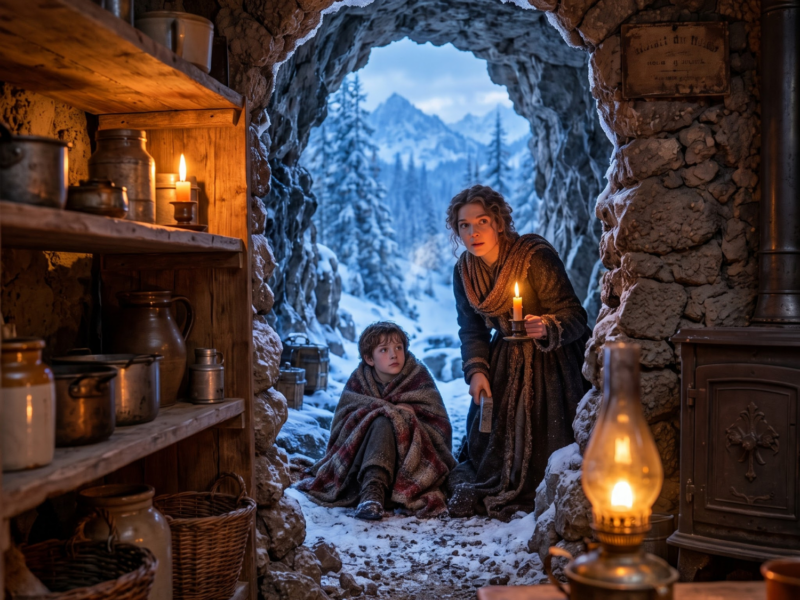
Wooden floorboards covered the uneven stone. Built into the rock walls were heavy wooden shelves. In the center of the room sat a black cast-iron stove. There was a narrow, built-in sleeping platform, a sturdy workbench, and several wooden cabinets.
Martha stood absolutely motionless in the dark. This was not another abandoned mining tunnel. Someone had meticulously built a home entirely inside Blackstone Mountain.
She walked to the nearest cabinet and pulled it open. Tin plates, a set of cooking tools, and a small, heavy metal container filled with lamp oil. She opened another cabinet. It held three thick wool blankets, sealed securely inside waterproof canvas.
Beside the iron stove stood a neat stack of split firewood. It wasn’t a massive pile, but it was dry. Completely, perfectly dry.
Martha covered her mouth with her hands, tears finally spilling over her eyelashes. For weeks, she had watched everything she loved disappear. Her husband. Their farm. Their horse. Their wagon. Samuel’s strength.
Now, in her darkest hour, Blackstone Mountain had given something back.
She inspected the iron stove. Its heavy black pipe disappeared into a natural stone shaft overhead, angling upward. Martha took a handful of dry kindling from the pile and lit it inside the stove.
She watched anxiously. The smoke rose cleanly, drawn powerfully up the stone shaft by the natural draft of the mountain.
She added a small log. The metal popped and pinged as it heated. Within minutes, a deep, radiating warmth slowly began to fill the hidden chamber.
Samuel crawled through the opening, his eyes wide with wonder. “Mama?”
Martha pulled him close, wrapping him tightly in one of Caleb Voss’s clean, dry blankets.
Caleb’s hammer had not revealed buried gold or silver treasure. It had revealed something infinitely more valuable. It had revealed time.









