She Lived in a Sheep Wagon — Then a Wyoming Blizzard Drove the Flock Toward the Tracks
The Shepherd’s Daughter
The trouble had begun in the first week of November.
Dougal Rennie, Isobel’s husband, had been working a band of sheep west of Rawlins when his horse slipped on a patch of black ice, coming down hard and snapping Dougal’s leg. The town doctor set the bone, but delivered the one word a sheepman hates to hear before the snow flies: Spring.
Dougal herded for Alasdair Kerr, a man who ran four bands across the brutal sweep of the Red Desert. Kerr was fair, but business was business, and winter was no time for charity. He came to the boarding house where Dougal lay bound in heavy wooden splints, standing awkwardly with his hat clutched in his raw-red hands.
“There’s not a herder to be had,” Kerr muttered, staring at the floorboards. “Not in November.”
Isobel was thirty-four years old. Born Isobel Hume in the rolling green hills of the Scottish Borders, she was a shepherd’s daughter through and through. She had walked hills behind sheep before she had learned to read words on a page.
“Then give the band to me,” she said.
Kerr looked down at Dougal. Dougal stared blankly at the ceiling, a heavy sigh escaping his chest. “She’s a better hand with ewes than I am,” Dougal said at last, a rare confession. “I never said it to her face, but it’s the truth.”
Kerr was quiet for a long, agonizingly long moment. “I won’t pay you top tier,” he said finally. “But I’ve twelve hundred old ewes—gentle ones, and the best lead ewe on the range. Owen Pugh will bring coal and flour every ten days. It’s a big range, and the wagon stays put. You’ll get Dougal’s wages: forty dollars a month and found, till he’s back on his feet. If it’s too much for you, tell Owen. There’s no shame in it.”
“It won’t be,” Isobel replied evenly.
It was not born of fierce courage, exactly. It was simpler than that: no band meant no wage, and no wage meant no spring.
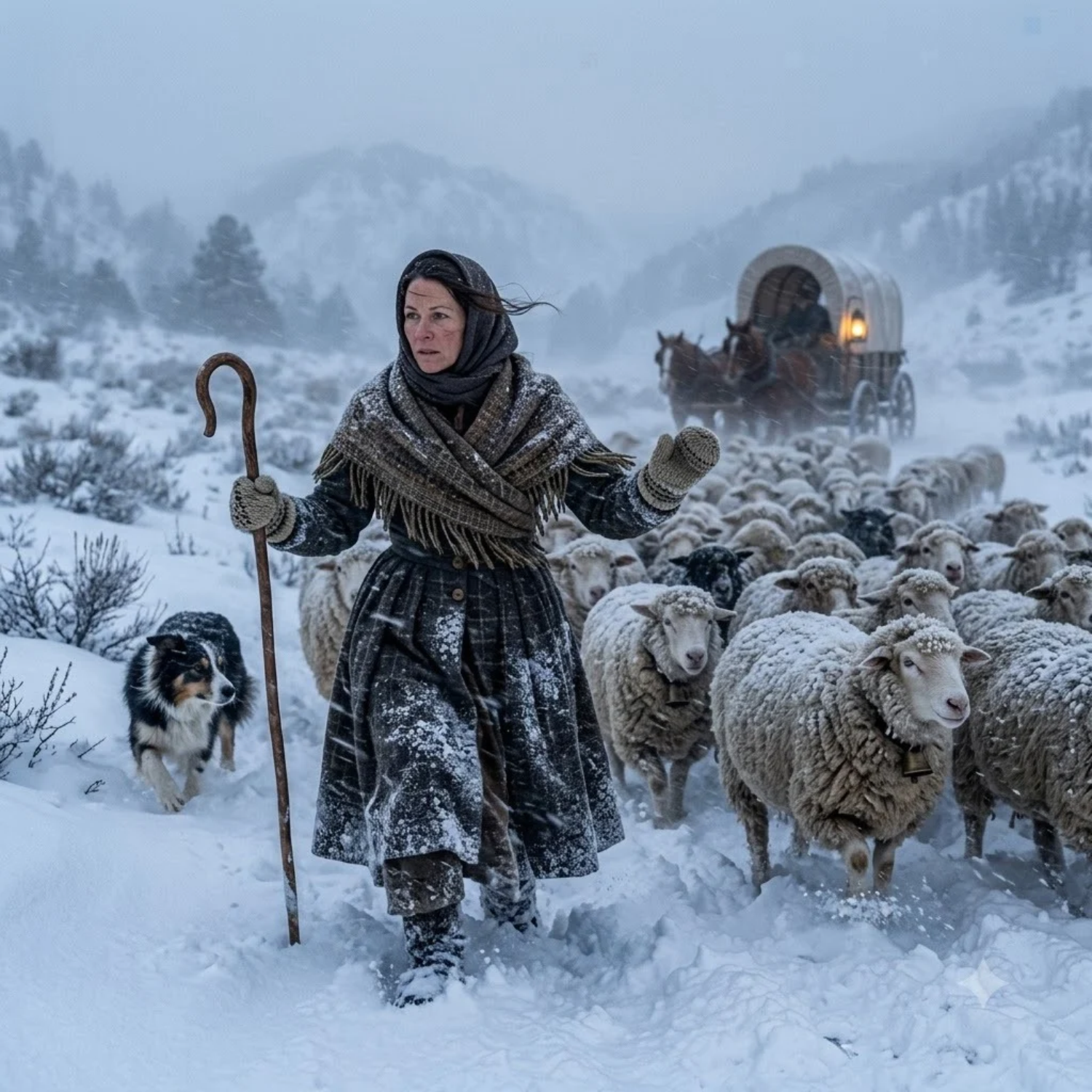
Two days later, Owen Pugh drove her out past the Union Pacific tracks, two days west of Rawlins. Owen was a Welshman near sixty, sporting a gray beard and a slow, deliberate way of speaking. Their home for the winter was a classic Wyoming sheep wagon: eleven feet long, six and a half feet wide, constructed of heavy white canvas stretched over curved wooden bows.
A split door sat at the front so the top half could open independently. Just inside on the right sat the small iron stove. Across the far end was a narrow bed, with a sliding table hidden underneath and storage benches lining both sides.
“The stove’s a friend and a thief,” Owen warned her as he showed her the tin ring protecting the canvas from the hot iron pipe, and the metal cap wired tightly down to the top. “A sudden wind takes a cap off, and it dumps thick black smoke right down your throat.”
Then came his strict, life-saving rules, ticked off one by one on his fingers: Never shut the stove draft up tight and go to sleep. Let the fire die out. And always, always sleep with the top half of the door cracked open a finger’s width, no matter how bitter the outside cold grew.
“Coal gas gives no warning you can trust,” Owen said solemnly. “So you don’t wait around for one.”
He left her nine sacks of coal, Dougal’s steady gray horse Tam, the intelligent collie Moss, and twelve hundred wool-laden ewes, before turning his team and driving away toward the east.