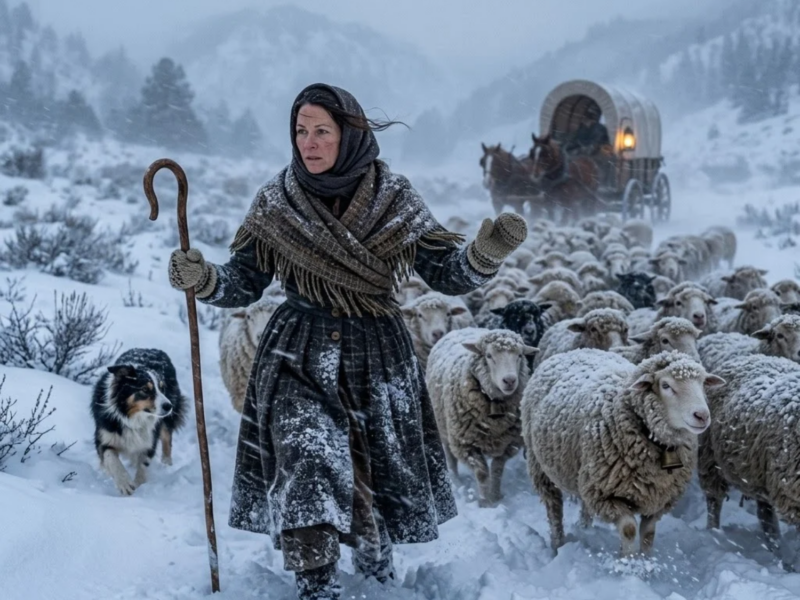
She Lived in a Sheep Wagon — Then a Wyoming Blizzard Drove the Flock Toward the Tracks
The Howling Dark
The second week of December arrived deceptively mild—a soft gray sky, a gentle southwestern breeze, and a light, wet dusting of snow that the ewes eagerly licked from the sagebrush.
It didn’t last. On the third afternoon, Moss refused his evening meal.
He stood rigid on the rise behind the wagon, staring fixedly toward the northwest, his black nose twitching as he tasted the air. To human eyes, the sky looked entirely ordinary—a flat, uniform gray. But Isobel trusted the dog implicitly.
She brought the band in an hour early, bedding them tightly against the lee of the wagon before running her evening count: Twelve black faces.
She filled her lantern, trimmed the wick, laid out a dry shirt and stockings on the bench, slipped her tin of rock salt into her coat pocket, and ate her supper in haste. Then, she lay down fully dressed in her woolens, her boots placed neatly by the bed and the top of the door cracked an open finger’s width. She managed a fitful, uneasy sleep.
She awoke violently as the wagon heaved.
The heavy anchor ropes groaned, holding fast, but the entire structure shuddered. The canvas boomed like a drum, and the stovepipe howled a high, piercing shriek in its tin ring. Fine snow hissed against the fabric like driven sand.
Moss was scratching frantically at the door, growling deep in his chest. And beneath the deafening roar of the gale, Isobel heard it—the one sound she had prayed she wouldn’t hear.
Clang. Clang.
Old Bell’s bell. Farther off than the bed ground, and moving steadily away.
The northwest wind had ambushed them in the dark, and the ewes had risen as one, turning their tails to the storm the way sheep always do, beginning a blind, doomed march straight southeast. Straight toward the deadly railroad cut.
Isobel was on her feet instantly. But before touching the door latch, she dealt with the fire, spreading the remaining embers thin so the unattended iron stove could not spark a blaze while she was gone. She lit her lantern, stepped out into the blinding white fury, hung it securely on its exterior hook, and checked the latch twice.
Snow wasn’t falling downward; it was driving horizontally in thick, blinding sheets so dense she couldn’t even see the end of the wagon tongue.
She didn’t run. Running soaked her inner wool with sweat and invited the killer cold. Driving the sheep from behind was equally useless; shouting at a drifting band only made them quickened their pace.
You cannot drive sheep into a wind. You can only lead them.
Instead of chasing from behind, Isobel plunged blindly into the dark, running wide along the flank of the moving column of gray wool until she reached the front. She whistled a sharp command to Moss, sending him wide to flank the opposite side. “Hold them!” she shouted over the wind. “Not stop them—hold them together!”
At the head of the churning mass of wool, she turned her shoulder directly into the biting gale, shook her tin can violently, and called out the familiar call.
Something large and heavy bumped hard against her knee. She thrust her bare hand forward, pressing salt into Old Bell’s mouth, then spun around and began to walk. Not fighting backward into the teeth of the wind where nothing would follow, but moving sideways across it toward the southwestern draw and her hand-built wall of sage.
A dozen steps. Shake the tin. A dozen more.
The wind slammed against her right cheek, shoving her and pushing Old Bell hard against her legs. Behind the old ewe, following her maternal instinct, the massive band began to curve. The head turned, and the rest followed blindly in a long, rolling gray river out of the blackness, with Moss darting back and forth like a shadow along the flank, keeping the edges tight.









