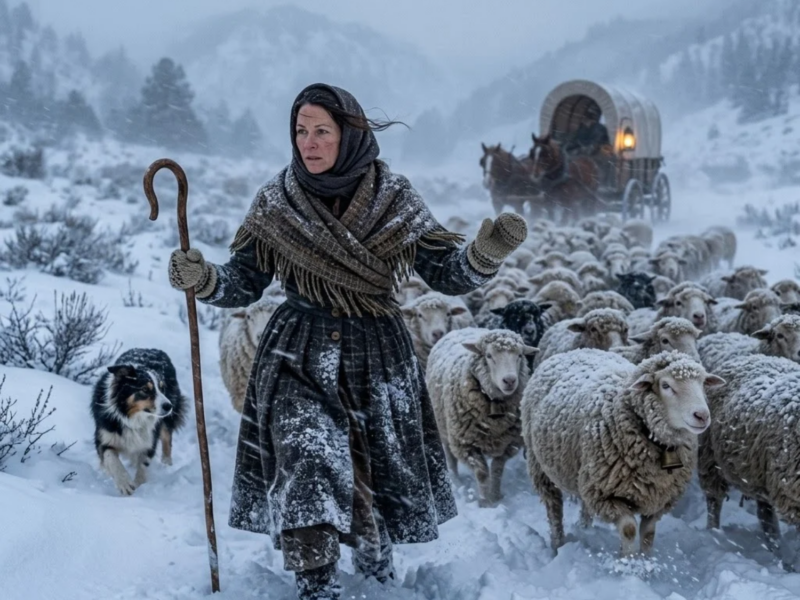
She Lived in a Sheep Wagon — Then a Wyoming Blizzard Drove the Flock Toward the Tracks
The Economy of the Desert
Owen had left her nine sacks of coal. If managed with absolute precision, a single sack was meant to last three days—twenty-seven days total. Owen’s schedule brought him out every ten days, so on paper, she had an abundance.
Paper, however, was not winter.
At the end of November, a brutal cold front plunged down out of a cloudless sky and locked the desert in a vise. The hungry iron stove began devouring a sack of coal every two days, and on the worst nights, even faster.
Worse yet, on the tenth day, Owen did not arrive.
By the twelfth day, she was down to her final three sacks of coal, with no way of knowing whether Owen was simply a day late or trapped by a drift fifty miles away.
She made a hard choice: she stopped burning coal at night. The tempting, easy path was to stuff the stove, close the draft and damper, and let the coal smoulder away until morning. But doing so produced silent, deadly coal gas in a room the size of a pantry.
Every night, she let the fire die out completely, cracked the top of the door an open finger’s width, and dressed for bed in layers of wool. Two heavy blankets, the sheepskin coat layered on top, a flat stone warmed on the stove and wrapped in flannel at her feet, and Moss stretched heavy across her legs.
She woke up cold every morning, but she woke up alive and clear-headed.
By day, she foraged for fuel. Massive desert sagebrush grew with roots as thick as a woman’s wrist—twisted, gnarled, and packed with volatile oils. An hour of hard labor with a mattock yielded an armful of roots, but sage burned hot, fast, and vanished into ash within fifteen minutes.
To compensate, she walked out to the old bed grounds where the sheep had slept for weeks, filling burlap sacks with sheep dung trodden into solid cakes. Dried behind the stove, the dung burned slow and steady, mimicking the peat fires of her Scottish home. Sage to start the flame; dried dung to hold it; the precious remaining coal reserved strictly for the bitterest mornings.
And the cold brought another crisis: snow.
In the Scottish Borders, too much snow was a deadly hazard. On the Red Desert, a dry winter was far more terrifying. There was virtually no running water, and desert sheep in winter do not drink liquid water—they eat snow, taking their moisture one mouthful at a time.
Now, the ground was bare, brown, and frozen as hard as cast iron. The small spring in the draw below camp was sealed beneath a sheet of ice as thick as a hand.
Every morning, Isobel drove the band out to hunt for lingering drifts tucked deep inside the north-facing draws where the sun never struck. Day by day, the drifts shrank. Seven draws held snow. Then five. Then three. She was forced to break open the frozen spring with an axe just to keep Tam, Moss, and herself alive.
Recognizing the danger, she took action. The largest snow-collecting draw lay half a mile southwest of camp. When the northwest gales blew, they swept the draw bare.
While the ewes grazed on the dwindling snow, Isobel labored with a mattock, digging up massive sagebrush roots and piling them along the lip of the draw, weighting them down with heavy stones. She built a low brown wall, waist-high and a hundred paces long, creating a pocket of dead, still air down in the bottom where a band could shelter completely out of the scouring wind.
On the fourteenth day, Owen’s wagon finally crested the rise. A wheel had broken on the rough road out of Rawlins. He looked at her carefully stacked sage roots, the sack of dung cakes, and the two untouched sacks of coal sitting quietly in the corner.
“Most would have burned the lot by now,” Owen marveled. “And shut the stove tight to choke it out.”
“You told me not to.”
“I tell everyone,” Owen grunted. “You’re the first one who actually listened.”
He unloaded fresh coal, flour, salt, and a short pencil-written letter from Dougal reporting that his leg was finally knitting together. Before driving off, Owen stood on the rise with her, pointing south and east toward where the black telegraph poles marched across the flats.
“Mind the railroad,” Owen warned gravely. “When a big wind comes screaming out of the northwest, sheep drift with it. They won’t face a gale; they just walk and walk until they hit a low place and pile in. The Union Pacific runs through a steep-sided cut over there. I’ve seen a whole band driven into a cut like that and crushed.”
He looked over at her newly built sage wall on the draw. “What’s that for?”
“A place to lead them to,” Isobel said quietly.









