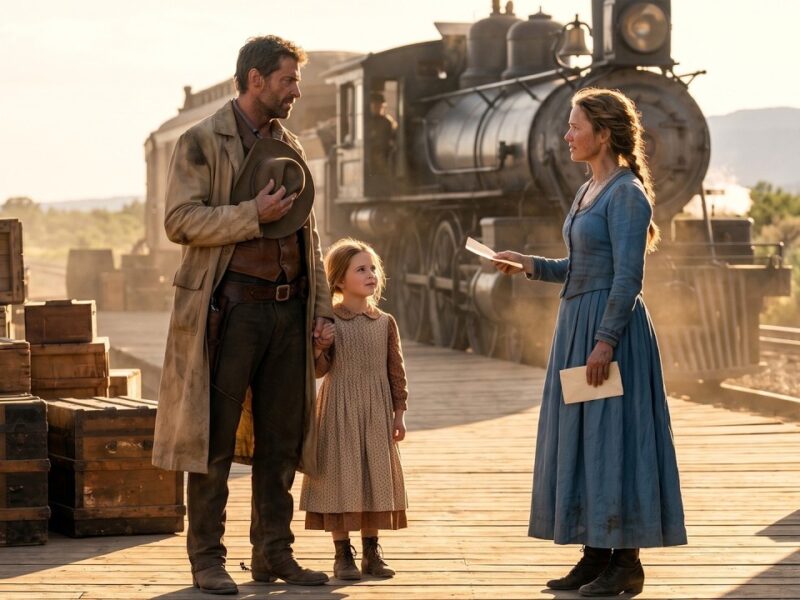
The Train Came in Without His Bride Again — The Woman on the Platform Had His Daughter’s Letter
The Train Came in Without His Bride Again — The Wo…
The Train Came in Without His Bride Again — The Woman on the Platform Had His Daughter’s Letter
The train came in without his bride again.
Elias Vance stood on the weathered wooden planks of the platform at Harlow Crossing, a solitary figure against the vast, graying sky of the high country. He held his worn felt hat in both hands, exposing his dark hair to the bitter November wind that cut straight through his canvas coat.
Three weeks running now. Three Tuesdays.
He had hitched the team and driven the heavy wagon out from the homestead each time. It was a grueling, bone-rattling hour each way over deeply rutted roads that turned to iron when the frost set in. And each time, with a massive, hissing billow of steam and the scream of iron wheels, the Denver and Rio Grande had pulled away, leaving the platform entirely empty.
Empty, that is, except for a random crate of dry goods bound for the mercantile, and old Prescott, the stationmaster. Prescott, a man who had seen decades of arrivals and departures, always looked at Elias with the exact same expression—the specific, heavy way a man looks at a dog sitting vigil by a fresh grave.
Elias was not a man who showed his feelings on his face. The muscles of his jaw were set, his dark eyes unreadable. People in the county who did not know him well thought that made him cold, a man carved from the local granite. People who knew him well—and there were very few of those left—knew it meant the exact opposite. It meant the feeling inside him was simply too large to be safely let out.
He put his hat back on, pulling the brim low against the wind. He turned to go.
He had a daughter at home. Millie was four years old, a serious child with eyes too old for her face. She had been asking him, every single morning for three agonizing weeks, whether the lady was coming today. Elias had stopped answering that question with yes after the second empty train. Now, he just told her they would have to wait and see.
His heavy boots sounded hollow on the platform. The wagon was already turned, the horses restless and pointed toward home, when he heard a sound behind him.
It was the sound of boots on the wooden platform. But it was not the frantic, hurrying sound of a man who might be calling out to someone he had missed. It was a slow, deliberate sound. The measured boots of someone who had made a heavy decision and was walking directly toward it without flinching.
Elias stopped. He turned slowly, the wind whipping the collar of his coat against his jaw.
There was a woman standing at the far, shadowed end of the platform. Beside her rested a single, faded carpetbag that had seen vastly better years. She was not looking at Elias. Her head was bowed against the wind, and she was looking intently at something held in her gloved hands, turning it over and over in her fingers.
Even from that distance, Elias’s chest tightened. He could see exactly what it was.
He had seen that piece of paper before. He had carefully cut that specific rectangle of paper himself from the back page of a church bulletin. He had handed it to his neighbor, Mrs. Croft, to post in the city, because Mrs. Croft had loudly claimed she knew a discreet network of respectable women in Denver who placed such matrimonial advertisements with care and dignity.
It was Millie’s letter.
Millie had insisted on adding something of her own at the very bottom of his dry, practical advertisement. She had dictated it to Mrs. Croft in the kitchen, because Millie was four and could not yet write her letters. Elias had not read what his daughter had said. He had not asked.
The woman standing on the platform had his daughter’s letter clutched in her hand.
And she was not his bride.
She was a stranger. She was taller than the woman he had corresponded with, her frame hidden beneath a plain, practical gray wool coat. She looked up from the paper and found his eyes across the distance. She did not look away, nor did she offer a polite, nervous smile.
Elias took his hat back off. He walked slowly toward her, his boots heavy on the boards, because there was absolutely nothing else a decent man could do when a woman stood alone on a desolate platform in November, with the light failing and nowhere obvious to go.
He stopped three feet away. “That paper,” he said, his voice a low rumble.
“Yes,” she said. Her voice was calm, pitched lower than he expected.
“Where is she?” Elias asked.
The woman’s expression did not change. It was not a hard face, he realized. It was a careful one. It was the face a person develops when they have learned, through hard experience, to meticulously measure exactly what emotion they give away to the world.
Without a word, she reached into her carpetbag and drew out a sealed envelope. She held it toward him.
Elias took it. His name—Mr. Elias Vance—was written on the outside in a neat, cramped handwriting he did not recognize. He looked up at the woman. She said nothing, only waited.
He tore the envelope open.
The letter inside was short. It was written in a hand that shook slightly in places, the ink blotting on the cheap paper.
Mr. Vance,
Miss Dorothea Crane, who accepted your advertisement in good faith, has taken ill with a severe fever in Denver three weeks prior. She could not make the journey. The physician does not know when, or if, she will recover sufficiently to travel. She is deeply sorry for the silence. She has asked her neighbor, a Miss Ada Voss, to carry this letter to Mr. Elias Vance of Harlow Crossing, and to explain the situation in person, since a letter alone seemed entirely insufficient to the weight of the matter.
Elias read it twice. The words blurred slightly in the cold wind. He folded the paper and looked at the woman standing before him.
“You’re Ada Voss,” he said.
“I am,” she replied quietly.
“You came all the way from Denver on the train… just to deliver a letter?”
She looked at him steadily, her eyes the color of slate. “I came because Dorothea could not come herself. And someone had to.”
Elias folded the letter and put it deep into his coat pocket. The wind pushed aggressively at both of them, howling through the wooden struts of the platform roof. A dry tumbleweed rolled off the far end of the platform, bouncing silently, and disappeared into the vast sea of gray sagebrush.
He looked at her thin coat. “Did you eat today?” he asked.
She paused. It was just a breath’s worth of hesitation, but he caught it. “On the train,” she said.
Something in the careful, guarded way she said it told him that on the train had been a very long time ago. Perhaps yesterday.
“The wagon’s over there,” Elias said, pointing with his hat. “I’ve got a venison stew sitting on a low fire at the homestead. You can eat before I figure out what to do about buying you a stagecoach ticket back to Denver.”
She looked at him, then looked toward the heavy wagon and the waiting team of horses. She reached down and picked up her carpetbag.
He did not offer to carry it for her. He sensed she would not have accepted the gesture. She did not offer it.
They walked side-by-side to the wagon without speaking another word. And that was how it began.
Related Articles

They Mocked the Widow’s Dirt Cellar—Then the Freeze Left Every Cabin Cold but Hers Warm
They Mocked the Widow’s Dirt Cellar—Then the Freeze Left Every Cabin Cold but Hers Warm…

A Homeless Veteran and His German Shepherd Inherited a Ridge No One Wanted — 35 Feet In, They Found
Chapter 1 / 7 A Homeless Veteran and His German Shepherd Inherit… A Homeless Veteran…

Neighbors Laughed When He Built A Cabin Inside An Old Barn—Until It Kept His Home 35 Degrees Warmer
Chapter 1 / 8 Neighbors Laughed When He Built A Cabin Inside An… Neighbors Laughed…

His Sod House Had No Woodpile in January – Until the Trains Stopped and the Town Came Begging
Chapter 1 / 10 His Sod House Had No Woodpile in January – Until t……

She Built Her Cabin Over the Woodshed and Never Burned Wet Wood Again
Chapter 1 / 8 She Built Her Cabin Over the Woodshed and Never Bu… She…

The Duke Abandoned Her on Their Wedding Day—Years Later, He Discovered What He Had Lost
Chapter 1 / 7 The Duke Abandoned Her on Their Wedding Day—Years… The Duke Abandoned…

He Wedged a Tiny A Frame Into a Crevice Before Winter and His Family Slept at 75°F While Town Hit
Chapter 1 / 7 He Wedged a Tiny A Frame Into a Crevice Before Win……

He Was Too Old to Ride—So He Bought the Ruined Ranch and Found the Room Behind the Fireplac
Chapter 1 / 5 He Was Too Old to Ride—So He Bought the Ruined Ran……

Settlers Laughed at His Underground Heat Recovery Duct — Until It Kept His Cabin 71°F Warmer
Chapter 1 / 9 Settlers Laughed at His Underground Heat Recovery… Settlers Laughed at His…

A Navy SEAL Built a Home Inside a Mountain—Then His Dog Warned Him Before the Storm
Chapter 1 / 5 A Navy SEAL Built a Home Inside a Mountain—Then Hi… A…