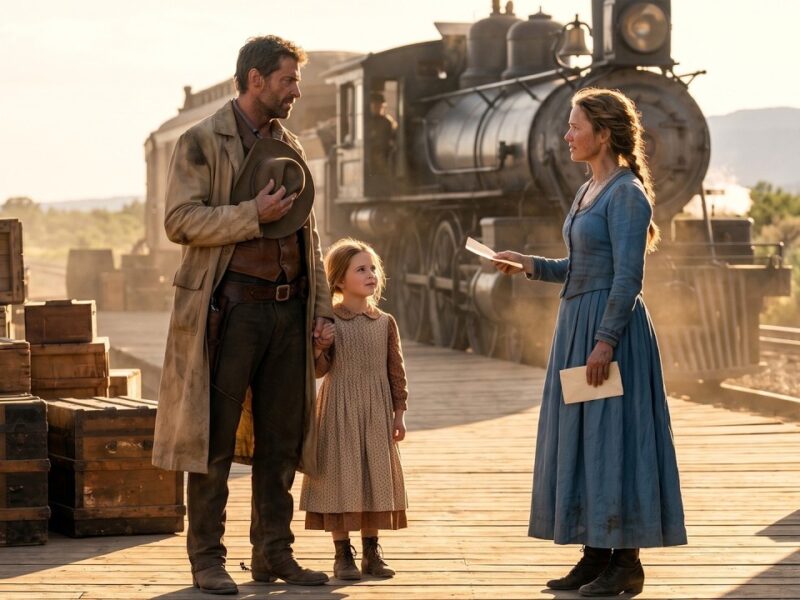
The Train Came in Without His Bride Again — The Woman on the Platform Had His Daughter’s Letter
The Thaw
The spring came to that high country the way it always did—agonizingly slow, and then violently sudden. The frozen creek broke its ice and began running loud and muddy again under the beautiful, haunting sound of meadowlarks returning to the sagebrush.
Elias, along with Fitch and Mendez, had pooled their meager funds and filed a joint legal injunction with the county surveyor regarding the water access on the southern draw. The Harper Concern from Salt Lake had sent no one back to the property since December. There was no absolute certainty in that silence, but it was something they could build on.
The new chair, sturdy and strong, stood at the kitchen table.
Millie had helped Elias sand the wood until it was smooth. Ada had stained it the exact same dark color as the others. Elias had fitted the wooden joints himself, taking twice as long as necessary because he wanted them to hold forever.
The broken shelf in the second room had been repaired. Ada had put her few, precious things on it. Her extra dress. Her mother’s silver thimble. A small, faded tintype photograph of a woman who must have been someone she had loved very much. Elias did not ask who it was. The shelf held it all securely, without complaint.
On a remarkably warm evening in late March, Elias sat on the front porch after supper. The last of the daylight was turning the sky a brilliant, bruised pink over the western ridge.
Ada came out the front door and stood beside his chair. She carried two tin cups of hot coffee, and handed him one.
Inside the house, through the open window, they could hear Millie singing happily to her river stones on the rug.
Elias took a sip of the coffee. He looked out over the land he had almost lost.
“You could have been in Sacramento right now,” Elias said quietly, breaking the evening silence.
Ada was quiet for a long moment. She sipped her coffee and looked out at the pink ridge, watching the colors shift.
“I’ve thought about that,” she admitted softly.
“And?” he asked, turning his head to look at her.
“And I think,” Ada said, her voice steady and sure, “that a person usually ends up exactly where they’re supposed to be. Even when the road that gets them there looks like a terrible mistake at the time.”
“Was it a mistake?” Elias asked, his heart hammering against his ribs.
She turned and looked down at him. Her face was fully, beautifully open in a way it had not been on that freezing November platform. In a way it only ever got now, in the quiet evenings on the porch.
“No,” Ada smiled, a real, radiant smile that reached her slate eyes. “Not even close.”
He reached out and put his thick arm around her waist. She leaned heavily into him, resting her hand on his shoulder.
They sat exactly like that until the pink was completely gone from the ridge, and the very first, bright stars appeared in the deepening blue sky. They sat until Millie called out from inside the house that the stone castle was finally ready, and everyone needed to come inside right now and see it.
They stood up together. They went inside.
The heavy oak door closed warmly behind them.
Out on the porch, the red ribbon Millie had tied to the post back in November moved gently in the evening spring breeze. It was frayed, weather-beaten, and stained by the snow, but it was still brightly red, still tied tight, and still faithfully holding to the nail that wasn’t going anywhere.
Some stories don’t begin the way you’d expect them to.
They begin with a profound absence. A person who doesn’t come. A seat that stays painfully empty. An envelope carried by the wrong hands to the right door.
Ada Voss gave up a ticket to a golden future that she’d bought with her own hard-earned money, and she never mentioned the sacrifice a single time. Elias found out only through a tear in a lining, and three desperate words scribbled on the back of a stub.
And it was little Millie, covered in bread flour and logic, who simply said what needed saying: that nothing was wrong, and absolutely everything was exactly as it should be.
That is how a home truly gets built. Not by grand, sweeping promises made in public, but by the quiet, devastating acts of sacrifice and love that absolutely nobody else witnesses.









