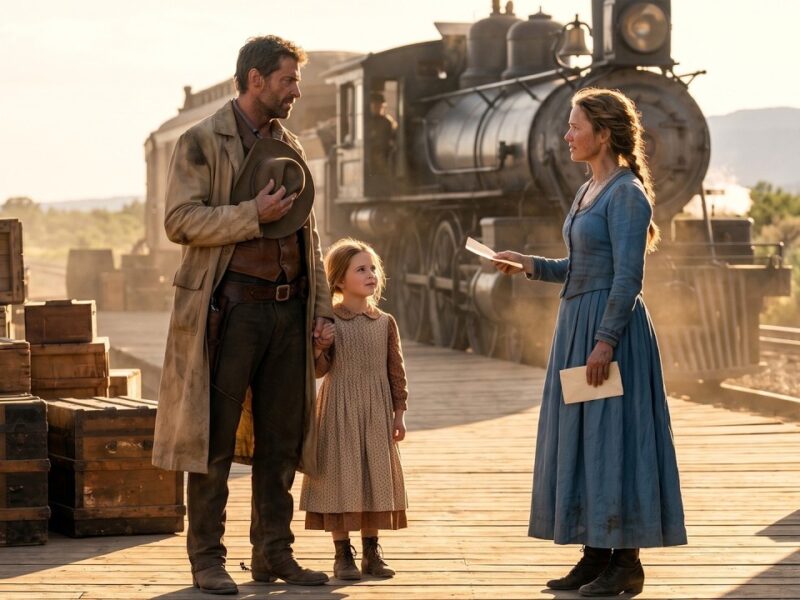
The Train Came in Without His Bride Again — The Woman on the Platform Had His Daughter’s Letter
The Architecture of Spoons
The first week was practical and highly deliberate, which perfectly suited them both.
There was always enough relentless work on a frontier homestead that two people could occupy the exact same small house all day and only cross paths at mealtimes, and during the necessary sharing of chores.
Elias was up long before first light, slipping out into the freezing dark to tend the stock, break the ice on the water troughs, and pitch hay.
Ada rose not long after him. By the time Elias returned, smelling of cold air and horses, she had hot coffee boiling, and the morning oat porridge was bubbling on the stove by the time Millie padded into the kitchen in her thick wool socks, her braids more undone than the night before.
They did not speak much in those early mornings. They did not need to. The kitchen quickly developed its own silent, efficient language of practical motion. Someone adding wood to the stove while someone else stirred the porridge. Someone finding the tin cups while someone else located the small ceramic pot of honey that Millie strictly required on Tuesdays and Thursdays, for reasons she never, ever explained.
On the third day, Ada asked quietly if there was a mending basket.
There was. It had sat untouched on the high shelf since Clara died. Elias pointed her to the shelf without explaining why it was covered in a thick layer of dust. Ada took it down, opened it, and did not comment on the dust.
That evening, sitting by the fire, she worked through three pairs of Millie’s woolen stockings. They had holes so incredibly old that the edges of the holes had worn completely round. She also worked through two of Elias’s heavy work shirts, patching the elbows, without saying a single word about them—because clearly they needed it, and on the frontier, that seemed to be reason enough.
Millie sat beside her on the wooden bench, her chin resting in her hands, and watched the needle flash in the lamplight.
“You sew fast,” Millie observed.
“I’ve had a lot of practice,” Ada replied softly, biting off a thread.
“Mama sewed slow,” Millie said casually. “She said it was because she was being careful.”
Ada paused, her needle hovering over the fabric. “Being careful is a very good reason for being slow.”
Millie considered this logic with great seriousness. Then, she climbed up onto the bench, leaned her small, warm weight completely against Ada’s arm, and tilted her head to watch the needle more closely.
Ada held the fabric steady, adjusted her angle to accommodate the child’s weight, and kept sewing. She did not freeze. She did not make a big, emotional thing of it.
Elias was sitting at the far end of the room, supposedly mending a broken leather bridle by the second lamp. He did not look up. But he heard it. He heard every single syllable of it.
On the fifth day, the weather turned. It snowed—not heavily, but a steady, relentless white curtain that painted the prairie.
Elias came in from the barn at midday, stamping the snow from his boots, to find Ada on her hands and knees on the kitchen floor with Millie.
The two of them were intensely focused on building something out of smooth, round river stones. Millie had been obsessively collecting these stones from the creek since summer, storing them in an old tobacco tin under her bed.
Ada was quietly directing the architecture of what appeared to be a very small, very complex house. Millie was eagerly providing the stones from the tin and a great deal of running commentary.
Elias stood in the doorway, snow melting on his broad shoulders, and did not move for a long moment.
Ada looked up, pushing a stray lock of hair out of her eyes. She saw him standing there. “There’s hot soup on the stove,” she said normally.
He came in, took his wet coat off, and hung it on the peg. “What are you building?” he asked.
“A house for the horses!” Millie announced proudly, pointing to the stones.
“We ran out of long horses,” Ada explained dryly, “so we’re using spoons for the roof.”
Millie held up two metal spoons to demonstrate the structural integrity.
Elias walked over and sat down cross-legged on the wooden floor right beside them. He looked at the structure.
“You need a door,” he observed.
Millie handed him a spoon.
He took it. And the three of them sat on the kitchen floor, surrounded by the smell of woodsmoke and simmering soup, and built a massive, sprawling house for the spoon-horses. They worked until the soup boiled over a little on the stove, and Ada had to scramble up to deal with it, laughing softly.
It was a very small thing. A moment on the floor.
Elias thought about it all evening while he chopped wood in the dark.









