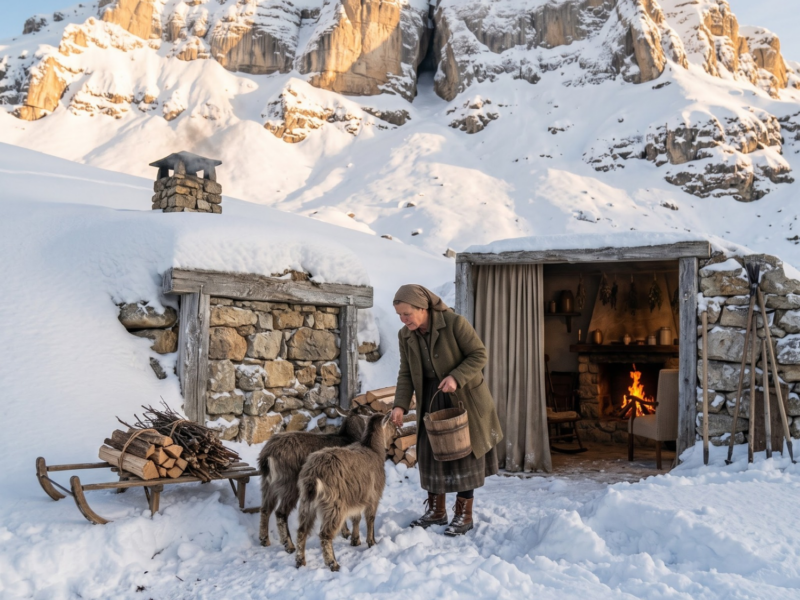
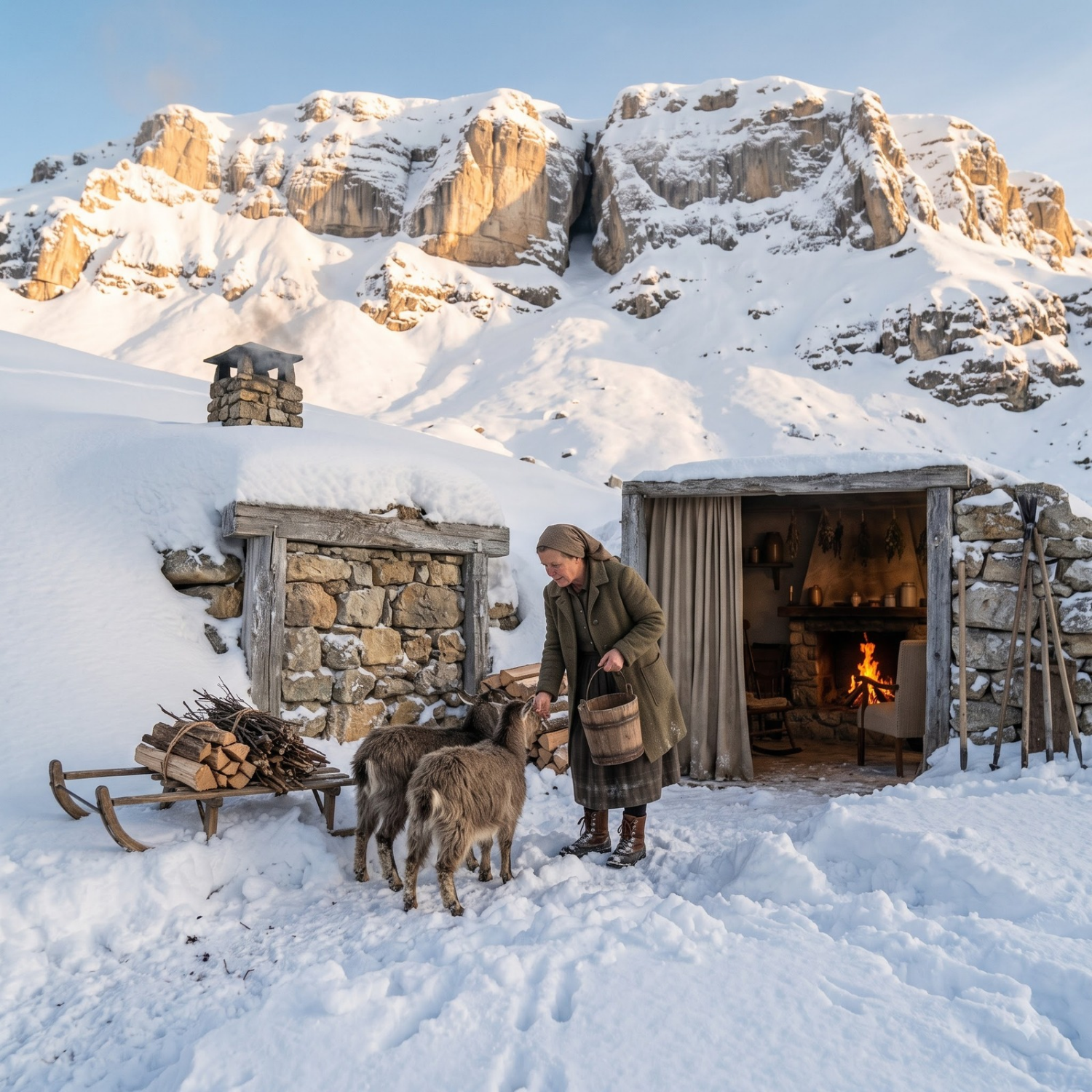
They Called Her Cave a Tomb—It Held 75°F When the Worst Winter in 52 Years Froze the Valley….
They Called Her Cave a Tomb—It Held 75°F When the…
They Called Her Cave a Tomb—It Held 75°F When the Worst Winter in 52 Years Froze the Valley….
The wind did not arrive first. The silence did.
At the top of Copper Spine Pass, Clara Voss stopped because the one creature that had never questioned a trail suddenly refused to take another step.
Scout planted all four paws deep into the crusted snow. His heavy body leaned back, angling instinctively toward the dark, ominous hillside instead of the beaten road ahead. The storm had not fully reached them yet—the sky overhead still held a deceptive, pale neutrality—but the dog already knew something she did not.
Clara tightened her cold-numbed grip on the braided rope looped securely around her wrist and looked toward the narrow valley, which was currently being swallowed alive by a rapidly advancing curtain of blinding white. Nine miles separated her from the safety of Alder Brakes. Nine miles of open, unforgiving switchbacks that had suddenly become impossible.
If you have ever wondered whether one small choice can decide who lives and who never reaches home, stay with Clara for a little while. This mountain was about to answer that question.
The first violent blast of wind slammed into her hard enough to steal the remaining breath from her lungs. Powdery snow burst across the mountain path sideways, stinging her cheeks like thrown glass. The faint wagon tracks she had followed all morning disappeared beneath fresh, swirling drifts as if they had never existed.
Her boots were soaked through. The heavy hem of her oversized wool coat snapped with the crack of a whip around her legs. She pressed one mittened arm across her face and forced herself to keep walking.
Scout stayed beside her for another dozen punishing steps. Then he stopped again. Not hesitant, not confused—certain. The blue heeler’s amber eye stayed fixed on the pine-covered hillside towering above the road. The other eye, a pale, milky gray scarred years earlier by a broken barbed-wire fence, seemed almost white against the blowing snow. His ears lay completely flat against his skull. The thick fur along his spine slowly lifted in a ridge of instinctual defense.
Clara had only seen him stand like that twice before in all the years they had roamed the range. Both times, the weather had turned far worse than any seasoned mountain man had expected.
She squinted toward the hill. Nothing. Only scattered pines, a jagged limestone ridge, and the relentless driving snow. Yet something about the space felt entirely different. Near the base of the trees, the snow was drifting almost straight downward instead of flying sideways. The limestone mountain itself was physically breaking the force of the wind.
Her father had once told her that mountains always whispered before they shouted. She wished he were still alive to hear this one.
Only six weeks earlier, Edmund Voss had been standing beside her in the Copper Spine barn, shouting good-naturedly over the best place to stack the winter hay. Now, he rested beneath frozen ground. His heavy work boots still stood empty beside the living room fireplace—a fireplace she no longer owned.
The thought came and went as quickly as the wind screaming past her ears. There was zero room for grief or memory on an open mountain during a whiteout. Only the next step mattered.
Her father had spent more than twenty years turning rough, hostile Montana land into a working homestead. He had arrived with little more than an iron axe, a stubborn mule, and enough raw determination to outlast bad seasons. He built fences before comforts, a barn before a proper bedroom. He often laughed that his cattle complained louder than people did.
Clara had grown up beside him instead of behind him. She learned how to sharpen cutting tools on a whetstone before most girls learned embroidery. She knew how to judge seasoned timber by its earthy smell. She could spot moldy, spoiled grain before even opening the sack.
When other children practiced their cursive handwriting, Edmund taught her how to read legal contracts and complex land topographical maps.
Knowledge weighs nothing, he used to tell her. That was why he insisted she carry as much of it inside her head as possible.
Those lessons had become priceless—and terrifyingly urgent—after his funeral.
Eleven days after the burial, Garrett Aldrich walked uninvited into their kitchen carrying neatly folded legal papers and polished boots untouched by mud. His voice stayed uncomfortably calm, almost friendly. He claimed Edmund had secretly transferred control of the Copper Spine homestead to him before his sudden death.
The document carried official signatures, impressive-looking red wax seals. Everything looked entirely proper—everything except the absolute truth.
Clara remembered reading the original mortgage agreement with her own eyes. It promised seasonal grazing rights to Aldrich, and nothing more. Garrett calmly folded the paper again before she could study the clauses longer.
“If you disagree,” he had said, buttoning his wool coat with deliberate slowness, “the land office will hear you out. Though it may take months.”
Outside, two hired men waited impassively beside their saddled horses.
Inside, Clara stood completely alone. Garrett left thirty dollars on the greasy kitchen table, a sack of dry beans, and a strict deadline: One week. After that, Copper Spine legally belonged to him.
She packed only what mattered. Her father’s leather-bound ledger disappeared deep beneath her coat before anyone noticed. A few candles, coarse salt, cured pork, half a loaf of cornbread, one woolen blanket, thirty dollars, and Scout.
She had cried exactly once—less than a minute of hot, furious tears. When the tears stopped, so did the past. The road ahead demanded every single piece of attention she still possessed.
And now, that road had vanished beneath blowing snow.
Cold worked differently than most people imagined. It didn’t always begin with sharp pain. Sometimes, it simply slowed everything down until the machinery of life ground to a halt. Thoughts arrived a heartbeat later than expected. Fingers obeyed clumsy commands more slowly. Her legs grew strangely, impossibly heavy.
Clara noticed every single physiological warning because Edmund had forced her to read old frontier medical guides during long, grueling winters. He always said that people rarely froze to death because they lacked physical strength; they froze because they stopped recognizing approaching danger.
Scout barked once—sharp, urgent, breaking through the howling gale. Then he left the road entirely. He scrambled up the steep embankment toward the hillside without looking back.
Clara stared after him through the blinding white. If she followed the road, she might eventually reach the town of Alder Brakes. If she followed the dog, she had absolutely no idea where she would end up.
Another violent blast of wind answered for her, nearly knocking her off her feet. The road had vanished completely. A wall of white swallowed everything beyond thirty feet.
She pulled her heavy wool coat tighter around her throat and began climbing after the dog. Each step buried her nearly to the knee in loose powder. Hidden rocks twisted treacherous beneath the fresh snow. Her breathing grew rough and ragged. The climb felt twice as steep as it looked from the trail.
Halfway up, Scout disappeared beyond her line of sight. His bark changed—short, excited, almost impatient.
Clara forced her burning legs higher, clawing at the frozen crust. She crested a rocky shelf and found him clawing furiously at the base of a towering limestone bluff. Snow flew behind him in white fountains.
At first, she saw nothing unusual. Just gray rock and ice.
Then her eyes caught it: a perfectly straight, vertical shadow, only four feet wide. Too even. Too clean. Nature almost never carved straight architectural lines into raw stone.
People did.
She dropped to her knees beside the dog and brushed the accumulated snow away with both gloved hands. Her knuckles struck solid iron beneath the drift.
An old, heavy iron latch—cold, solid, and heavily weathered—attached to a massive timber door buried deep inside the recessed hillside.
A hidden door.
Related Articles

They Mocked the Widow’s Dirt Cellar—Then the Freeze Left Every Cabin Cold but Hers Warm
They Mocked the Widow’s Dirt Cellar—Then the Freeze Left Every Cabin Cold but Hers Warm…

A Homeless Veteran and His German Shepherd Inherited a Ridge No One Wanted — 35 Feet In, They Found
Chapter 1 / 7 A Homeless Veteran and His German Shepherd Inherit… A Homeless Veteran…

Neighbors Laughed When He Built A Cabin Inside An Old Barn—Until It Kept His Home 35 Degrees Warmer
Chapter 1 / 8 Neighbors Laughed When He Built A Cabin Inside An… Neighbors Laughed…

His Sod House Had No Woodpile in January – Until the Trains Stopped and the Town Came Begging
Chapter 1 / 10 His Sod House Had No Woodpile in January – Until t……

She Built Her Cabin Over the Woodshed and Never Burned Wet Wood Again
Chapter 1 / 8 She Built Her Cabin Over the Woodshed and Never Bu… She…

The Duke Abandoned Her on Their Wedding Day—Years Later, He Discovered What He Had Lost
Chapter 1 / 7 The Duke Abandoned Her on Their Wedding Day—Years… The Duke Abandoned…

He Wedged a Tiny A Frame Into a Crevice Before Winter and His Family Slept at 75°F While Town Hit
Chapter 1 / 7 He Wedged a Tiny A Frame Into a Crevice Before Win……

He Was Too Old to Ride—So He Bought the Ruined Ranch and Found the Room Behind the Fireplac
Chapter 1 / 5 He Was Too Old to Ride—So He Bought the Ruined Ran……

Settlers Laughed at His Underground Heat Recovery Duct — Until It Kept His Cabin 71°F Warmer
Chapter 1 / 9 Settlers Laughed at His Underground Heat Recovery… Settlers Laughed at His…

A Navy SEAL Built a Home Inside a Mountain—Then His Dog Warned Him Before the Storm
Chapter 1 / 5 A Navy SEAL Built a Home Inside a Mountain—Then Hi… A…