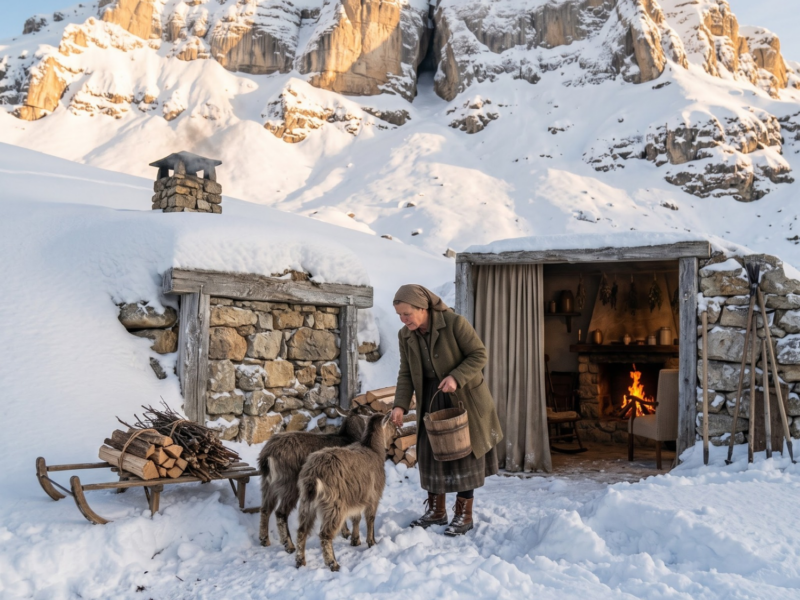
They Called Her Cave a Tomb—It Held 75°F When the Worst Winter in 52 Years Froze the Valley….
The Unbroken Circle
The storm finally broke on the morning of the fourth day.
It did not taper off gradually. It simply stopped, as if someone had flicked an invisible switch across the entire North American continent.
The absolute silence that followed was so complete, so profound, that it woke everyone in the underground chamber.
Clara walked to the heavy wooden door, lifted the iron bar, and pushed it open wide.
The blinding morning sunlight hit her eyes with the force of a physical impact. The world outside had been completely transformed into an endless, pristine, glittering sea of white. Every familiar contour of the landscape was buried beneath monumental, sculpted drifts that caught the brilliant sun and threw back a million flashing diamonds.
The air was desperately cold—still hovering around thirty below—but it was dry, still, and utterly devoid of the killer wind.
One by one, the survivors stepped out of the dark, warm sanctuary into the blinding light. They stood on the snowpack, shading their eyes, breathing in the vast, clean emptiness of the high country.
Nobody cheered. Nobody wept hysterically. They simply stood together, shoulder-to-shoulder, looking out over the magnificent, unbroken white expanse of the valley below, deeply alive.
They had survived the worst winter the territory had produced in half a century. Not because they were exceptionally lucky, and not because they possessed boundless wealth or government protection.
They had survived because a woman named Agnes Whitmore had cared enough years ago to carve a secret hearth into the heart of a merciless stone mountain, and because a woman named Clara Voss had possessed the unwavering courage to find it, defend it, and share it when the sky fell.
Two days later, the valley roads were partially cleared by teams of shoveling men from the lower settlements.
The survivors packed their meager belongings, said their emotional, tearful goodbyes, and began the long trek down the mountain toward their respective homesteads. Many of them would spend the coming spring rebuilding their ruined cabins—but this time, they would build them differently. They would build them lower, anchor them deeper, and respect the undeniable architecture of the earth.
And as the last of them walked away down the snowy trail, Clara stood on the porch of her cave, watching them go.
She turned back inside the warm, quiet stone room.
The cast-iron stove was radiating a gentle, steady heat. The water in the basin was clear and fresh. The shelves were well-stocked with the provisions of survival.
She walked over to the wooden shelf, picked up the cracked leather journal of Agnes Whitmore, and ran her thumb gently over the worn cover. Then she took out her own pen, opened to a clean, blank page at the very back of the book, and began to write:
The storm came. The stone held. The work continues.
She closed the journal, set it back in its rightful place, and sat down in the quiet warmth of the hearth. Outside, the great mountain stood tall, silent, and eternal against the endless blue of the Wyoming sky. And deep inside its stony heart, the fire was left burning.









