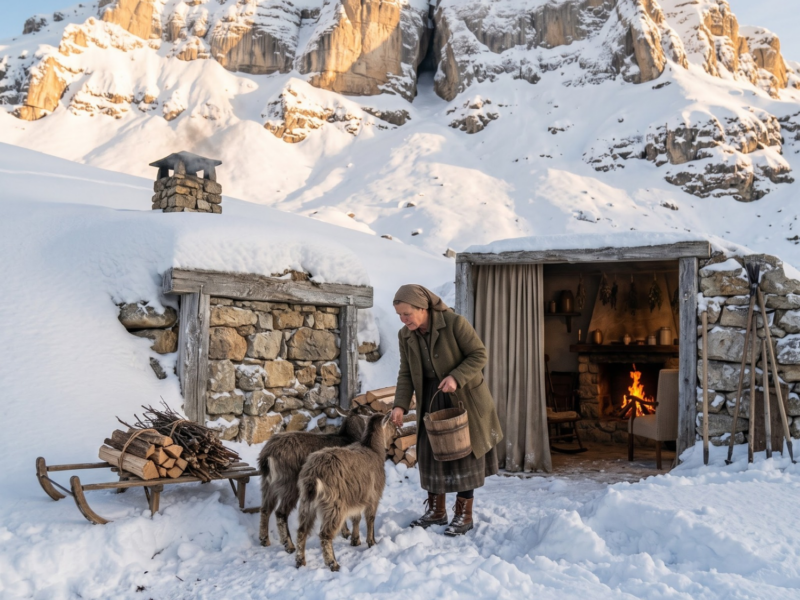
They Called Her Cave a Tomb—It Held 75°F When the Worst Winter in 52 Years Froze the Valley….
The Door in the Mountain
Clara pulled one thick leather glove off with her teeth and pressed her bare, freezing hand against the narrow frost-filled crack around the wooden frame. The limestone felt intensely cold, but not as brutally cold as the mountain air swirling around her.
Something was living beyond that heavy timber door—something the blizzard had not touched.
She wrapped both hands around the frozen iron latch and pulled with every last ounce of strength she had left in her aching arms.
Creak.
The frozen oak hinges resisted for one long, agonizing moment. Then they violently gave way with a deep, subterranean groan that instantly disappeared beneath the howling roar of the blizzard above.
A warm, steady current of still air slipped through the widening opening. It was cold compared to a hearth fire, but it was living cold—not the biting, stripping wind that stole warmth from bone in seconds.
Scout stepped through the shadowy doorway without waiting for an invitation. That alone told Clara everything she needed to know.
She squeezed inside, dragged the heavy timber door shut behind her with a massive effort, and dropped the iron drop-bar securely into its forged brackets.
Instantly, everything changed.
The storm vanished. Not completely, but muted into a distant, muffled rumble that sounded like weather happening in another world entirely.
For several heartbeats, she simply stood in the pitch-black entryway, breathing. The quiet felt almost impossible after hours inside the screaming wind.
She struck a sulfur match against the box. Its small, flickering yellow flame revealed rough cedar beams supporting a narrow entrance tunnel. Smooth stone steps disappeared downward into the comforting darkness. The walls were packed earth instead of bare, weeping rock.
Someone had built this place. Someone had worked here with meticulous care for years.
Scout was already several steps below, his sharp claws clicking softly against the stone floor. Clara followed him carefully, holding the sputtering match before her.
Each step downward stole another piece of winter away. The air grew steadily steadier, dry, and almost gentle. The smell changed, too. The sharp scent of cold snow gave way to the rich aroma of dry cedar, old timber, and something faintly sweet—dried apples.
She reached the bottom of the steps and struck a second match, lighting a wick on a small iron wall-lamp she found bracketed near the landing.
The tiny flame bloomed, revealing a chamber large enough to comfortably shelter several families. Heavy wooden shelves covered every single wall from floor to vaulted ceiling. Glass canning jars stood in neat, perfect rows. Canvas sacks of grain rested on limestone blocks elevated just above the floor. Wooden barrels lined one dim corner. Bundles of dried medicinal herbs hung gracefully from overhead pine beams.
Nothing looked abandoned. Everything looked prepared. Whoever had built this subterranean sanctuary expected someone, someday, to desperately need it.
Clara walked slowly around the subterranean room, exactly as her father had taught her to survey unfamiliar ground: Never rush. Notice everything.
The glass jars held preserved beans, corn, turnips, and wild berries. Strings of dried beef hung neatly from forged iron hooks. Dry firewood rested securely beneath thick sheets of oilcloth, completely protected from any ambient damp air.
Every single shelf sat several inches above the floor on stone footings to keep creeping moisture away. Even before touching anything, she understood one profound truth: this underground shelter had been designed by an architect who understood mountain winters better than most people ever would.
Scout stopped beside a small, cast-iron box stove. He looked back at her once, his tail giving a single, subtle wag.
Clara knelt beside it. The firebox was impeccably clean. Fine gray ash still rested inside from an old fire that had burned away long ago. And neatly stacked beside the stove lay dry, split pine kindling, arranged with careful, deliberate hands.
No careless person left wood this neatly stacked.
She smiled for the first time in days. Not because she felt completely safe—she knew better than that—but because someone she had never met had planned ahead for her survival.
She built the fire slowly, exactly as she had watched her father do a thousand times. Small, dry twigs first, then slightly thicker splits of cedar. A bright, cheerful orange light spread rapidly across the stone chamber, pushing the shadows back against the earth walls.
For a moment, everything seemed perfect.
Then, a thick plume of gray smoke rolled back out of the stove door, spilling across the low ceiling.
Instead of climbing upward through the chimney flue, the smoke hung heavily in the room, stinging her eyes.
Scout immediately retreated toward the tunnel entrance.
Clara stayed remarkably calm. Her father had fought blocked, stubborn stovepipes on the homestead a hundred times. She systematically searched the wall behind the stove until she found a long, rusted iron cleaning rod hanging neatly on a nail beside the masonry.
Standing on a sturdy wooden crate, she thrust the rod upward into the iron pipe.
With a sharp, metallic crack, the blockage broke free. Chunks of packed ice and soot rattled down inside the vertical pipe. A sudden, violent rush of freezing air swept down through the chimney, pulling the draft instantly upward.
The fire leaned forward hungrily, roaring to life. The smoke disappeared up the flue within minutes, leaving the air crystal clear.
Clara climbed down and placed one bare hand against the side of the cast-iron stove. “That will do,” she whispered into the quiet room.
Scout circled the hearth once before happily settling down beside the growing, steady heat.
Only now did Clara allow herself to eat. She opened one of the preserved jars: sweet corn, simple, cold, but tasting better than any fine meal she could remember. She shared a strip of dried beef with the dog before drinking deeply from one of the sealed water barrels.
The water tasted old, mineral-heavy, but clean. Whoever had built this place had even solved the eternal problem of winter water access. Near the vaulted ceiling, a narrow, cleverly engineered stone channel carried melted snow from a surface catchment into the massive storage barrel below.
Nothing here happened by accident. Everything served a vital purpose.
The quiet hours passed. As warmth slowly returned to her frozen hands, Clara finally explored every shadowy corner of the chamber.
She found precise drainage channels cut neatly into the bedrock floor beneath the shelving. She found hidden ventilation openings cleverly concealed inside the limestone masonry. She found food storage so logically arranged that older provisions would naturally be consumed first.
She felt almost as though the unknown builder were still walking silently beside her, explaining every structural decision without saying a single word.
Near the back wall, half-hidden in the gloom, she noticed something wrapped in heavy, weathered leather. She picked it up, carrying it closer to the warmth of the stove.
It was a journal. The leather cover was deeply cracked with age. Across the front, carefully written in faded iron-gall ink, stood a single name:
Agnes Whitmore.
Clara opened the first page with trembling fingers. The handwriting was small, precise, and remarkably orderly. Every single inch of paper had been used wisely.
The earliest journal entry dated back several years. Agnes had written that she worked as a frontier midwife, traveling treacherous mountain trails through every punishing season because isolated pioneer families had absolutely no one else to call when a birth went wrong.
Then, one bitter winter, a sudden blizzard nearly ended her life. She had survived that freezing ordeal only because her lost horse had instinctively found shelter in this very limestone pocket before she did.
Afterward, she had made herself a sacred promise: She would never trust blind luck again.
The journal meticulously described three grueling summers of digging, blasting, hauling massive timber, learning advanced ventilation mechanics from experienced hard-rock mining crews, studying subterranean moisture control inside natural caves, and testing long-term food preservation until nothing spoiled.
Every single page revealed another careful, ingenious improvement. Nothing had been rushed. Nothing had been wasted.
Clara kept reading long after the fire settled down into a bed of glowing red coals. One specific sentence stopped her reading completely. It had been written with noticeably heavier pressure than every other line on the page:
Prepare while the sky is clear. Storms never ask for permission.
She quietly closed the leather journal. The fire crackled softly in the dark. Scout slept peacefully beside the stove. Outside, thousands of tons of blinding snow continued crashing across the freezing mountain.
Inside, one woman’s careful, obsessive work from years earlier was keeping two exhausted strangers alive.









