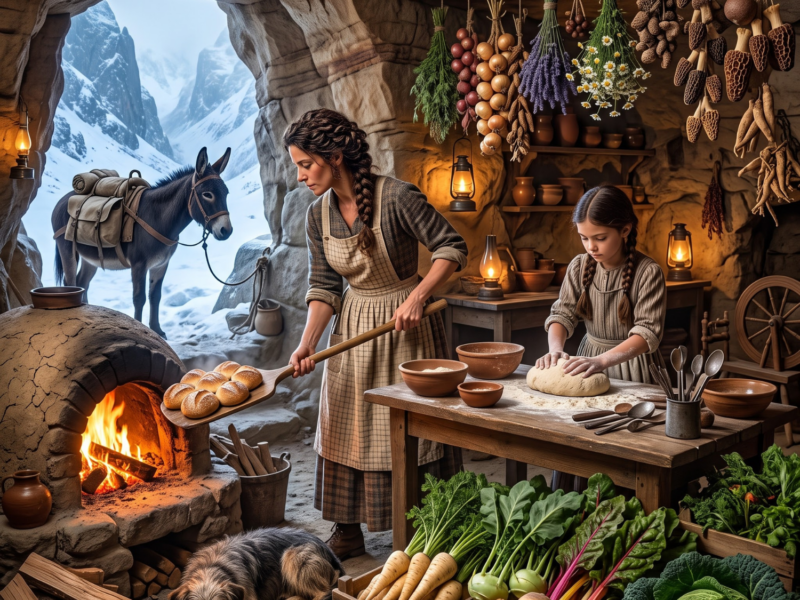
They Expected a Frozen Widow in a Blizzard — Instead They Found Fresh Bread and a Warm Shelter
Stone and Smoke
Black Furnace Ravine stretched farther and deeper than Mara had anticipated. But rather than rushing blindly into the dark, she spent the remaining hour of daylight studying the architecture of the stone.
The northern side of the ravine drew her attention immediately. The snow had melted away in wide, erratic patches. Working around a massive limestone outcropping, she discovered a broad, deep alcove recessed into the hillside. It was practically a cave, shielded by a heavy sandstone overhang. The floor inside was dry dust. Thin beads of moisture clung to the ceiling, suggesting that a vein of geothermal heat was moving through hidden, deep-earth fractures below them.
But one critical question remained: Could the place breathe? A warm cave was useless if it suffocated them in their sleep.
As dusk fell like a heavy curtain, Mara gathered dry twigs and built a small fire near the alcove’s entrance. She, Elsie, and Bramble sat completely still, watching the smoke.
At first, the gray ribbon rose straight up, pooling against the ceiling. Mara held her breath. If it rolled backward, they would have to sleep in the freezing open air. But then, the smoke bent. Drawn by a hidden, natural draft, it slid deeper into the darkness of the cavern and disappeared up through an unseen chimney in the rocks.
The cave was pulling air through itself.
Outside, the blizzard closed its icy jaws over the mountains. Inside, the smoke had delivered its verdict. They were going to live through the night.
The first forty-eight hours disappeared into a blur of brutal, primitive labor. Black Furnace Ravine offered possibilities, but possibilities did not stop the wind. They did not keep flour dry.
Mara started with the bones of the earth: stone.
Because the alcove sat beneath a sandstone overhang, she only needed to build a front wall. Juniper, harnessed to ropes, hauled smaller boulders from the ravine floor, while Mara rolled the massive foundation stones into place by hand, tearing her fingernails and leaving her shoulders screaming in agony long after sunset. Slowly, a rough, crescent-shaped windbreak took form.
Meanwhile, Elsie gathered every dead branch and twig trapped beneath the ledges. Dry wood was the currency of life, and it was becoming scarce as the snow piled higher.
By the second afternoon, the shelter looked intentional. Mara built a raised sleeping platform using sturdy poles, stone supports, and salvaged pine boughs. Keeping their bedding off the warm but damp ground would prevent heat loss. Nearby, she lashed together a hanging storage rack using cordage, keeping their pathetic food supply away from mice.
It was ugly. The walls were uneven, the platform creaked, and the windbreak leaned. But that night, as the true fury of the storm struck the cliffs, sending tornadoes of snow past the ravine entrance, the small fire inside the alcove burned bright and steady. The windbreak held. The raised bed stayed dry.
Long after Mara finally collapsed into exhaustion, Elsie remained curled beneath a thick blanket, the stoneware jar of sourdough tucked safely against her small, beating heart.









