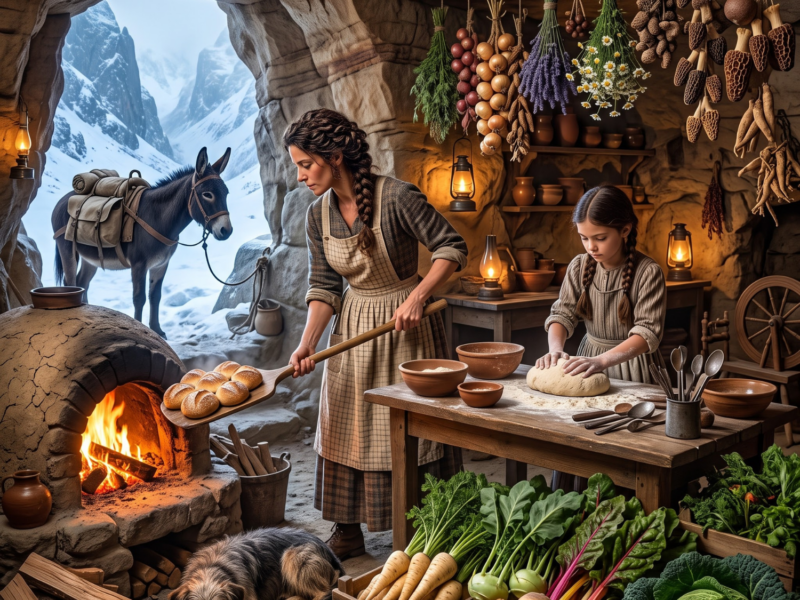
They Expected a Frozen Widow in a Blizzard — Instead They Found Fresh Bread and a Warm Shelter
Seeds in the Dark
On the third morning, Mara explored deeper into the cave system. Following the natural draft that pulled their smoke, she squeezed through a narrow passage at the back of the alcove and discovered a second, hidden chamber.
It was smaller, but noticeably warmer, the air thick with humidity. Most importantly, a jagged, ten-foot crack in the ceiling allowed a brilliant, concentrated shaft of sunlight to pierce the gloom, illuminating the stone floor for several hours each day.
Mara stood in the beam of light, dust motes dancing around her. A radical, dangerous plan began forming in her mind. This wasn’t just a shelter. It was an incubator.
The first step of her plan was obvious: Bread. Bread meant calories, morale, and survival. The sourdough starter had survived the journey, but it needed to be fed, and it needed an oven.
The second step required blind faith. Along with the weathered map and the starter, Thomas had left behind a small, oiled leather pouch of cold-hardy seeds: winter rye, turnip, Detroit dark red beets, and Russian kale. He had dreamed of farming. When they were evicted, Mara had packed the pouch out of sheer grief.
Now, bathed in the underground sunlight, those seeds were no longer a widow’s keepsakes. They were an arsenal.
Back in the main alcove, Mara sorted the pitiful flour sack Edwin had given her. She carefully chipped away the moisture-ruined clumps, salvaging the dry powder in the center. The work was agonizingly slow. But for the first time since Thomas died, Mara was no longer just waiting for the end. She was engineering a beginning.
Her first attempt at building an oven relied on good instinct but too little thermal mass. She shaped river clay over a dome of stacked stones, packed ash beneath it for insulation, and fed a fire inside until the chamber glowed red.
The intoxicating smell of baking yeast changed the atmosphere of the entire cave. Elsie sat cross-legged, staring at the oven as if it were magic.
But physics is an unforgiving master. When Mara pulled the loaf out, her heart sank. The crust was charred black and split open, smelling of bitter smoke. Inside, the dough was heavy, wet, and raw. Three days’ worth of precious flour had been wasted.
Elsie, ever resilient, broke off a piece of the burnt crust and chewed it valiantly. She managed two bites before her jaw gave out.
Mara studied the ruined loaf. The fire had touched the bread, but the oven walls hadn’t retained the heat long enough to bake it through.
By morning, she was hauling heavier sandstone. The second oven was a beast. She doubled the thickness of the clay walls, added massive heat-absorbing stones behind the fire chamber, and narrowed the mouth to trap the radiant energy.
While the new oven cured, she turned her attention to the sunlit chamber. The soil there was too rocky. Elsie spent hours carrying handfuls of rich, decaying leaf mold from the ravine floor. Mara mixed it with sand, crushed limestone, and clean wood ash, creating a nutrient-rich loam. Into this precious dirt went the rye, turnip, beet, and kale seeds.
For three days, the garden looked like a miracle. Then, disaster struck.
The turnip leaves softened. By the next morning, they had collapsed into a rotting, brown mush against the soil.
Mara touched the limestone wall above the bed. It was slick with water. Condensation was gathering on the cold rock and dripping heavily onto the fragile sprouts. The geothermal warmth had fooled her; temperature was only half the battle. The stone was breathing dampness into the wrong place.
She pulled the dead turnips from the earth one by one. Elsie watched from the shadows, her eyes wide with disappointment. Mara didn’t look away from the ruined bed. She had made a mistake, but the cave had just given her a piece of data.
For the next two days, Mara did not plant. She became a student of the stone. She tracked the beam of sunlight. She marked where moisture gathered when the night temperatures dropped. She realized the condensation always formed along the northeast edge, where the rock was coldest.
She hiked into the ravine, cut dozens of flexible willow branches, and wove them into a tight lattice. She wedged the lattice against the ceiling, several inches away from the cold limestone. Now, the condensation gathered on the rock, slid down behind the willow shield, and bypassed the garden entirely. Air could move, but the freezing water was diverted.
A few days later, the kale stopped wilting. The beet leaves stood taller. The earth had forgiven her.









