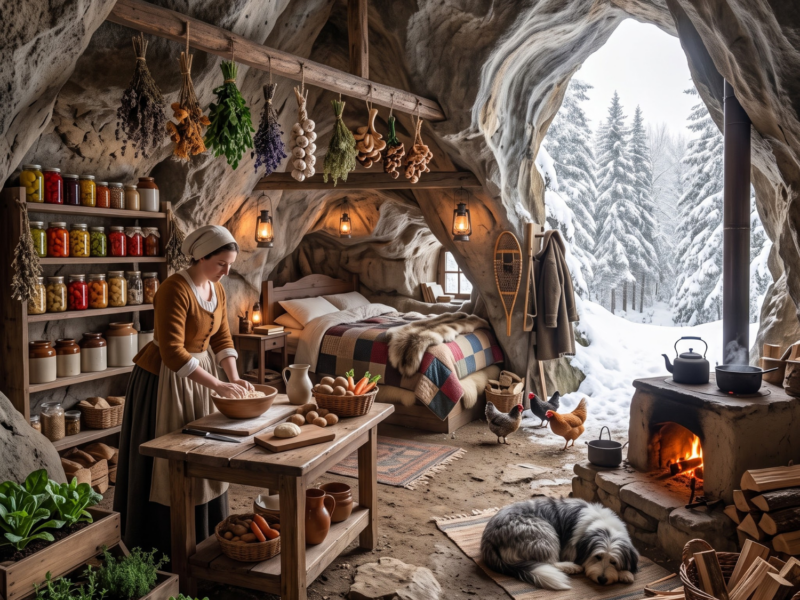
They Gave Her a Cave to Die In — Then 8 Feet of Snow Hit… and It Became Their Only Shelter
The Siege of the Parlor
Dorothea had been desperately trying to build a fire in the massive, decorative stone fireplace in the parlor since the total failure of the furnace became apparent.
She was not a woman without resourcefulness, despite her elegant magazine columns. She had found the heavy brass-handled fire irons, the small hearth broom, and the ornate, decorative log basket that had never, in their entire time in Millhaven, been used for anything except aesthetic, rustic effect.
She had laid the fire correctly. She knew how to lay a fire from her childhood—crumpled paper, dry kindling, and split hardwood arranged in the proper, breathing configuration. The fire was burning brightly.
The catastrophic problem was the room itself.
The front parlor of the Algate house was massive. Twenty-two feet long and fourteen feet wide, with a sweeping ceiling that rose fourteen feet high at its center peak. The stone fireplace, purely ornamental in its architectural conception, put out just enough radiant heat to warm the immediate, three-foot vicinity of the hearthstone.
Beyond roughly eight feet in any direction, the heat instantly dissipated and vanished into the massive, freezing volume of cold air that the huge, single-pane plate-glass windows were conducting inward. The glass was radiating cold at a rate that could absolutely not be matched by a single, small fire burning hardwood at a decorative pace.
She burned the few decorative logs from the basket. Then, shivering violently, she went upstairs and brought down all the spare wool blankets from the cedar chest, and the extra down comforters from the unused guest bedroom.
When the logs ran out, she took a heavy fire iron and smashed two wooden chair backs from her expensive dining room set. She burned them in the grate, which gave her exactly twenty minutes of additional, sputtering heat, and filled the room with a toxic smell of burning lacquer that made her eyes water and her throat burn.
She put on every single layer of clothing she could physically manage—three dresses, two sweaters, and a winter coat—and sat on the floor as incredibly close to the hearth as she could get without catching her skirts on fire.
And she still did not feel warm. She only felt slightly less cold. That was the absolute maximum comfort that was available.
By the morning of the second day of the blizzard, the decorative glass thermometer that Cornelius had hung on the parlor wall for reference during the summer read 18 degrees.
By that evening, as the wind howled outside, it read 11 degrees.
Cornelius had ransacked the house and found three more things to burn: an empty wooden crate of packing materials left over from their move from St. Louis, a wooden louvered shutter that had been stored in the attic, and a wooden footstool. None of it produced sufficient, lasting heat. It flared up, and then it was gone.
On the morning of the third day, Dorothea awoke on the hard parlor floor where she had been sleeping, curled into a tight ball closest to the hearth.
She found that the fire had gone completely out during the night, leaving only gray ash.
She did not have the immediate sensation of freezing cold, so much as the terrifying absence of the physical capacity to feel anything at all at her extremities. Her hands, when she held them up to her face, were a pale, bloodless lavender at the tips of the fingers.
She tried to rebuild the fire with newspaper. She could not physically manage the fine, motor-skill work of tearing the paper with her wooden, unresponsive fingers.
Her body did not answer her brain’s instruction.
Cornelius rebuilt it for her, his own hands shaking violently. He had very little wood left. Half a shattered crate, two splintered chair legs, and a section of decorative baseboard he had aggressively pried off the hallway wall with a heavy iron poker.
When the pathetic fire was finally going again, she huddled desperately into it. Cornelius crouched beside her. He looked at her pale face, her blue lips, and he did not like what he saw.
“I need you to stay awake, Dorothea,” he said, his voice cracking with fear.
“I am awake,” she whispered, her voice barely a breath. “Neil… we need to get help. We have to go.”
“The storm is still blowing outside,” he said. “It’s a whiteout.”
“The storm has been going for three days,” Dorothea said. She looked at him with the terrifying, absolute clarity that sometimes comes when a desperate situation has stripped everything back to its essential, brutal structure. “We are going to die in this house if we stay in it.”
He stood up slowly. He looked around the massive, freezing room he had built with such overwhelming pride and care. The smooth plaster walls, now coated in frost. The expensive plate glass, rattling in the wind. The ornamental fireplace that was currently burning the ruins of his dining chairs. The expensive, decorative Persian rugs that were now serving as desperate, additional insulation against the freezing floorboards.
He had designed this beautiful room for a very specific, civilized set of conditions. And those conditions simply did not include what was happening outside the walls. The room was not a failure of his taste, or a failure of his ambition.
It was simply not built to survive this. He had not built it for this, because he had not, in any real, practical way, believed that this level of violence from nature was actually possible. He had believed his money made him immune.
He put on his heavy coat, pulling his hat down low.
“Neil?” Dorothea whispered.
“I’m going next door,” he said.
She tried to say something else. Her frostbitten fingers twitched. Her eyes went to the middle distance, unfocused, and then slowly fluttered closed. She did not say it.
He got out through the back kitchen door by leaning his entire body weight against it to force it open against the drifted snow.
The wind that met him on the other side was blowing at thirty degrees below zero, with a northerly wind chill that instantly sucked the breath from his lungs and replaced it with absolute, burning nothingness.
He could not see more than three feet in front of his face. The neatly manicured yard he had proudly stood in six months ago with a crystal glass of bourbon, calling out and laughing at his neighbor, was completely unrecognizable. Everything was a swirling, violent, moving white void.
He found the property fence line only by stumbling blindly forward and falling heavily over it. He went along the fence by hand, feeling the frozen wood. He found the gap where the gate latch was. He crossed the open, treacherous ground between the two properties with his arms out for balance, slipping on the ice beneath the snow, until his gloved hands reached the rough, frozen back wall of the log cabin on Blackwood Road.
He followed the wall, stumbling through waist-deep drifts, to the window.
He could see a very faint, warm, golden light inside. It wasn’t coming from the room itself. It was coming from the floor. It was coming from some space below the floorboards.
He pressed his numb hand against the freezing glass and knocked.
His hand did not cooperate the way he wanted it to. The frozen fingers were not responding individually. He made the best, clumsy fist he could manage and brought it weakly against the glass.
Thump.
A pause.
Thump. Again.
He was very, very cold. He had been cold before in his comfortable life, waiting for trains or walking in the city. But this was an entirely different kind of cold. It was the specific kind of cold that does not announce itself as physically painful or dangerous, because it actively begins to numb the brain, removing the cognitive capacity to assess danger.
He knew, intellectually, that he should feel terrified. He could not locate the feeling of terror in his body. He was just so incredibly tired.
He knocked again. Slower, and much weaker than the last time.
Inside the cabin, below the floor, in a warm, insulated room that smelled of dry oak wood and pine smoke, Hazel Voss, who had been reading a journal by firelight, put her book down on her knee and looked up at the ceiling.
She knew the difference between the sound of the wind, and the sound of something else.
She set the book down and stood up. The sound came again from above, even fainter than the last. The rhythm of it had changed from a deliberate knock to something closer to a weak tap. And the interval between each tap was longer than the one before, exactly as if the thing producing it was rapidly running out of the particular physical resource required to make the sound.
Hazel picked up the heavy iron poker from beside the glowing stove. She climbed the steep wooden stairs, unlatched the trapdoor, pushed it open, and stepped up into the frozen, pitch-black dark of the cabin above.
The cold in the cabin was immediate, total, and shocking. Thick, white frost had formed completely over the interior log walls. The water in the drinking bucket by the cold kitchen stove had a solid skin of ice on the surface, thick enough to hold its shape if turned upside down. Her breath came out in a dense, white cloud and immediately sank toward the floor rather than rising.
She crossed to the rear window. She held the oil lamp up high and looked through the frosted glass.
The shape on the other side of the pane was barely human.
It was pressed heavily against the window at a severe angle, suggesting it was desperately using the glass as a physical support rather than as a door to knock on. The face was turned toward her, pressed to the glass. It was the awful, translucent color of old tallow wax. The lips were split and bleeding in the corners.
And the eyes, when they finally found her through the glass, had in them the dark, unfocused, vacant quality of someone who has very, very little time left to find whatever it was they came looking for.
She knew the face. She had known it, and deeply disliked it, for eight months. She had never, in her nightmares, seen it look like this.
She unlatched the window frame and pushed it forcefully open against the howling wind.
The man on the other side did not climb through it so much as he simply fell through the opening, landing heavily, partway across the wooden sill. Hazel caught him under the arms with a grunt of exertion, and pulled him the rest of the way inside with her raw strength.
He crashed down onto the frozen floorboards. He took a long, shallow, ragged breath that rattled wetly in his chest, sounding like something broken and loose inside his lungs.
“Dorothea,” Cornelius Algate rasped. His voice was a thin, whistling wheeze, barely audible over the wind howling through the open window. “She… won’t wake up. Please.”
Hazel knelt down on the freezing floor beside him. She looked at his waxen face for exactly one second. She looked at the ice on the walls, and the snow blowing in through the window behind them.
Then, she stood up. She walked to the open trapdoor and yelled down into the warmth below, her voice carrying the absolute authority of a commanding officer in a war zone.
“Toby,” she shouted. “Get up. I need you.”









