They Gave Her a Cave to Die In — Then 8 Feet of Snow Hit… and It Became Their Only Shelter
The Warning
By the bitter end of October, the dugout was completely finished.
It was twelve feet wide and fourteen feet long. It was accessed by a heavy trapdoor cut seamlessly into the storage room floor above, hinged with thick flat iron and sealed tightly at the edges with a double layer of thick wool felt to prevent drafts.
The staircase was eight steep, incredibly sturdy treads of solid Oregon fir. The walls were cedar post framing, lined perfectly with the oiled canvas vapor barrier. Each canvas panel overlapped the one below it like shingles, sealed completely at the joints with sticky, hot pine pitch. The floor was packed clay, swept clean, and covered in places with salvaged, thick burlap sacks to insulate against the cold ground.
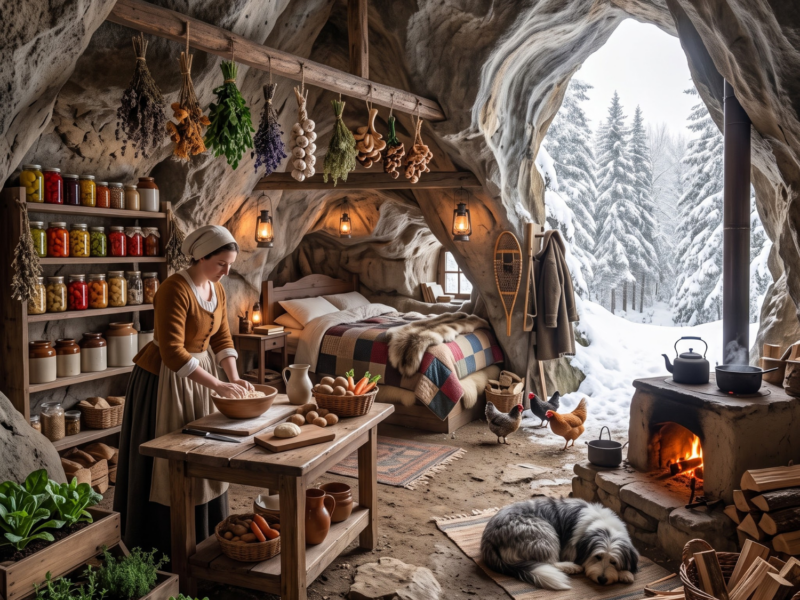
In the deep alcove carved into the newly expanded east wall sat the cast-iron parlor stove. Its metal flue pipe angled sharply up and through the old, existing stone chimney of the cabin above—a complex, dangerous configuration that had taken her four frustrating, soot-covered attempts to get exactly right and drawing safely.
Along the rear wall, she meticulously stacked the firewood. It was three full cords of dense white oak and ash. It had been split and seasoned since April, dried to the absolute core, the ends pale and clean where the moisture had entirely left them.
The underground room smelled incredibly safe. It smelled of dry earth, cedar, and pine pitch.
When she lit the stove for the very first test in late October, the room temperature went from a chilly 48 degrees to a toasty 68 degrees in exactly thirty-five minutes.
She sat on the single wooden crate she had brought down to use as furniture, drank a hot cup of coffee, and listened to the complete, extraordinary, insulated silence of being deeply underground.
The exact same week, Cornelius Algate took delivery of twelve massive burlap sacks of premium coal from a heavy freight wagon out of Billings.
Two hired men stacked the heavy sacks in the newly built coal storage shed at the very back of his property. It was a flimsy, timber-framed structure with a solid roof and a wide double-door that faced directly north—straight toward the prevailing, brutal winter wind.
To protect the coal, Cornelius lazily covered the door opening with a large, waxed canvas tarp. He secured the flapping tarp with a single length of hemp rope, tied loosely to two short wooden stakes driven into the already frozen, unyielding ground.
“Mrs. Voss!” Cornelius called out loudly across the fence when the delivery was done.
His voice carried the particular, smug pleasantness of a man who firmly believes he has just decisively won a competition he thought he was losing.
“I finished my winter preparations in one single afternoon!” Cornelius boasted. “Twelve sacks of premium coal for a modern furnace that has not required me to dig a single, filthy inch into my own property like an animal!”
Hazel was standing at her trapdoor, meticulously checking the drop-latch mechanism with a file. She paused. She looked across the yard at the coal shed.
She looked at the direction the wide door faced. She looked at the heavy, stiff canvas tarp. And she looked at the shallow, wooden rope stakes driven into the frozen, impenetrable ground.
She looked at all of this for exactly as long as it took her experienced eye to understand exactly what catastrophic failure she was looking at.
“Good,” Hazel said flatly.
She lowered herself through the trapdoor and pulled it firmly shut above her, locking out his voice.
Toby was splitting decorative birch logs near the stable when this entire exchange happened. He had his own, clear line of sight to the coal shed.
He stood holding the splitting maul. He followed the exact same, silent sequence of visual observations that Hazel had just followed. The north-facing door. The stiff tarp. The shallow stakes in frozen dirt.
He arrived at the exact same, terrifying conclusion by a different route. He had grown up on a freezing farm in Iowa. He knew intimately what a sixty-mile-per-hour north wind carrying jagged ice crystals could do to a canvas tarp secured with two shallow wooden pegs.
He opened his mouth to shout a warning. He looked over at Cornelius, who was already walking arrogantly back toward his massive house with the highly satisfied, swaggering posture of a man who has just won a debate.
Toby slowly closed his mouth.
He set the heavy splitting maul down on the chopping block. He stood for a long moment with his calloused hands at his sides. The late October sky above him was the pale, clean, innocent blue of a season that was almost over.
He picked up the splitting maul and went back to work. Some men had to learn the hard way.









