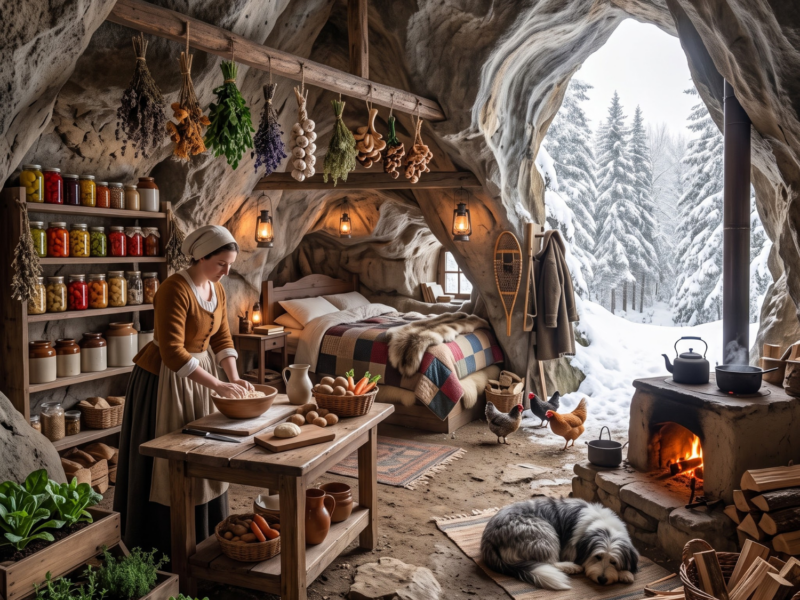
They Gave Her a Cave to Die In — Then 8 Feet of Snow Hit… and It Became Their Only Shelter
The Apprentice
What ultimately saved Hazel from a particular, suffocating kind of loneliness that long, hot summer was the boy across the fence.
Tobias Crane was nineteen years old. He had come to Millhaven on a freight wagon from a failing farm outside of Cedar Rapids, Iowa, with absolutely nothing to his name except a serviceable knowledge of draft horses, and the kind of deep, physical endurance that comes from having worked since childhood without anyone ever asking whether you were tired.
He worked full-time for Cornelius Algate. Toby did all the brutal, menial labor that Cornelius needed done to maintain his grand estate, but absolutely did not want to think about doing himself: mucking out the small, pungent stable; splitting the decorative, perfectly sized firewood for the front porch pile; running trivial errands into town.
Toby was a quiet, deeply attentive young man. He observed the chaotic world around him with the incredible patience of someone who has learned the hard way that the world does not slow down to explain itself to poor boys.
The first time he stopped his work at the fence line to watch Hazel dig, he said absolutely nothing. He stood leaning on his rake for perhaps ten minutes. He watched the steady, efficient rhythm of her work. He noted the precise way she positioned the heavy pickaxe before each stroke to maximize leverage. He observed the meticulous system by which she sorted the displaced earth into wheelbarrow loads, separating the clay from the topsoil.
Then, he quietly went back to his own exhausting tasks.
He came back to the fence the following Saturday. And the one after that.
Eventually, sensing she wasn’t going to chase him away, he began to ask questions. And they were the right kind of questions. They were specific, intensely practical, and entirely without the mocking condescension that the rest of the town’s questions carried.
“Why white oak?” Toby asked one morning, leaning on the top fence rail as she stacked her underground woodpile.
Hazel set the pickaxe down and slowly straightened her aching back. She looked at the boy.
“Burns slow and even,” she said simply. “Soft wood, like pine, burns hot and incredibly fast. You get two hours from a pine log. Maybe three if you damp it down. In a long, three-day storm, when you can’t go outside to get more, that burn rate matters. You want wood that coals.”
“How long a storm are you planning for?” Toby asked.
“Long enough.”
“And the stove?” he pointed toward the open trapdoor. “Why the small one? Why not a regular, massive wood stove to heat the whole place?”
“Because in a small, completely enclosed space underground, a regular wood stove will literally cook you alive,” Hazel explained, wiping her brow. “And it consumes oxygen too fast. The parlor stove puts out exactly enough radiant heat for the small room without stripping all the breathable oxygen. The offset flue arrangement is the key. It slows the exhaust.”
Toby nodded slowly. It was the deep, processing nod of someone actively storing vital information for later use, not merely politely acknowledging it.
Hazel picked up the pickaxe again. After a moment, she paused and added, without looking at him, “Any other questions you have, ask them, Toby. Don’t just stand there looking like you’re working a difficult math problem out in your head.”
After that invitation, the questions came much more regularly. And Hazel found, to her surprise, that answering them was not a burden.
The boy listened to her. He listened the exact way she had listened to Francis Two-Clouds thirty years ago in the mountains: with the absolute whole of his attention, entirely without the male ego’s need to demonstrate that he already knew the answer.









