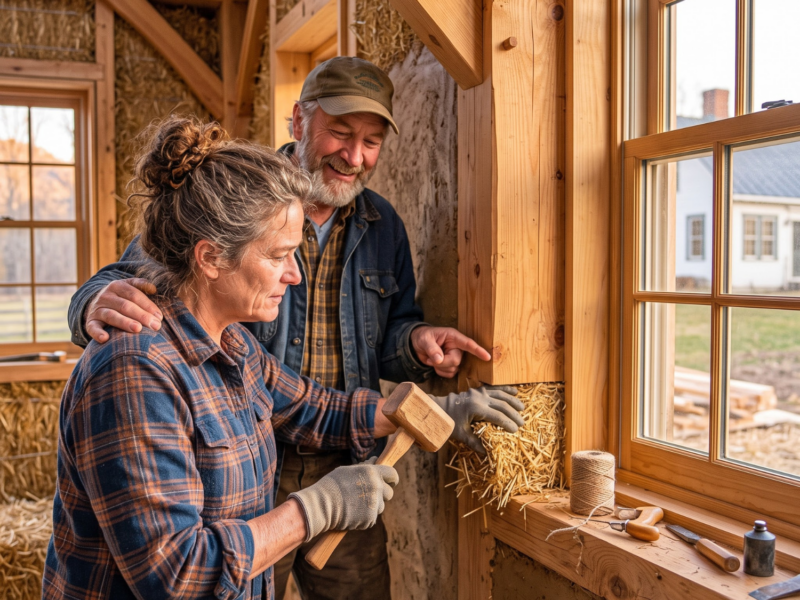
They Laughed When She Wrapped Her House in Straw—Then the First Blizzard Hit…
The Pride of Neighbors
Ray was lying on a creeper underneath the trailer, a grease gun in his hand, when Martha’s muddy work boots stopped beside his red metal toolbox.
He slid out, wiped a streak of black grease from his cheek with a rag, and looked at the receipt clutched in her hand. He didn’t say anything. He just waited.
“I need to collect dry replacements from Lee,” Martha said, her voice tight with the effort it took to ask for help. “Could I borrow your trailer today?”
Ray sat up slowly, wiping his hands. Behind him, Martha noticed a dark, rotted stain climbing an old, structural barn post. Years earlier, Ray had stacked wet bedding against it, hiding the water damage until the post nearly snapped and he’d had to spend a fortune replacing the timber.
“That’s what I was looking at over there,” Ray said softly, nodding toward her house. “I wasn’t just running my mouth, Martha. I know what wet straw does to wood.”
“You managed to do both,” Martha replied flatly.
Ray almost smiled. He appreciated a woman who didn’t back down. He reached into his pocket, pulled out a brass hitch-lock key, and tossed it to her.
“I need it back before my feed run on Friday morning,” Ray said.
“You’ll have it tonight,” Martha promised. She took the key, turned on her heel, and walked back to her truck without a word of thanks. Out here, thanks were implied by bringing the equipment back unbroken.
At the farm supply counter, the air smelled of fertilizer and stale coffee. Lee credited the spoiled load without a fuss. A local rancher collecting heavy fence staples leaned against the counter, eyeing Martha’s muddy clothes.
“You really building a straw house, Martha?” the rancher asked with a smirk. “Gonna put a hayloft in the living room for the big bad wolf?”
Martha didn’t blink. She let the man’s chuckle die in the awkward silence, focusing entirely on Lee as he tallied up her exterior materials on a legal pad.
When Lee pushed the calculator toward her, Martha’s stomach dropped. The total for the exterior sealing wrap and the specialized screws took significantly more of her budget than she had anticipated.
She opened her biscuit tin. She counted out the cash, separating the bills reserved for firewood into a different pocket so she wouldn’t be tempted to touch them. When she handed Lee the money, she was left with exactly fourteen dollars.
She had the insulation, but she still needed the wooden boards to cover the outside of the straw to protect it from the snow.
Martha sat in the cab of her truck, the engine idling, and called June Mercer. June was a brilliant, eccentric builder who specialized in sustainable architecture and had designed Martha’s retrofit for a fraction of her usual fee.
“June, I’m short on cash for the exterior siding,” Martha admitted, hating the sound of her own voice.
“Don’t panic,” June’s calm voice came through the receiver. “The structural protection underneath is what matters. The outer finish just needs to block the wind and snow. Sound, reclaimed boards will serve perfectly fine. Go to the salvage yard on Route 9. I’ll meet you at my workshop this afternoon to cut them.”
By noon, the sky had turned a flat, bruised purple. Martha was walking between towering, chaotic racks of lumber at the reclaimed material yard.
She passed beautiful, matching stacks of salvaged oak and cedar—wood she couldn’t afford to look at. She walked to the back of the lot and stopped at a stack of mismatched, weathered pine. The boards carried three different colors of peeling, lead-free paint: faded barn red, a sickly pale blue, and weathered gray.
It was ugly. But it was solid.
She counted out the exact square footage the house needed, handing her last fourteen dollars to the yard manager. The pretty pieces of wood stayed on the rack. The usable, ugly ones went into the back of Ray’s borrowed trailer.
At June’s workshop, the air hummed with the sound of a table saw. Martha backed the trailer up to the open bay doors. June, a wiry woman in her forties with sawdust in her hair, helped Martha pull the boards off the trailer.
June rejected two pieces that had hidden splits, tossing them aside, but pulled the rest into a neat stack.
“These will do,” June said, tapping a pale blue board. “It’s going to look like a patchwork quilt, Martha, but it will keep the storm out.”
Martha wrote the new, smaller dimensions on the back of her supply receipt. They had just enough coverage.
At the supplier’s storage barn, Lee opened the dry replacement stack of straw. Martha checked every single bale with her bare hands, digging deep into the center to ensure they were bone dry.
When she finished loading the trailer, she noticed something wedged behind the trailer’s spare tire. It was a heavy, folded, waterproof canvas cover. Pinned to it was a note written on a torn piece of cardboard in Ray’s messy handwriting:
Bring the cover back, too.
He hadn’t mentioned it. He had known she would be hauling in the weather and had quietly provided the protection she forgot to ask for.
Martha spread the heavy canvas over the dry straw, securing it with bungee cords, and tucked Ray’s note into her pocket.
At the county road junction, a vicious gust of wind caught one loose edge of the canvas, snapping it like a whip. Martha immediately pulled the truck into a wide gravel turnout, killed the engine, and fought the wind to secure the strap before the straw could be exposed to the elements.
Beyond the intersection, the road crossed miles of open, harvested cornfields. There was absolutely nothing to slow a west wind out here. If she lost the straw now, she lost the house.









