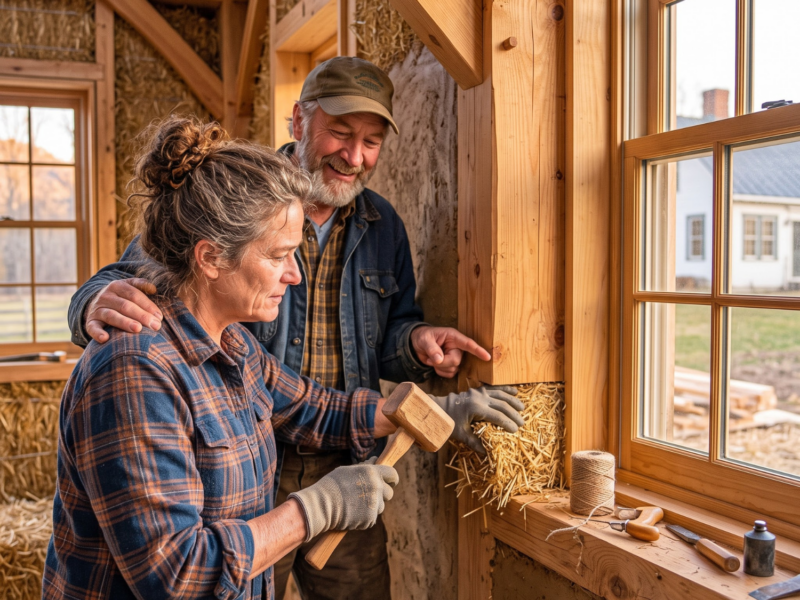
They Laughed When She Wrapped Her House in Straw—Then the First Blizzard Hit…
The Whiteout
Inside the house, the atmosphere had fundamentally changed.
Martha brought three days’ worth of heavy, seasoned oak firewood inside, stacking it within arm’s reach of the cast-iron stove. She checked the heavy, rechargeable battery lantern resting on its shelf, ensuring the indicator light was green, and plugged her cell phone into the wall outlet beside it.
The house was sealed, but it would still need internal heat to survive what the sky was about to deliver.
Nora called on Sunday morning. Her daughter’s voice was tight with anxiety.
“Mom, the weather reports are getting worse. They’re calling for two feet, plus drifts. Should I come get you now, before the county roads turn to ice?”
Martha looked around her kitchen. She looked at the ugly, pale blue boards visible through the window.
“The window is fixed, Nora,” Martha said, her voice carrying a deep, immovable calm. “June is coming back in an hour to check the last of it. If the house isn’t ready, I promise I will call you to come get me.”
That specific, conditional answer settled Nora far more than a blind promise would have. They agreed to speak again that evening.
Martha walked over to the front door, looked at the packed duffel bag, and left it exactly where it was.
By Sunday afternoon, the temperature plunged to five degrees. The sky was a terrifying, opaque white. The last exposed straw was covered by the finished wall assembly.
June walked the perimeter of the house, checking around the openings, testing the repaired junction with a moisture meter, and inspecting the seals. She walked the house once more with Martha, shining a flashlight into the corners.
“It’s tight, Martha,” June said finally.
There were no grand, cinematic announcements when June packed her truck. She simply put away her tools, hugged Martha tightly, and drove away to beat the storm. Ray gathered his sawhorses, carried his workbench across the short dirt lane to his own farm, and waved once before going inside.
At the county junction a mile away, a Department of Transportation worker swung a heavy, orange warning barrier across the exposed route, locking it in place. The roads were officially closed.
Snow was beginning to travel completely horizontally across the gravel, driven by a howling, forty-mile-an-hour wind.
Martha watched from her yard until Ray reached his porch. Only then did she step inside and pull her heavy front door shut, throwing the deadbolt.
By evening, the snow was striking the weather-facing north wall of the house hard enough that Martha could hear it over the static of her AM radio. It sounded like someone throwing handfuls of sand against the glass.
Martha laid another thick, split oak log onto the established fire, closed the heavy iron stove door, and hung her damp work gloves on a rack nearby.
She had done this exact same routine through a dozen other winters. But in those previous years, the fire had only managed to warm the kitchen, while freezing, bitter air had crept aggressively along the hallway and bedroom floors, forcing her to sleep in the kitchen.
Tonight, she deliberately left the bedroom door wide open.
She walked through the house. It was quiet. The draft that usually whistled through the baseboards was gone. The heat from the stove was rolling lazily down the hallway, filling the back rooms.
She kept her wool blanket on the daybed in the kitchen out of habit, but for the first time in her life, she didn’t need it.
A violent gust of wind rattled the old windowpane. Martha walked over to it, placed her hand against the repaired edge, and waited. It was cold to the touch, but dry. Nothing fresh was running down the wall.
Then, with a loud POP from a transformer down the road, the lights went out.
The hum of the refrigerator died. The AM radio fell instantly silent. The house was plunged into absolute darkness, illuminated only by the faint, orange glow of the embers visible through the stove glass.
Martha didn’t panic. She calmly reached out, switched on the battery lantern, and set it on the kitchen table.
Across the lane, Ray Hollis was standing in his kitchen when his modern, expensive propane furnace ground to a halt.
He waited for thirty seconds, expecting the fan to kick back on. It didn’t. He looked out the window at the dark, invisible neighboring yards. The power grid was down across the county.
His rooms were still warm, holding the residual heat, but with temperatures plunging toward negative twenty with the windchill, there was no telling when the power would return. A house without a heat source in this weather became a freezer within hours.
Ray picked up his cell phone and called Martha.
“You still got heat?” Ray asked when she answered.
“The woodstove is going,” Martha said. “Are you alright?”
“Furnace is dead,” Ray admitted.
For a long moment, neither of them added anything. The silence hung heavy over the cellular connection. Outside Ray’s window, blowing, loose snow was rapidly filling the shallow tire tracks across the lane, erasing the boundary between their properties.
“Come over while you can still see my porch,” Martha said firmly. “I’ll put my lantern in the window.”
“You sure?”
“Bring your own coffee.”
Ray packed a few overnight things into a duffel bag, drained his water pipes so they wouldn’t burst, and checked that his house was secured.
The walk was only about a hundred yards, well short of the exposed, deadly county road, and both farmhouses were still faintly visible to each other.
Martha turned her heavy lantern toward the front window, creating a beacon in the whiteout.
She watched Ray’s flashlight beam move erratically along the shared lane, fighting the wind. It disappeared briefly behind a snow-drifted fence post, then rose onto her porch.
She opened the door before he could knock, stepping aside as he stumbled in, covered in snow, gasping for breath against the brutal cold.
Martha quickly pulled the kitchen daybed clear of the wall and spread clean bedding over it for Ray. He took off his heavy coat, shook the snow from his boots, and glanced at the narrow daybed where she had been sleeping for weeks. He sat down without making a joke.
Martha handed him a mug of instant coffee made with hot water from the stove kettle. She settled into her rocking chair near the fire.
Ray took a long sip of the hot coffee, letting the warmth return feeling to his fingers. He looked around the kitchen, feeling the profound, deeply insulated heat trapped within the straw-bale walls.
“You worked hard for this, Martha,” Ray said softly.
“So did you,” Martha replied, looking at the fire.
For a while, they just listened to the oak logs popping in the stove, the lantern throwing their long, flickering shadows across the kitchen ceiling. Outside, the last visible outline of Ray’s barn disappeared entirely into the blowing snow.
Martha stayed in her rocking chair a little longer than she meant to, finding a strange, quiet comfort in the shared silence.
Eventually, Ray set his empty mug aside. “I’ll take the first turn with the fire,” he offered.
Martha began to protest, saying she was used to waking up every three hours to stoke it.
Ray simply pointed toward the daybed. “Then you’ll know when it’s my turn to sleep. Go to bed, Martha.”
Before she lay down, Martha called Nora on her cell phone. The signal was weak, but it connected. She told her daughter that the power was out, but the house was incredibly warm, the stove was working perfectly, and Ray was there to help. They would call again in the morning.
Nora let out a long breath of relief, thanked Ray through the phone, and asked her mother to please get some rest.
This time, Martha did.









