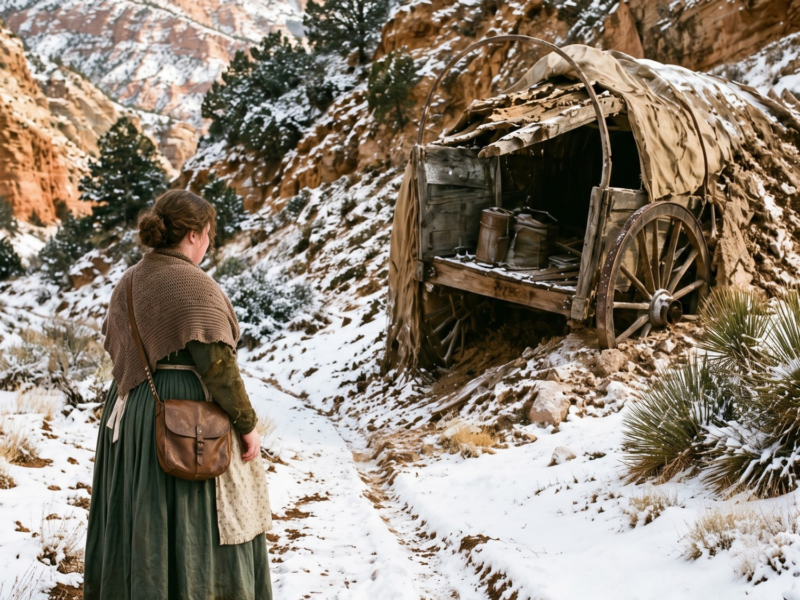
They Left Her in the Snow to Die—She Uncovered a 90-Year-Old Secret Buried Forever
The Fox’s Den
Silas had taken her out in November of 1877 on a morning so cold the air itself seemed reluctant to move. She had been thirteen. They were following a fox’s track across a field of crusted snow, and Silas had suddenly stopped, pointing with one gnarled finger at a place where the track disappeared into a shadow at the base of a granite outcropping.
The entrance to the den was invisible until you were directly in front of it—a narrow gap angled into the rock face so that the prevailing northwest wind passed entirely over it. Inside, Silas explained, the fox slept in a pocket of its own warmth, the stone holding the heat of whatever small fire of life burned in that animal, with the earth below the frost line sitting at a temperature that did not vary by more than a few degrees, regardless of what the sky decided to do overhead.
“That fox isn’t fighting the winter,” Silas had told her, his voice carrying the particular roughness of a man who had spent decades talking mostly to himself and to landscapes. “It isn’t building a fortress. It found the one place winter can’t reach, and it went there.”
She had thought about that fox intermittently for seven years. Standing on her slope with the wind at her back and the sheep making their small sounds below, she thought about it with the focused intensity of a person who has just recognized that a memory they have been storing is not a memory at all, but an instruction.
There was a second memory. She was fifteen, and Silas had taken her twenty miles north of the home ranch to a location he had known since his trapping years, where an old line cabin sat half-buried in a hillside. Its roof was a living mat of grass, and its entrance was so low you had to duck to enter.
Inside, a single tallow lamp revealed a space that was cool in the way of a root cellar, but not cold in the way of the outside world. Silas had let her stand in that space for a long time without speaking, letting her senses register what her mind would then work to understand.
The walls were packed earth. The floor was packed earth, sloped barely perceptibly toward the entrance. The roof was timber framing covered with brush, canvas, and two feet of living sod. At the far end, a chimney of flat stones mortared with clay and dried grass rose up through the roof and emerged above grade, capped with a piece of tin bent at an angle.
“Put your hand to the wall,” Silas had said.
She did. Cool, but not frozen, not damp. “The earth below the frost line holds the warmth of the season that just passed,” he told her. “It doesn’t forget. Long after the snow comes, the ground six feet down still remembers August. You give animals a space where that memory is the temperature they’re living in, and you’ve done more for them than any timber barn with gaps in its boards.”
She had asked about the chimney. Silas had walked to it, placed his palm near the opening at the base where it met the interior wall. A faint movement of air, barely perceptible, but present.
“Warm, wet air wants to rise,” he had said. “You give it a path up and out. It pulls fresh, dry air in from below, from the door crack, from wherever the cold comes from. The animals don’t choke. They don’t rot from the inside out with wet lungs. The air moves slow, quiet, steady—the way good things move.”
She had filed these observations in the place in her mind where Silas’s lessons lived, not labeled as useful or applicable, simply stored with the precision of a person who has been taught that the point of observation is not always immediate.
Silas had believed—had spent his entire life acting on the belief—that the land contained logic, and that a person who learned to read that logic was never entirely without resources, regardless of what the surface condition suggested. Standing on her slope at twenty years old, with winter coming and four dollars in her coat pocket, Marin Callaway arrived at the conclusion that she was not going to build on this land. She was going to build into it.
Act II: The Subterranean Architecture
Chapter 4: The Clay Seam
She began the survey that same afternoon, moving along the contour of the slope with the unhurried attention of a person doing a thing they will not get a second chance to do correctly. She was looking for three things simultaneously:
-
A section of the slope steep enough to allow significant depth of excavation without the roof becoming impossibly thick or the entrance requiring an approach that would be treacherous in snow.
-
Soil deep enough above the bedrock to excavate the dimensions she needed.
-
A natural feature—a depression, a slight hollow, a change in the drainage pattern—that would tell her this particular spot had already been selected by the land itself for the purposes she had in mind.
She found it in the late afternoon light when the shadows had lengthened to the point where the terrain read differently than it did at midday: a slight concavity in the slope roughly forty feet from the granite spine that ran along the ridge, where the angle steepened slightly and the soil was noticeably darker, indicating greater depth and better moisture retention from the seasons.
It was a place the winter runoff avoided. The grass there was taller than the grass around it, which meant the root system below was deeper, which meant the soil was not just surface accumulation, but genuine depth.
She knelt and pushed the mattock handle straight down into the earth. It went eighteen inches before meeting significant resistance.
She was standing in the place she would make her stand.
Virgil Oaks rode past the property line on the second day after she arrived, not stopping, not calling out his horse, picking along the ridge trail that connected his spread to the road south. He was a man of fifty-four, broad across the shoulders with a face that the Wyoming weather had worked on for three decades until it had achieved a kind of severity that was not unfriendly, but was entirely unambiguous about its experience.
He ran the largest sheep operation in the county: twelve hundred head, two ranch hands, and a barn that Marin had heard described as the best-built structure between Laramie and Cheyenne.
He did not stop. He looked at the slope, at the temporary pen of saplings, at Marin standing with the mattock handle in her hands, doing her soil assessment with the expression of a man cataloging a situation he expects to be called upon to respond to later. Then he rode on.
His silence was its own statement. She had heard its grammar before at the trading post three days earlier. Constance Faber had given Marin her flour, her salt, and a look of such thorough pity that it had the quality of a verdict.
Constance was a woman who managed the social temperature of the small community around Burnt Creek with the attentiveness of someone who believed that information properly circulated was a form of care. The story of Marin Callaway’s situation would have reached every household within riding distance before the flour was used.
Marin was not naive about this. She had factored the community’s foreknowledge into her plan in the same way she factored the weather: not as a variable she could control, but as a condition she had to account for.
She began the excavation on a morning when the sky was the pale blue of deep cold and the frost on the grass cracked under her boots. She started by cutting sod—not because it was the most urgent task, but because it was the task that, done correctly, would make everything else possible.
The sod on this part of the slope was thick buffalo grass and sage, with root systems woven into a mat that had been building since before anyone now living had been born. She worked the shovel’s edge in with a rocking motion that Silas had shown her, the blade nearly perpendicular to the surface, slicing rectangles twelve inches wide and twenty-four inches long.
She pried each one free with the mattock, lifting from below rather than tearing from above so the root system stayed intact. She laid the cut sod grass-side up on a flat section of ground upslope in rows, with the care of someone setting out a material they will need in good condition weeks from now. Because she would.
These were not the waste product of the excavation. These were the roof.









