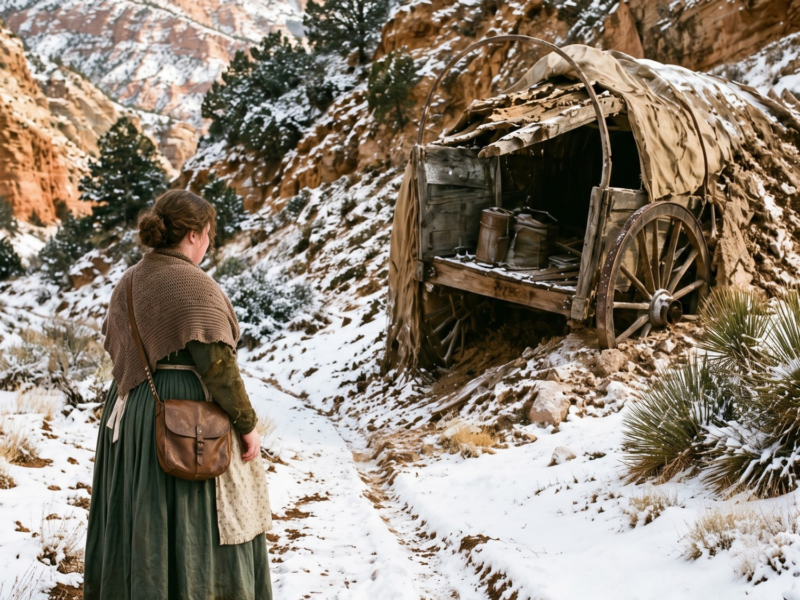
They Left Her in the Snow to Die—She Uncovered a 90-Year-Old Secret Buried Forever
The Discovery in the Trench
The work consumed the first day entirely, leaving her with a cleared rectangle of raw earth the size of a modest room, muscles that had been tested all the way to their limits, and the deep, specific satisfaction of a person who has spent a day doing exactly the right thing with total attention. She ate dried meat, drank water from the canteen she kept inside her coat to prevent freezing, and slept in her bedroll under the open sky with the sheep making their nighttime sounds fifteen feet away.
On the third day of digging, when the excavation had reached four feet in depth, she hit the problem.
The mattock struck stone—not the scattered granite she had been encountering in occasional knuckle-sized pieces that simply needed to be extracted, but a continuous resistance that rang through the handle in a way that meant mass, not surface.
She cleared the surrounding soil by hand, feeling the shape of it: a single slab of granite roughly six feet long and three feet wide, sitting at a slight angle in the earth like a sleeping animal. It bisected the planned left wall of the excavation.
Blasting it was not an option she had the means to pursue. Digging around it in a way that maintained the structural integrity of the surrounding soil would require redesigning the excavation entirely. Breaking it manually would take days she could not spare in the window before the ground froze too hard to work.
Marin sat on the edge of the excavation for a period she estimated at twenty minutes, looking at the granite slab. Not with frustration—frustration was a response to things you had expected to go differently, but with the considering attention she would give any problem that had revealed itself as more interesting than it first appeared.
The slab’s angle was, she realized as she looked at it, not a complication. It was a finished wall.
Its upper surface was at roughly the height her left wall needed to be. Its lower edge was planted in soil that would not shift under the weight of a sod roof. It was not in the wrong place. It was already in the right place.
She recalculated the interior dimensions around the stone, adjusting the right wall to maintain the twelve-foot width, and continued digging.
The excavation deepened. The pile of displaced earth beside it grew into a significant mound that she began shaping deliberately, pushing it to the sides rather than behind, instinctively understanding that it would serve as additional insulation banking against the exterior walls once the structure was complete.
Virgil Oaks came on the seventh day.
She heard his horse on the slope above before she saw him, and she continued working—the rhythm of the mattock and shovel had become her primary sensory experience, the swing and bite and lift as natural as breathing. She was five feet down, moving soil into the wheelbarrow with the steady economy of someone who had long since stopped thinking about the individual actions.
He rained up at the edge of the excavation, horse shifting its weight, and the long silence of a man taking inventory. She paused, leaning on the shovel handle, and looked up at him.
Virgil Oaks looked back down at her with the expression of a man who has seen a great many things that did not survive the winter, and has learned not to let that history show too plainly on his face. He dismounted, ground-tied the horse, and came to the edge of the hole.
He was quiet for another interval, studying the dimensions, the mound of displaced earth, the rows of cut sod laid carefully upslope. His voice when it came was not unkind.
“That’s a serious amount of digging for a root cellar.”
Marin explained it. She kept it plain, kept it precise, the way Silas had taught her to explain any technical thing—not as a defense, not as an argument, but as the transfer of information from a person who has it to a person who does not. She told him about ground temperature below the frost line, about the thermal mass of packed earth, about the collective body heat of twenty-two sheep in an enclosed space. She used Silas’s phrase: The earth is a miser. It holds what it has. It was the most accurate description she had of the principle she was applying.
Oaks listened. His head tilted at a slight angle that indicated genuine consideration rather than polite patience. Then he crouched at the edge of the hole, picked up a handful of the excavated soil, felt its texture between his fingers, and set it down.
He named three problems. He named them in the order of his concern, which Marin noted was also the order of their actual severity:
-
Moisture. Earth held damp. Damp combined with enclosed space and animal heat created the conditions for a particular kind of disaster—not dramatic, not sudden, but thorough. Wool in sustained damp didn’t just become uncomfortable; it became a vector for respiratory infections.
-
Air quality. Twenty-two animals breathing in a sealed space would deplete oxygen and accumulate carbon dioxide at a rate that would produce lethargy long before it became fatal. But the lethargy itself suppressed the metabolic activity that generated the heat she was counting on.
-
The precedent of conventional wisdom. Every structure built into earth in this territory had attempted to function as a barn and had failed. The soil moved. The drainage was never what you planned. The animals refused to settle. It was a tomb, not a shelter.
His second point landed differently than his first and third, because Marin did not have an immediate answer to it. She knew the moisture problem; she had the solution to that in her mind (a waterproofing layer between the timber framing and the sod: tallow-treated canvas, the same logic Silas had used on the line cabin’s roof). She knew the drainage problem (the sloped floor, barely perceptible, but sufficient).
But the ventilation—the ventilation was the one element she had not fully resolved. She knew it was necessary. She knew the general principle from Silas’s stone chimney. She did not yet know with certainty whether she could build that chimney without materials she did not possess.
She did not say any of this to Oaks. She said: “The earth holds what it has, Mr. Oaks. If you give it a reason to hold warmth, it will. I intend to give it that reason.”
Oaks looked at her for a moment with the expression of a man who hears in someone else’s words an echo of a confidence he recognizes because he once had it himself before the land educated him. He said her father had a fine barn. He said that a measure of humility would serve her flock better than a principle.
He mounted his horse, looked at her one final time with the flat, sorrowful assessment of a man who has already written the ending, and rode back toward the ridge.
The sound of his horse faded. The wind moved through the sage. The excavation was five feet deep, and she was standing in it with the shovel in her hands, and the specific cold of a problem she had not fully solved sitting in her chest like a stone.
She climbed out of the hole. She sat on the edge with her legs hanging down and looked at the sky, which was going the color of pewter in the northwest in the way that meant the warm days were numbered. She thought about the flat creek stones she had seen during her first survey of the property—the way they sat in the stream in the particular stratified patterns that meant they would split cleanly if struck at the right angle.
She thought about the distance to the creek, the weight of sufficient stone, the fact that her wheelbarrow could make the trip in roughly forty minutes per load. The problem was soluble; the materials existed on this land. She simply had to get them here, cut them to shape, and build a structure.
She had seen it built once fourteen years ago by a man whose hand she had watched with the unself-conscious attentiveness of a child who does not yet know she is being educated.
She went down into the hole.
Act II: The Ribs of the Mountain
Chapter 6: The Visitor from Burnt Creek
Agnes Puit came on the fourteenth day.
Marin had not met her before, or rather, had seen her at the trading post on two or three occasions. Agnes was a woman of perhaps fifty with the particular kind of stillness that came not from contentment, but from having made a large number of decisions about what to spend energy on and what to let pass. She had homesteaded five miles down Burnt Creek after her husband Robert died in the spring of 1879, working her own land through five seasons without visible assistance, and had achieved a reputation in the community that consisted almost entirely of people saying about various things she had done that they would not have believed it possible.
She arrived in the mid-afternoon on a horse that moved with the deliberate efficiency of an animal that had learned to conserve itself over long days of work.
The horse tied to the edge of the excavation, Agnes dismounted without preamble. She walked to the edge of the hole, looked down at the workspace, the drainage trenches, the stone slab acting as the left wall, and finally at Marin, who was on her knees fitting a timber joint at the base of the wall.
Agnes unstrapped a cloth bundle from behind her saddle. She held it out. Still warm bread. Marin could smell it from four feet away, and the smell reached something in her that she had been keeping compressed since the morning she left her father’s property.
She did not say thank you in a way that invited sentiment. She said, “That’s appreciated.”
Agnes looked at the shoes, the mud, the raw hands. “You’re building it wrong at the corners,” she said.
Marin paused, her chisel half-raised. “Which corner?”
“The northwest. You’ve got no offset for the prevailing winter draft. The wind will slide down the granite and pool right in the corner, freezing your lowest course first.”
Marin sat back on her heels. She studied the corner in question. Agnes was right; she had calculated the regional wind, but she had miscalculated the micro-eddy off the granite spine.
“How would you step it?” Marin asked.
Agnes crouched at the edge, her joints popping slightly. “Two inches back on every third course. Break the laminar flow. Make the wind trip over itself before it hits the seal.”
They talked for twenty minutes about stone physics, mortar consistency, and the precise angle at which a beaver built its lodge against the current. It was the longest conversation Marin had held with another woman since her mother died.
When Agnes mounted to leave, she looked down at Marin with eyes the color of winter river ice. “The town is saying you’re building a grave, Win. They’re laying bets on whether you freeze in November or December.”
“Let them bet,” Marin said, wiping clay from her forehead. “I’ve got stone to lay.”
“Aye,” Agnes said, turning her horse. “Stone don’t care about bets.”









