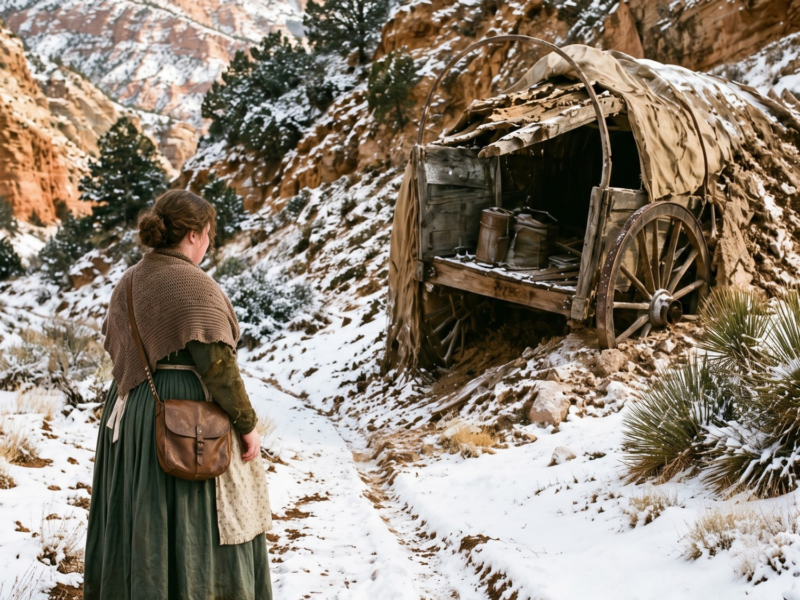
They Left Her in the Snow to Die—She Uncovered a 90-Year-Old Secret Buried Forever
The First Freeze
The last week of October arrived with the cold settling in, not gradually, but with the decisiveness of a door closing. The temperature at night dropped to single digits. The creek was no longer skimming ice at its edges; it was freezing to its bed in the shallows.
The grass on the hillside went from gold to the particular gray-brown of things that have finished their season and are waiting for the next.
Marin moved her supplies into the front section of the dugout. First, the ten-foot portion she had partitioned from the main animal space with a hanging blanket and a timber frame. Her bedroll, her cook-fire materials, her food stores, her tools.
The space was tight, honest, and entirely sufficient. The air inside smelled of packed earth, of the clay mortar on the chimney, of the dry grass in the drainage trenches—a smell that was not unpleasant, that had the quality of something old, patient, and entirely indifferent to human opinion.
She tested the ventilation one more time before bringing the animals in. The draft through the door crack was consistent: cool, dry air moving inward at the bottom of the door gap while the chimney pulled warm air up from the interior. The system was in equilibrium.
She brought the sheep in on the twenty-ninth of October.
They did not want to go. This was predictable; animals accustomed to open air and natural light were not naturally drawn toward a dark opening in the earth, regardless of what waited on the other side of it.
The lead ewe—a large, gray-faced animal Marin had named in her own mind as Margaret after no one in particular—stood at the entrance for a full two minutes, head lowered, nostrils working. The other twenty-one animals clustered behind her with the compressed energy of a group waiting on a decision.
Marin had a small amount of grain saved carefully from the trading post purchase for exactly this moment. She placed a handful just inside the entrance, stepped back, and waited.
Margaret moved forward. Once the lead ewe crossed the threshold, the others followed with the chain-reaction compliance that was sheep’s most useful characteristic.
Within ten minutes, all twenty-two were inside. Their bodies filled the main space with a warmth that was immediately physically palpable to Marin standing at the entrance.
She checked the ventilation shaft. The draft was unchanged. The added heat from twenty-two animal bodies was increasing the differential, which was increasing the flow, which was exactly what the design intended. More heat produced more ventilation, which produced more fresh air, which allowed the heat to remain beneficial rather than becoming toxic. The system was self-regulating in the way of good designs—not requiring adjustment, simply responding to conditions.
She pulled the heavy plank door closed, dropped the bar into its iron brackets, stood in the dark for a moment, listening to the sounds the animals made as they settled into the new space: the shifting of hooves on the dry grass, the steady, quiet sound of rumination, beginning as the first use lay down the collective exhalation of twenty-two warm bodies in an enclosed space that she now understood in her body as well as her mind: genuinely warm.
The thermometer she had borrowed from Constance Faber—the only interaction with that woman she had sought since her departure—read forty-one degrees Fahrenheit inside the dugout at sunset. The outside air was reading seventeen.
The difference was not a miracle; it was arithmetic.
Act IV: The Test of the Stone
Chapter 11: The Second Test
The sky two days later took on a color that was not weather, but warning.
The northwest horizon went the flat gray of hammered lead. The smoke from Marin’s small exterior cook-fire, made in the morning before she moved fully inside, refused to rise, hanging at knee height and drifting downhill in a way that meant the atmospheric pressure had dropped to a point where the air itself was declining to carry things upward.
The birds that had been present on the slope every day of her work were gone. The creek, what she could see of it from the entrance, had stopped moving entirely.
She had filled every container she owned with water the previous day. She had brought in the last of the exterior firewood. She had filled the small storage space behind the partition.
She had done everything that could be done in the order it needed to be done, without excess and without omission.
She brought herself inside. She barred the door. The first sound the blizzard made was the sound of something very large becoming certain of itself.
A low-frequency vibration that was less heard than felt, building over the course of an hour from absence to presence to the sense that the air outside had become a substance with intentions. Then the wind reached its full register, and the sound was not wind anymore, but pressure: a continuous roar that had the quality of something that had traveled a great distance and had finally arrived at the place it was always going.
Inside the hill, Marin listened.
The sound came to her through forty feet of packed earth and two feet of living sod as a low, muted vibration—present, identifiable, entirely stripped of its power to terrify. She could hear what it was; she could not feel what it was doing.
The temperature inside had risen to forty-four degrees as the storm drove the outside temperature down, widening the differential between earth warmth and outside cold. Working in her feverish preparation, the dugout’s thermal mass now acted as she had designed it to act: not fighting the cold, simply refusing to acknowledge it.
She sat in her small partitioned space with the tallow lamp burning, listening to the muffled voice of the worst thing Wyoming could produce, and understood in her body the thing her grandfather had spent his life trying to articulate: that the land was not the enemy. The land had never been the enemy. The land was the oldest, most patient, most reliable ally available to anyone willing to learn its language.
She had learned it. She was here. The storm had not reached her.









