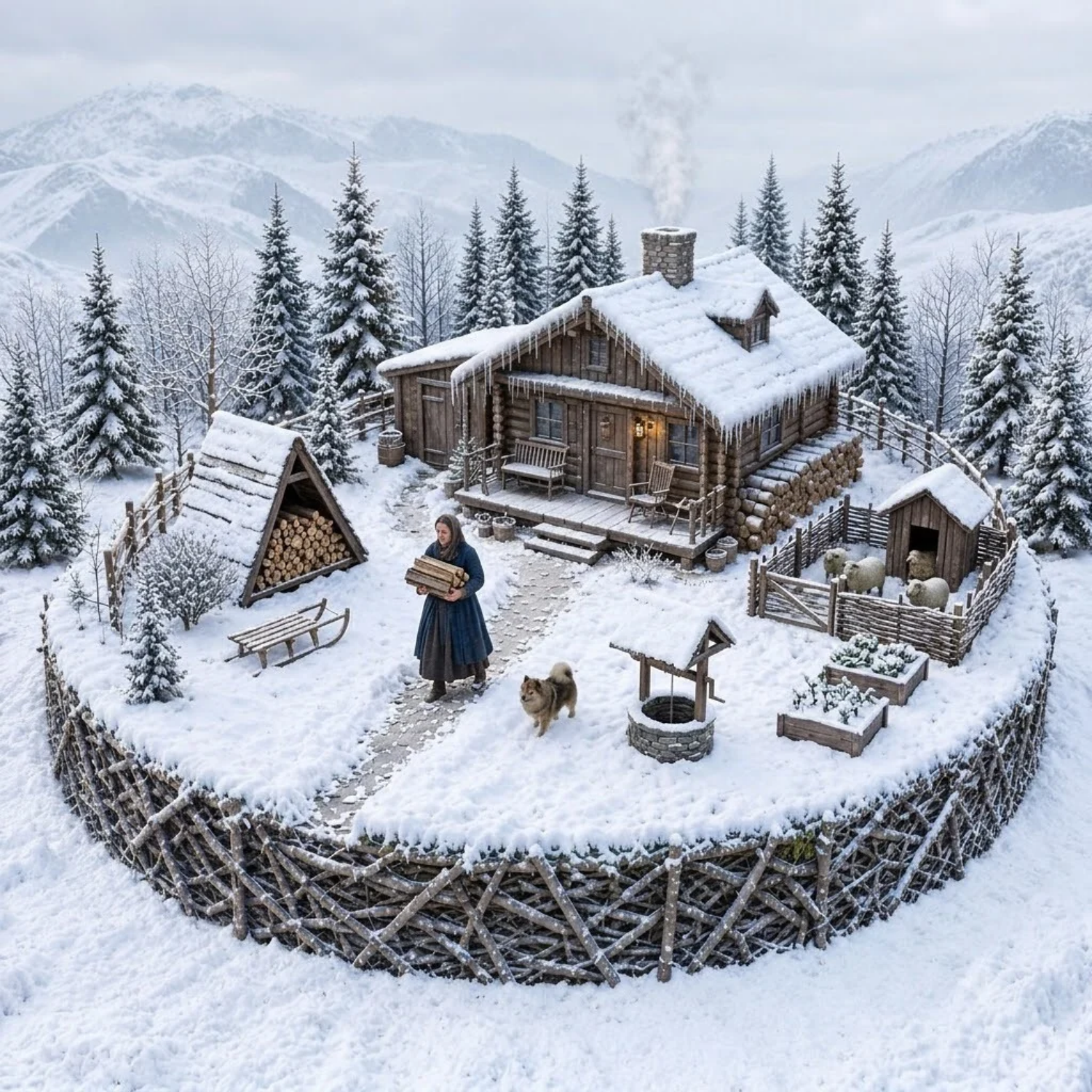
They Mocked Her for Planting Trees Around Her Cabin—Until the Harshest Winter Came
The Silence After Thomas
Three springs earlier, Eleanor Hayes had been thirty-eight years old, standing in the wreckage of a life she had never expected to navigate alone.
Her husband, Thomas, had just died during a fierce winter blow, leaving her with everything she had never wanted to own by herself: a rough, drafty cabin, a few acres of tired, stubborn land, one patient brown mare, a small purse of savings, and the crushing silence left behind in the empty rooms.
Thomas had perished less than three miles from the front door. One afternoon, a handful of cattle had broken through a weak section of the pasture fence and bolted toward the open flats to the west. Thomas had saddled his horse before dark, refusing to wait for morning. He had smiled, pulled his heavy coat tight, and promised he would be back before supper.
He never came back. Searchers found him the next morning, huddled near an abandoned haystack, frozen solid.
For months afterward, people in town assumed Eleanor remembered finding his body most clearly. They were wrong. What she remembered was the wind.
That night, while Thomas was somewhere out on the freezing plains beyond the reach of her lantern light, the wind had assaulted the cabin with terrifying regularity. It traveled across miles of uninterrupted land with nothing to slow it down, slamming into the west wall, hissing through every drying log-crack, and pulling the heat out faster than the iron stove could ever generate it. Eleanor had fed wood into the fire until her hands shook with exhaustion, but the room grew steadily colder. By dawn, thick frost had bloomed on the inside of the window frames.
After Thomas was buried, the neighbors came by with well-meaning advice. They told her to sell. They said a widow living alone had no business trying to hold onto land so exposed to the elements. They suggested she move closer to town, rent a small room, and take in laundry or work the hotel kitchen.
Eleanor said no. Not because she thought the cabin was safe—she knew it was a death trap—but because the land was the last physical thing she and Thomas had built together. She refused to surrender it just because winter had taken him.
Spring came late that year, dragging its feet through mud and slush. When the ground finally softened, Eleanor walked her property line with a shovel resting on one shoulder, knowing with a cold certainty that another winter was already marching toward her.
Her roof needed heavy repairs. Some logs in the walls had shrunk further, leaving wide, whistling gaps. Her pile of firewood was dangerously small, and her savings were nearly exhausted. She realized with sudden clarity that she could spend the entire summer cutting more wood, burning more fuel, and chinking more cracks, only to face the exact same terrifying problem when the wind returned.
More fire, she realized, would only mean feeding a losing battle.
She didn’t just need a bigger fire. She needed to change what happened to the wind before it ever reached her walls.