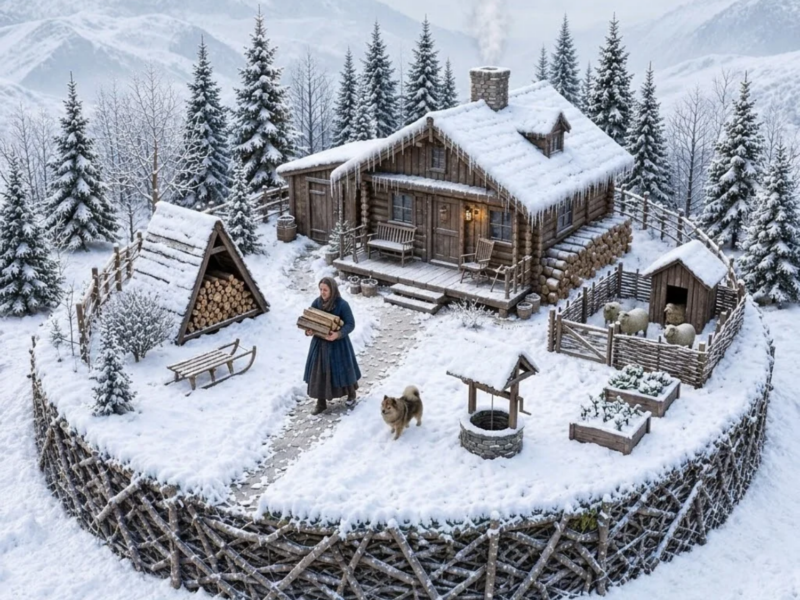
They Mocked Her for Planting Trees Around Her Cabin—Until the Harshest Winter Came
The Night the Wind Broke
The first big freeze arrived silently, locking the ground in iron. Then, the wind turned and blew straight out of the northwest.
By evening, heavy, bruised clouds swallowed the mountain peaks. The snow started as fine, biting grains, turning by midnight into a howling whiteout unlike anything the valley had seen in a generation. In town, a stable roof lost half its shingles; a heavy barn door tore off its iron tracks and vanished into the dark; families panicked, stuffing spare quilts and wool blankets into their window frames to keep the glass from imploding.
At Eleanor’s cabin, the outer trees shook violently under the initial impact. Branches snapped with sharp, cracking echoes, and blinding sheets of snow swirled furiously between the trunks.
Yet, every single row of trees was absorbing the wind’s energy.
The first ragged row took the full brunt of the gale, shattering its primary force. The second row broke the remaining streams into smaller eddies. The inner rows slowed down whatever kinetic energy managed to survive the gauntlet.
By the time the air reached the cabin walls, it was bitterly cold, but it flowed past like a gentle river rather than a battering ram. The iron stove held its heat for hours longer than in previous years. The log walls did not groan and shriek. Instead of burying the cabin doors, the blowing snow settled peacefully in long, deep drifts between the outer rows of trees.
On the second night, the storm intensified, screaming at a pitch that rattled teeth.
Eleanor heard a sharp crack louder than any thunder. Throwing a heavy coat over her shoulders, she cracked the front door open. A massive cedar in the front row had snapped under the weight of the ice and wind.
For one terrifying heartbeat, she thought her entire defense was collapsing. But as she watched, the wind rushed through the new gap—only to smash directly into the second and third rows behind it. The localized failure did not cascade into total disaster.
That was why a single row had never been enough. The defense was layered, redundant, and deep.
Shortly before sunrise on the third day, someone hammered frantically on her door.
Eleanor threw it open to find Daniel and Sarah Mercer standing there, their two small children wrapped in frozen blankets. Part of their homestead roof had been ripped away into the night, and their firewood stash was entirely buried under five feet of packed drift.
Eleanor pulled them inside into the stable warmth.
That afternoon, Caleb Morris arrived, his beard a mask of frost and blood staining one leather glove. Part of his cattle barn had collapsed inward, and he had spent hours fighting to drag his terrified livestock out before the freezing drifts buried them alive. He could no longer keep his own family’s rooms above freezing.
He didn’t mention the trees. Eleanor didn’t mention his past jokes. She handed him a hot mug of coffee.
By evening, seven people were crowded into the small cabin. By the next day, there were eleven.
They slept wherever they could find space—on the floor, on benches, wrapped in spare blankets. They shared their meager rations, took turns feeding the iron stove, and listened in awed silence as the monstrous storm raged outside the earthen walls.
For the first time, the people huddled inside understood what Eleanor had been building out there in the dirt. It wasn’t landscaping. It wasn’t firewood.
It was time. Every foot those trees had grown over three brutal summers now stood as a physical barrier between their fragile lives and the unyielding fury of the sky.









