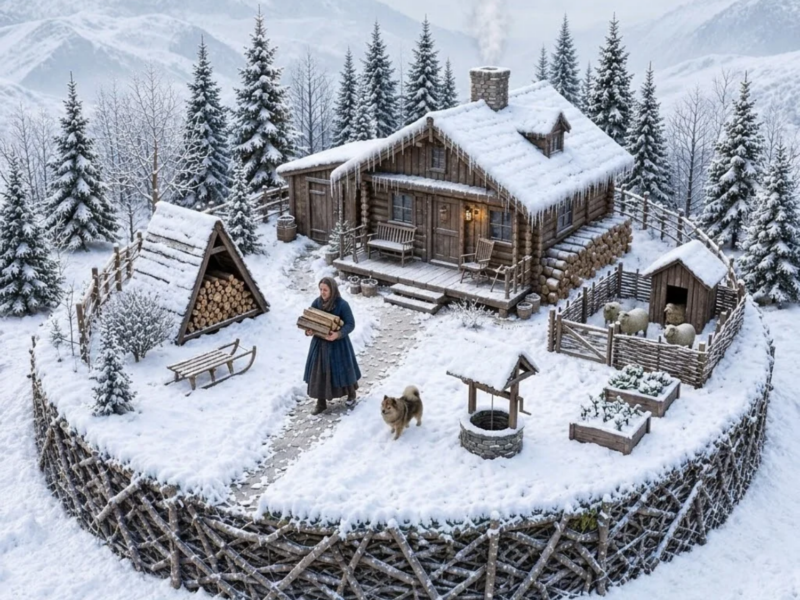
They Mocked Her for Planting Trees Around Her Cabin—Until the Harshest Winter Came
The Green Shield Catches the Wind
In the second spring, Eleanor adjusted her strategy based on hard observation.
She studied which varieties of trees had survived the summer’s drought and the winter’s freeze, and planted more of those. She widened the gaps where snow had drifted too heavily, and plugged the holes where the wind had blown clean through unchecked. She stopped searching for a theoretical perfection and focused entirely on what the land showed her. Where did the snow land? Where did the branches bend? Where did the frost linger the longest?
By the second winter, the tallest rows had surpassed her shoulders.
During the first major northwest gale of that season, she pulled a woolen scarf across her face and walked out from the open field toward her cabin to test the invisible architecture.
At the outermost row, the wind still hit with savage force. But as she stepped between the first and second rows, the pressure dropped noticeably. Behind the third row, the air felt choppy, slowed, and disorganized. By the time she reached the cabin wall, the wind was still freezing, but its killing momentum was gone.
That night, she burned perceptibly less wood. It wasn’t a miracle, but it was undeniable proof.
Still, the town didn’t care. To them, Eleanor was simply a lonely woman spending years watering sticks while the rest of the county focused on survival and livestock.
By the third summer, the jokes grew harsher. The trees were consuming land that could have been used for a larger vegetable garden, chicken coops, or grazing space for cattle. They hadn’t generated a single penny of income. They demanded constant pruning, watering, and protection.
A ranch hand leaning against the rail outside the mercantile spat into the dust and sneered, “Three years of growing firewood she won’t live long enough to burn.” The men around him chuckled.
Eleanor simply drove her shovel back into the dirt and kept working. She no longer needed them to understand.
By late autumn, the trees had transformed into something formidable. The outer rows were thick, gnarled, and chaotic, forming a broken green-and-brown barrier across the windward side of her property. Behind them, younger rows rose in tiered steps. Most importantly, the soil between the rows had changed; protected from the scouring wind, the native grass grew thicker and richer than anywhere else on the flat.
Then, nature issued its own warning.
Birds began migrating south weeks earlier than usual. Mule deer drifted down from the high mountain timber long before the first flakes fell. Old Isaac Bell, who had survived more winters than anyone else in the valley, leaned against the store porch one gray afternoon and spat out a grim prediction: “This one’s got teeth.”
Most people laughed it off, as they always did. Eleanor didn’t laugh.
She stacked every stick of firewood under heavy canvas, chinked every gap in her log walls with fresh moss and thick clay, dried venison, filled sacks with beans and flour, and walked every single row of her living windbreak to inspect the branches. She still didn’t know if her three-year experiment would hold against a historic gale. Three years was nothing in the life of a forest.
If the storm was bad enough, it would expose every miscalculation she had ever made.









