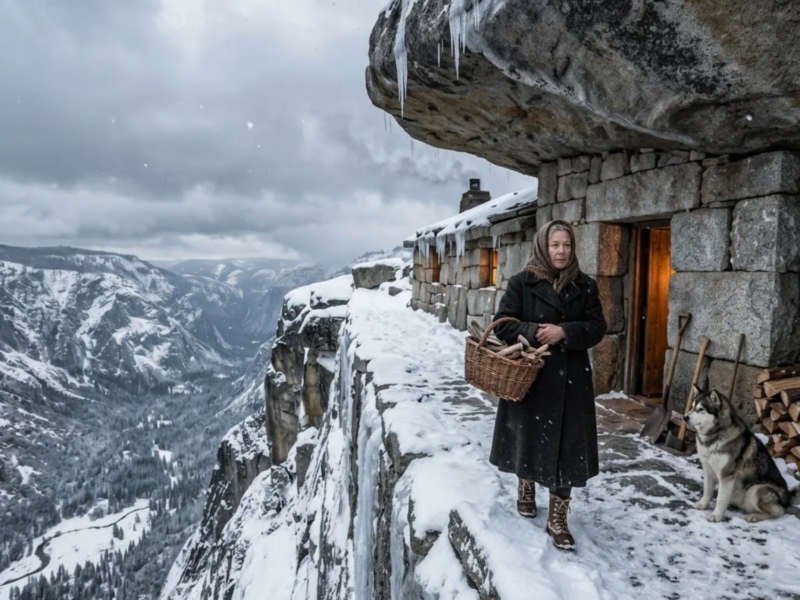
They Mocked Her Hidden Mountain Shelter—Then the Coldest Winter on Record Proved Her Right
The Ghost of Michael Ravenhill
Silas Redfern found her at her work on the twenty-third day of October. He reined in his bay gelding at the edge of the shelf, sitting in the saddle for a full ten minutes before uttering a word.
Silas was a company man drawing wages from the old Rocky Mountain fur outfit, a relic of an era when the beaver market had still reigned supreme. He had known Mabe for fifteen years, ever since he was a green kid stumbling into her camp during a deadly blizzard, saved by her silent, uncomplaining hospitality. He owed her his life, and he had ridden four days out of his way to check on her before the high passes locked shut.
“You’re going to freeze to death up here, Mabe,” Silas called out, his breath pluming white in the biting air.
Mabe didn’t look up. She set a flat piece of granite into the mortar, tapped it twice with her wooden mallet, and reached for another stone from the pile she had hauled up from the scree slope six hundred feet below.
“I’ve seen the beavers, Mabe. I’ve seen the horses,” Silas pressed on, his buffalo robe pulled tight against the wind. “Even the mosquitoes cleared out early. This isn’t a normal winter. Come down with us to the Green River camp. There’s room, there’s company, and a stove that draws proper. You don’t have to prove anything to anyone anymore.”
Mabe finally paused. She laid her mallet across her knee, looking up with gray eyes so utterly still that Silas felt a chill worse than the wind.
“This is good enough for me, Silas,” she said softly.
He shook his head, turned his horse, and rode back down the narrow trail. Halfway down, he stopped and looked back one last time. Her small, resolute figure against that half-built wall on the face of a cliff at 8,000 feet remained burned into his memory. He would tell the story in barrooms across three territories for the rest of his life, always ending with the conviction that he had watched a woman walk willingly into her own grave. He would be wrong, but it would be a long time before anyone could tell him so.
Mabe watched him disappear without a shred of resentment. She understood his fear; it was just another facet of the weather. But Silas and his kind only knew how to build green-log cabins chinked with moss, hanging a canvas across the door and praying the fire held. Most winters, that sufficed. This winter would not.
As she pressed a sandstone slab into place, her mind drifted backward across the decades, recalling the strange, winding path that had brought her to this lonely ledge.
She had been born in the parish of Kilmer, west of Inverness, in the winter of 1839—the only surviving child of a village blacksmith and an educated woman who could read four languages. Her mother had taught her the alphabet by tracing letters onto her small palm by the peat fire. But the Highland famine took her mother in 1851 when Mabe was twelve, and her father broke inside, drinking the smithy into total ruin over the next six years.
When they finally booked passage for America in 1858, it was nineteen-year-old Mabe who packed their trunk and led him down to the Glasgow docks. Her father lasted less than a year in Boston before consumption finished him off. Mabe buried him in a pauper’s plot, finding herself twenty years old, alone in a foreign land with a scholar’s mind trapped in a frame too frail for factory looms.
After two years coughing cotton lint in the Lowell mills, Mabe made a desperate, silent decision. She cut her hair short, bound her chest in unbleached muslin, bought men’s work clothes from a rag shop, and boarded a train west under the name Michael Ravenhill.
For seven months, she worked on Union Pacific survey crews across the Nebraska grasslands, swinging a heavy iron mall, learning to spit and swear, and discovering that a person could entirely vanish if they wore the right disguise. By late 1861, the mountains called to her. An old Irish crew boss named Howerin had guessed her secret within a week, kept his silence, and pressed forty dollars into her palm on her final day, telling her to learn from the trappers.
She rode out the next morning with a muzzle-loading rifle and forty dollars sewn into her coat lining. For twenty-five years, she had lived on the razor’s edge of the wilderness, shedding the muslin bindings for a wool shirt, earning the respect of the mountains and the Crow people, who called her The Stonewoman.









