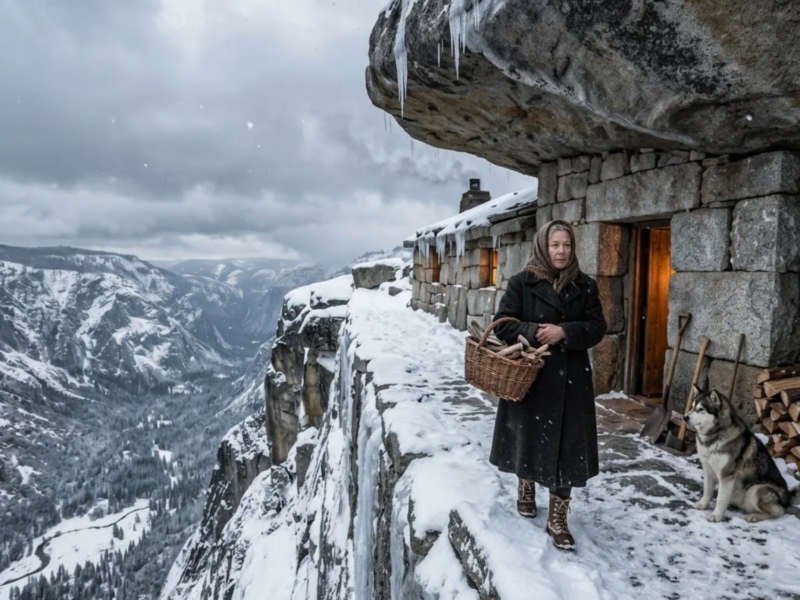
They Mocked Her Hidden Mountain Shelter—Then the Coldest Winter on Record Proved Her Right
The Verdict of Spring
The thaw finally arrived in April, slow and muddy, carrying the stench of swollen rivers and thousands of perished cattle down in the lowlands.
When the mountain passes opened enough to travel, Mabe and Josiah packed light and rode down to Fort Ashcroft. The frontier trading post was in a state of mourning; the open-range cattle industry across the northern plains had been virtually wiped out by the winter, with legendary spreads losing upwards of ninety percent of their herds.
At the post, Mabe immediately sat down and penned a detailed, carefully worded letter to her old lawyer friend, Marston, in Cheyenne, detailing the systemic fraud against Josiah.
While she wrote, Josiah reconnected with Etienne Beaumont, the aging Metis trapper who had taught Mabe the masonry secret years ago. Beaumont looked at Mabe with profound, weary respect when he heard how the shelter had performed.
“It is always the mass,” Beaumont told her, his eyes twinkling. “They won’t understand it down here. They’ll build their green-log cabins again in the spring, and ten years from now, another winter will kill them. But you… you did what your grandmothers did before there were books. You are the only one who listened.”
It took six months of legal maneuvering, but true to his word, lawyer Marston unraveled the brother-in-law’s corrupt land grab in Cheyenne. The warrant against Josiah was officially dropped, his stolen property restored, and his sister Rebecca was successfully relocated to a dry, healing climate in Arizona.
Josiah returned to the Bitterroot Range in November, bringing his restored life and a profound, permanent gratitude. He wintered with Mabe again that year, mastering the trap lines, reading the weather, and honoring the sacred rules of the cliff shelter.
Mabe Ravenhill stayed on her mountain for three more winters, continuously improving the fortress by adding interior insulating dead-air spaces and stone shelving. When a knee injury sustained from breaking through river ice in 1889 finally limited her physical mobility at age fifty, she made a calm, rational exit.
She passed the cliff shelter down to Josiah—with the strict, unyielding condition that he never sell it, and that he pass the knowledge of its construction on to someone worthy. Josiah kept the shelter until his passing in 1905, after which it was handed down through a young Crow trapper named Bay Titish.
Mabe moved down to Bozeman, opening a small provision and book shop on a quiet side street, spending her remaining years teaching reading and practical skills to young women. She never married, preferring the vast, honest companionship of the mountains she had conquered.
When she passed away in November of 1905 at the age of sixty-six, her simple gravestone on the East Ridge bore the exact epitaph she had requested in her final letters:
Mabe Ravenhill — Stonewoman of the Bitterroots.
Today, the cliff shelter still stands on its limestone ledge at 8,000 feet. The masonry wall she raised across its mouth has not dropped a single stone in over a century. Modern structural engineers studying the site have marveled at her primitive mortar, noting that its compressive strength actually increased over time, outperforming modern lime cements under extreme freeze-thaw cycles.
Wildlife biologists measuring interior winter temperatures have confirmed that Awe Bakp consistently runs fifteen to twenty-five degrees warmer than the freezing gale outside, operating precisely as Mabe designed it.
She didn’t survive the brutal winter of 1886 because she was physically stronger than the men who perished. She survived because she possessed the one virtue the frontier routinely punished: the humility to listen to the land.
While others fought the elements with brute force, Mabe Ravenhill worked with them, laying stone upon stone until the mountain itself adopted her as one of its own.









