They Tried to Take Her Ranch—Then She Found 12 Hidden Stairs Behind the Cellar Wall
THE FOUNDATION HOLDS
The lawsuit was formally withdrawn the next morning.
In the office of Coleman Ree, with Ada Fenomore and Orin Pile standing as witnesses, Margarite Ashcom Dell signed a formal quitclaim, acknowledging that the Hollow Marsh property belonged entirely to Wifred Ashcom, as the lawful heir to the trust of Ruth Mero.
That afternoon, Winnie walked into Elias Thorncastle’s bank and laid four hundred and twenty dollars on the ledger.
Thorncastle stamped the note PAID IN FULL, his spare face softening into a rare, genuine smile. “Your father wouldn’t have believed a word of this, Winnie. But he would have been exceedingly proud to be wrong.”
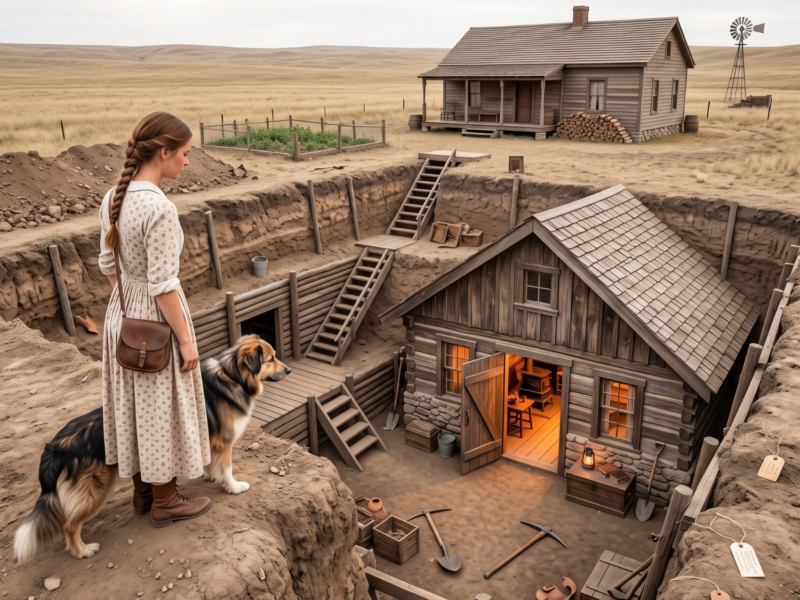
Margarite stayed at the ranch for a week. On her final evening, Winnie took her down the twelve wooden treads into the hidden room. The stove was ticking warmly. The books lined the shelves.
Margarite sat in the single chair, running a frail hand over the smooth plank table. “She built this alone,” the old woman whispered. “She was hiding from the world, but she left the door unlocked for whoever came after.”
Margarite pulled a thin, worn silver ring from her finger and pressed it into Winnie’s palm. “The land was never mine to give you. But someone in this family should have something that is honestly hers to keep.”
When spring finally broke over the Hollow Marsh, the ice shattered on the creek, and the cottonwoods burst into vibrant, violent green.
Winnie did not board up the cellar.
Instead, with Ada Fenomore’s help, she carried the old school desks from the boarded-up town building and placed them in the drylaid stone room. The valley’s children, including the young immigrant boy she had saved from the storm, came up the track every morning. They learned their letters and their sums in the exact same room, at the exact same table, where their grandparents had learned them forty years ago.
On a quiet evening in May, after the children had gone home, Winnie sat alone at the plank table.
She laid two objects side by side in the lamplight.
One was Prudence Vain’s brass-bound boxwood folding rule. The tool that had taught her to look behind the paint, to find the true weight-bearing beam in any structure, and in any lie.
The other was Ruth Mero’s smooth riverstone.
Winnie traced the worn boxwood, listening to the absolute silence of the stone walls. Her grandfather had built a house on a lie, and her father had died trying to maintain it. But Winnie had done what they could not. She had taken a wrecking bar to the false walls of her own history, and found a foundation made of solid truth.
It was, just as the widow had promised, a room quiet enough to think in, and strong enough to keep.









