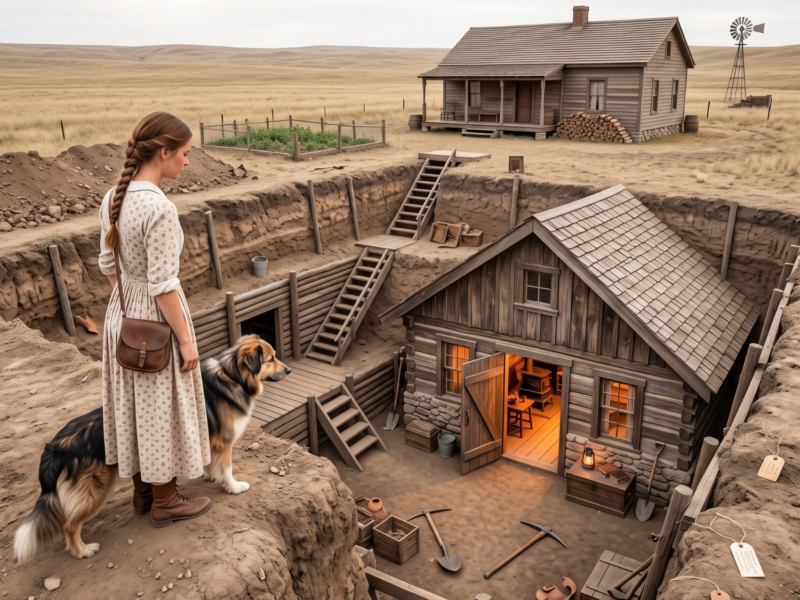
They Tried to Take Her Ranch—Then She Found 12 Hidden Stairs Behind the Cellar Wall
THE LAWYER IN THE SNOW
The county records office sat behind the feed store in town, smelling of dust and dried tobacco. Coleman Ree, the spare, careful clerk, looked up as Winnie walked in. The frost had silvered the hem of her white dress, and her father’s oversized coat hung heavily on her shoulders.
Without a word, she unfolded the 1849 oilcloth deed and laid it over his open ledger.
Ree’s eyes scanned the faded ink. He lifted it to the window, inspecting the territorial stamp. His weary face went pale. “Where did you get this, Winnie?”
“Under the potatoes,” she said flatly. “In a room that hasn’t seen light since the winter of fifty-two.”
Ree set the parchment down as if it were a live rattlesnake. “Your aunt filed a notice of intent to quiet title yesterday. She isn’t just calling your note; she’s preparing a lawsuit to seize the land entirely, claiming her father was cheated out of it by your grandfather. If I record this widow’s deed…” He swallowed hard. “It doesn’t just invalidate her claim. It invalidates yours. It means your grandfather was a squatter.”
“Record it,” Winnie ordered, her jaw set. Prudence Vain, the fierce widow who had taught Winnie carpentry, had drilled one rule into her head: The truth is the only structure that never needs shoring.
Ree copied the deed into the county book, his pen scratching loudly in the quiet room. “You’ve dug up a stick of powder, girl. Carry it carefully.”
Winnie rode back to the ranch under a bruised, iron-colored sky. But as she crested the rise above the marsh, she pulled her mare, June, to a halt.
A hired buggy from the town livery was parked in her front yard.
Standing on her porch, smoking a thin cigar, was a man in a tailored city coat and a hard bowler hat. He smiled as she approached, exuding the unhurried confidence of a predator.
“Miss Ashcom,” he said, tipping his hat. “Horus Kettle. Attorney at law, out of Laramie. I represent your aunt.”
Winnie didn’t dismount. “You’re trespassing, Mr. Kettle.”
“I prefer to think of it as an early inspection of my client’s future property,” Kettle said smoothly. He pulled a leather wallet from his coat and laid a stack of crisp banknotes on the porch rail. “Three hundred dollars, cash. My client is prepared to be generous. Sign a quitclaim, pack your bags, and you can start a new life somewhere warmer.”
Winnie looked at the money, then at the man. “Three hundred dollars wouldn’t cover the note she just bought. You’re trying to buy me cheap before a judge sees what I filed this morning.”
Kettle’s smile vanished. The smooth veneer cracked, revealing cold, calculating malice. “I know about the paper you took to the clerk, Winnie. A dead widow’s deed found by a desperate girl in a basement? A judge will call it a forgery. Twelve men in a jury box will laugh you out of the territory. Take the money.”
“A man doesn’t drive a buggy through the snow to warn a girl off a paper that won’t hold,” Winnie said, her fingers tightening on the reins. “He rides because it will. Get off my porch.”
Kettle picked up the money, his eyes dead and flat. “Memories are unreliable things, Miss Ashcom. And papers found in cellars go missing just as easily. Sleep lightly.”









