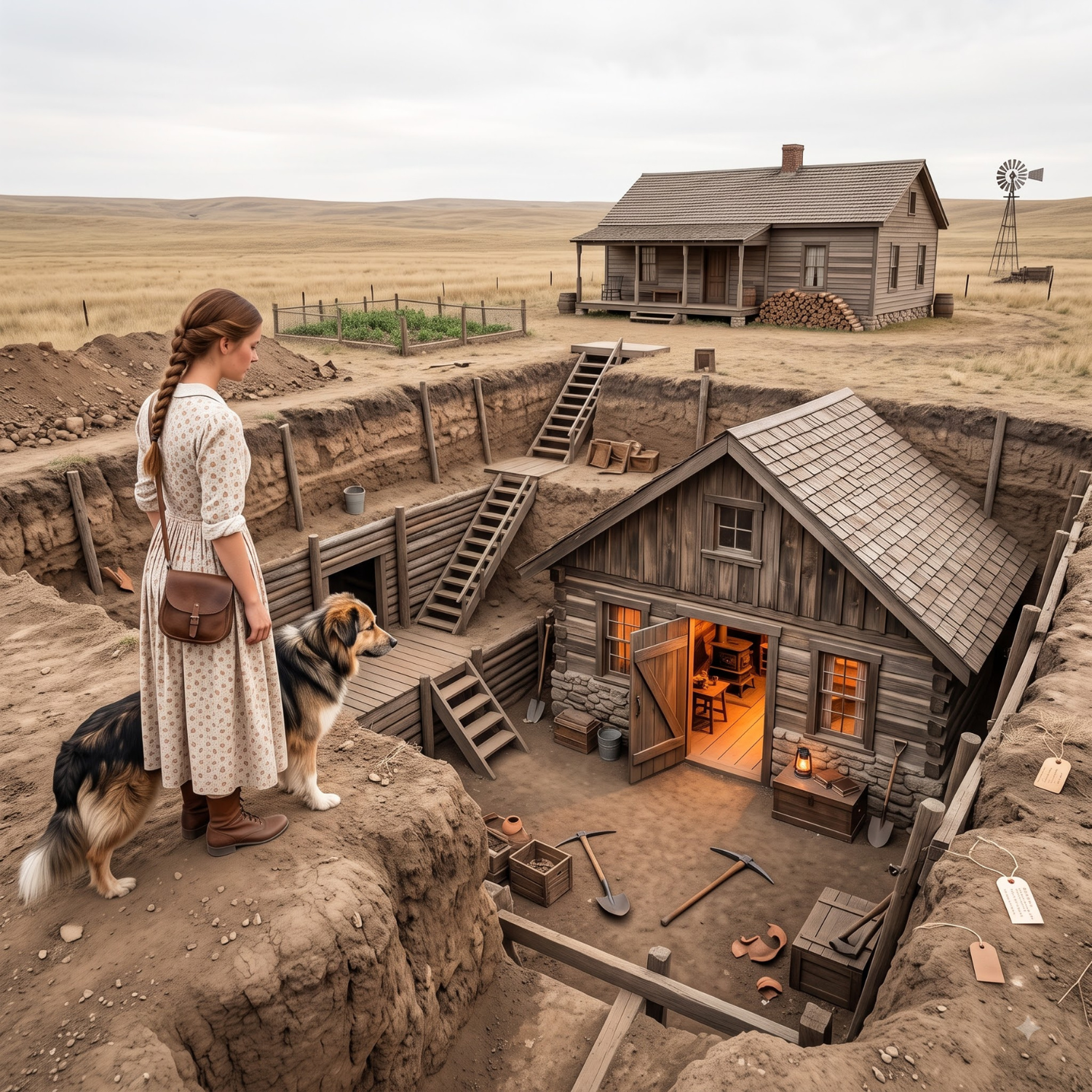
They Tried to Take Her Ranch—Then She Found 12 Hidden Stairs Behind the Cellar Wall
THE BREATH OF THE MOUNTAIN
The wood was cool, but it was not the cool of packed earth.
Nineteen-year-old Wifred “Winnie” Ashcom pressed her bare palm against the red-brown boarding in the deepest corner of the root cellar. Her father had sworn these planks only held back the spilling hillside, and his father had sworn it before him. But as Winnie slid the brass edge of a folding boxwood rule along the timber, the dimensions—thirty-two inches wide, sixty-one inches tall—told a different story. Dirt did not require perfect right angles.
She wedged the flat edge of a wrecking bar beneath the lowest plank and leaned her weight into the iron. The old nails shrieked, a dry, protesting sound that echoed off the drylaid fieldstone.
Behind the freed board, there was no soil.
Winnie raised her kerosene lantern. The glass chimney chattered faintly against the wire guard as her hand trembled. Where a hillside should have been, a narrow doorway framed in silver-gray timber opened into pitch blackness.
A breath of air exhaled from the void, brushing her face. It was dry and faintly sweet, carrying the scent of cold woodsmoke and the distinct, brittle perfume of paper kept out of the damp for decades.
She pried the second board loose, then the third. She set her boot on the first wooden tread of a descending stair. The dark below waited with absolute stillness.
Winnie descended twelve steps, her breath pluming in the chill, until her boots hit a smooth plank floor. She raised the lantern high.
It was a room, fourteen feet square. A small iron stove sat against the north wall, its pipe vanishing into a sealed flue. A built-in bedstead occupied the west wall, its straw tick gray with age. On a rough-hewn table in the center lay a small stack of leather-bound books, an oilcloth pouch, and a sealed envelope weighed down by a smooth riverstone.
Winnie crossed to the table. Across the envelope, faded brown ink sloped in an elegant, archaic hand: For whoever finds this.
She broke the brittle wax. Inside was a letter, a heavy rawhide pouch that clinked with the distinct, dense sound of gold coin, and a document stamped with a territorial seal. She unfolded the stiff parchment.
It was a deed to the Hollow Marsh property, dated 1849.
It did not bear her grandfather’s name. It belonged to a woman named Ruth Mero. And the date proved that this room, and the ground above it, belonged to a stranger long before the first Ashcom ever swung an axe in this valley.
Footsteps thumped on the floorboards directly above her head.
Winnie froze, extinguishing the lantern in one frantic, sweeping motion. She stood in the suffocating dark, her heart hammering against her ribs, clutching a deed that had just rewritten the history of her family. Someone had just walked into her empty house.