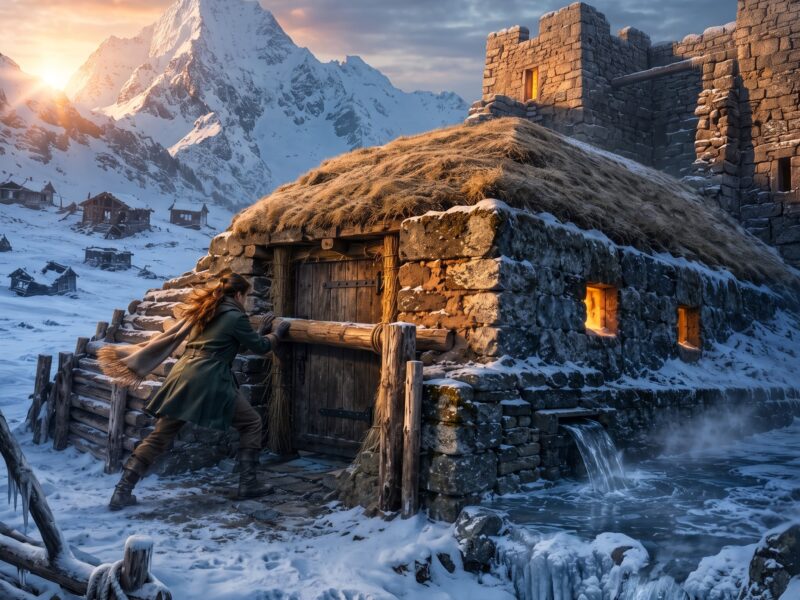
Thrown Out With Her Children, She Found an Abandoned Ice House — Then Winter Made It Unbeatable
Spring and Stone
When the historic storm finally broke on the fifth day, the retreating clouds revealed a world entirely transformed. It was a landscape of blinding, crystalline beauty, and profound, devastating destruction.
The town of Blackwood was crippled. Dozens of modern homes were completely unlivable, their plumbing systems destroyed by expanding ice, their drywall ruined, their structures damaged by the invasive cold.
But the story of what had happened out at the old ice house spread like a brushfire. It was told in hushed, awestruck tones by the shivering crowds gathered at the emergency shelters in the school gym.
The woman they had all called crazy had sheltered a dozen people in her “tomb” through the worst storm in a century. The structure they had mocked as a primitive relic had been the only one in the county to effortlessly withstand the full, terrifying fury of the winter without electricity.
As the roads were finally cleared, people began to make the trek up the snow-filled lane. They didn’t come to gawk or mock. They came to see. They came with serious questions, their own unshakeable certainties about modern construction and survival shaken to the very core.
Ara, holding Anders Nilson’s weathered leather-bound journal in her hands, would stand by her heavy arched door and explain.
She spoke of the earth not as a thing to be paved over, but as a blanket. She explained the concept of thermal mass, teaching them how the heavy stone walls acted exactly like a battery, charging with heat and releasing it slowly. She showed them the simple, incredibly clever ventilation system that kept the air fresh and breathable without creating heat-stealing drafts.
She was not gloating. She was teaching. She was passing on the lost, vital knowledge that had been entrusted to her across a century of silence. She was sharing the absolute secret of resilience—not just for a house, but for an entire community.
And they listened. They listened not to an outcast, but to a leader. A woman who possessed a deep, grounding wisdom they had forgotten they desperately needed.
Marcus was ruined. The physical damage to his massive, expensive home was catastrophic, but the damage to his reputation was worse. In a frontier town built on neighborly trust and mutual aid, his callous, greedy treatment of his brother’s widow became an unforgivable stain once the town saw what he had forced her into. Facing social exile, he was forced to sell the family home at a massive loss to cover his mounting debts, and he left town quietly in disgrace.
Mr. Abernathy, however, underwent a completely different kind of transformation.
Deeply humbled and intellectually awakened by his brush with freezing death, the building inspector became Ara’s most fervent, vocal advocate. He petitioned the town council, but he did not use his old, rigid code books. He used Anders Nilson’s journal.
He argued passionately for sweeping new building ordinances—codes that actively encouraged, rather than prohibited, the principles of earth-sheltered, passive design and thermal mass.
The stone structure was officially, permanently removed from the condemnation list with a stamp of approval. It was never again called “Ara’s Folly.” The townspeople, in a collective gesture of deep respect, began calling it The Hearthstone. It was a name that spoke of its incredible warmth, and its central, undeniable importance to their survival.
Ara, the dispossessed widow who had arrived with nothing, was officially offered a position as a paid consultant for the county’s new resilient building initiative.
A year later, spring had returned in full force to the valley.
The broken trees and scars of the great storm were still visible, but there were also profound signs of a new beginning. All across the county, several families were building new homes. But they were not building flimsy, towering boxes of sticks and vinyl siding. They were building sturdy, low-profile structures nestled deeply into the protective hillsides, their designs heavily inspired by the Hearthstone.
Ara stood outside her home. The sun was incredibly warm on her face. The massive sod roof was vibrantly alive, bursting with yellow and purple wildflowers. Leo and Mia were running and chasing butterflies in the green meadow above the quarry. Their bright, unburdened laughter carried easily on the gentle, warm breeze.
She turned and looked at the low, unassuming profile of the stone house. It was now so much a part of the natural land, it seemed to have organically grown there from a seed.
She understood now that this place had saved them from much more than just the cold. It had been a crucible. A place that had tested her, stripped her down to her absolute core of strength, burned away her fear, and then allowed her to rebuild herself from the foundation up.
She had come to this place with absolutely nothing but a pittance born of spite, and a future as bleak and terrifying as a winter sky.
She had found a ruin. And by choosing to listen to it, by honoring its hidden, ancient wisdom, she had built a sanctuary. Not only for her own children, but for an entire community.
The deepest, most profound value, she knew now, is often buried. It is often mistaken for worthlessness, covered in dirt and darkness, waiting patiently across the centuries for a hand desperate enough to dig, and a heart determined enough to rebuild.









