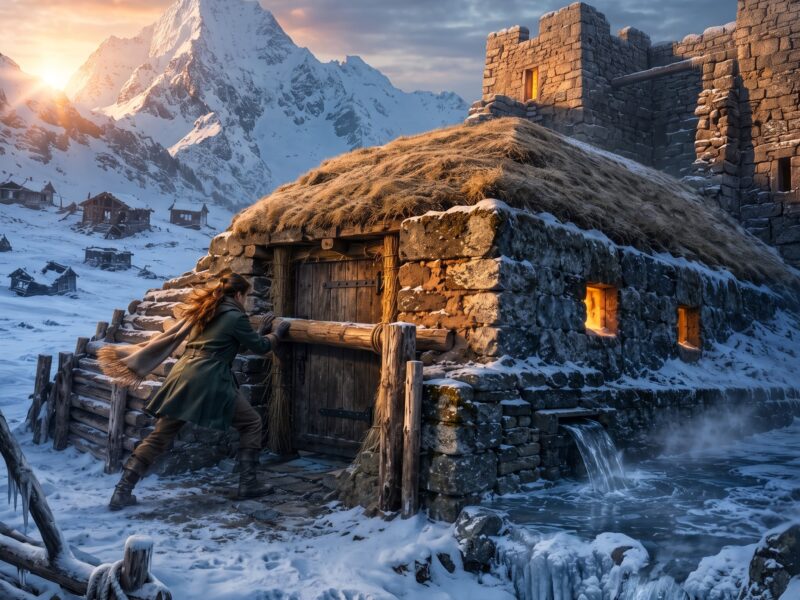
Thrown Out With Her Children, She Found an Abandoned Ice House — Then Winter Made It Unbeatable
The Great White Silence
The whispers from the sky began in early December.
Meteorologists on the crackling AM radio spoke in hushed, grave tones. They used terrifying, historic phrases like polar vortex, century-event cold snap, and bomb cyclone.
A massive, unprecedented mass of Arctic air, they warned, was breaking free from the polar cap and plunging directly south across the plains. It was a frozen tsunami that would shatter century-old temperature records and bring modern life to an absolute, grinding standstill.
People in town chuckled nervously at the grocery store, stocking up on bread, milk, and batteries. Their faith was firmly, blindly placed in their massive central heating systems, their fleets of municipal snow plows, and the steadfast, invisible hum of the electrical grid. They saw the incoming storm as a mere inconvenience—a few days of cozying up indoors watching movies.
They had forgotten the true, ancient face of winter. They had forgotten its raw, unfeeling power to effortlessly break the fragile, complex systems they so arrogantly depended upon.
Ara watched the gray, bruising sky from her doorway and felt absolutely no fear. She felt only a strange, deeply rooted sense of calm. The ultimate test was coming. Her home, her “folly,” was ready.
The storm did not merely arrive. It fell like a hammer.
One moment, the world was gray, cold, and still. The next, it was a blinding, shrieking, violent whiteness.
The wind came first. It was a physical, battering wall of force that tore massive branches from the trees and howled around the hills like a wounded, enraged god. Then came the snow, driven horizontally by fifty-mile-per-hour gusts, so thick and dense it instantly erased the world beyond ten feet.
The temperature plummeted. Ten degrees. Zero. Ten below. Twenty below.
The battery-powered radio, crackling with heavy static before it finally died completely, reported that it was the coldest, most aggressive air mass to hit the region in recorded human history.
Ara stood for a moment in the deep, double-doored entryway of her home—the “cold sink” airlock Anders had brilliantly designed. She opened the outer door an inch and felt the raw, homicidal fury of the storm trying to rip the wood from her grasp. The outer door shuddered violently under the impact of the wind.
But when she forced it closed, and then stepped through and closed the thick, insulated inner door behind her, she stepped into an astonishing, profound stillness.
The deafening roar of the blizzard outside was instantly reduced to a distant, muffled, harmless whisper.
The air inside was incredibly warm, smelling deeply of cured woodsmoke and the fresh bread she was baking on top of the stove. Leo and Mia were lying comfortably on the stone floor, drawing on pieces of scrap cardboard, bathed in the soft, steady, golden glow of an oil lamp. They were wearing light sweaters.
Outside, the arrogant, modern world was dying.
The first thing to go was the power. A great, blinding blue flash lit the distant horizon as a major electrical transformer exploded under the ice load. The scattered, comforting lights of the town miles away winked out instantly, plunging the entire valley into a profound, terrifying darkness, broken only by the swirling, chaotic white of the snow.
With the electricity gone, the massive, expensive furnaces in ninety-nine percent of the homes fell dead silent. The electric pumps that drove their hot water baseboards, and the massive fans that blew their forced warm air, simply ceased to function.
Their superior, code-approved, fiberglass insulation was absolutely no match for the savage, invasive, negative-thirty-degree cold. It was a passive defense, and without active heat generation, it was failing rapidly. The cold seeped through the drywall. Pipes began to freeze and burst within hours.
Inside Ara’s house, her small cast-iron stove was an active, beating heart, pumping out a steady, reliable warmth. It required no electricity, no grid, no municipal pumps. It required only the seasoned oak Silas had brought her, and a match.
The heat radiated from the iron into the massive granite walls, which held it fast—a vast, indestructible reservoir of thermal energy. The temperature inside the stone lung did not waver a single degree.
The children did not shiver. They were safe. They were warm.
Her folly, the primitive, half-buried, condemned tomb, was proving to be the most advanced, resilient piece of survival technology in the entire county.









