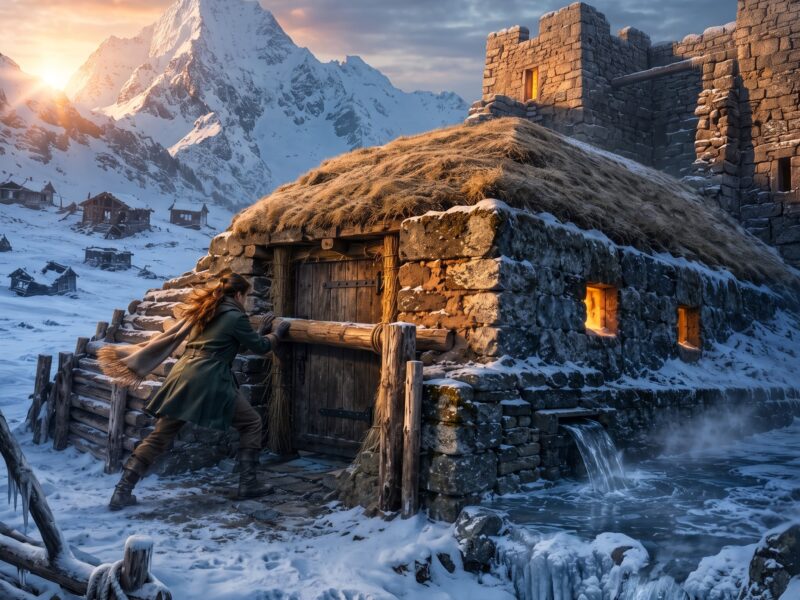
Thrown Out With Her Children, She Found an Abandoned Ice House — Then Winter Made It Unbeatable
The Tomb in the Hill
The day they finally arrived at their new property, a grim, heavy gray sky wept a cold, relentless drizzle.
The taxi driver, a surly man with a chewing tobacco habit, flatly refused to take his sedan down the deeply rutted, overgrown lane that led to the property. He dumped their few suitcases at the edge of the county road, collected his fare, and sped away, leaving them standing in the rain.
They walked, carrying their bags, the thick, sucking mud pulling at their shoes. The land was a desolate tangle of vicious thorn bushes, skeletal, dying weeds, and jagged rocks, sloping sharply down into a shallow, shadowed dell.
And there, sunk deeply into the earth of the hillside like a half-buried tombstone, was the structure.
It was not a building. Not in any sense that Ara recognized. It was a wound in the earth.
It was a squat, windowless box of dark, moss-eaten granite. Its roof was not shingled or tin, but a hummock of wild, overgrown grasses and dirt, blending seamlessly into the hill behind it. A low, arched doorway gaped open like a black, waiting mouth, leading into absolute, terrifying blackness.
Leo tightened his grip on Ara’s hand. “Is this our new house, Mama?” he whispered, his small voice trembling with barely contained terror.
Ara looked at the damp, dark, imposing stone. She listened to the oppressive, heavy silence of the place, broken only by the dripping rain. The very last, fragile ember of hope within her chest turned instantly to ice.
Despair was no longer an abstract feeling. It was a physical landscape, and she was standing directly in its cold heart.
The first four days were a blur of cold, exhausting misery. They slept in a flimsy nylon camping tent pitched on a rare, relatively flat patch of ground near the entrance. The nights were terrifying, punctuated by the strange, guttural cries of unseen animals in the quarry lands, and the ceaseless, shivering huddling of her children.
Ara forced herself to go into the stone structure during the daylight hours, armed only with a cheap, battery-powered lantern.
The inside was vastly worse than she had feared from the outside. The air was incredibly thick, choking her with the smell of deep decay, wet rot, and damp earth. The floor was a treacherous mire of sucking mud and generations of rotted leaves, home to a scuttling, unseen population of insects that fled from her light. The massive stone walls wept a constant, slick condensation, making the room feel like the inside of a cold, sweating lung.
It was a cave. It was a cellar. It was a place explicitly designed to hold the cold, not to repel it.
She spent hours just mindlessly clearing debris, her hands raw and bleeding from hauling out heavy, fallen stones, rotten timbers, and the massive, intricate nests of forgotten creatures. Her mind became a numb, repetitive litany of failure. I have led my children into a tomb. I have failed them.
The crushing weight of her mistake was a physical presence in the dark room, pressing down on her shoulders, stealing the very air from her lungs.









