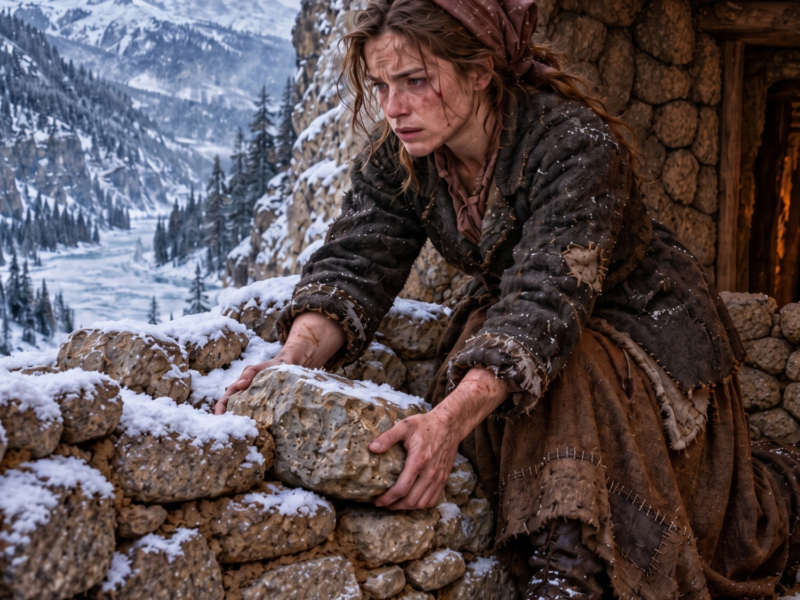
Thrown Out With Nothing, She Built a Home Inside a Mountain — Then Winter Sealed the Entrance
The Question
In the small, quiet hours of the following morning, Dorothea finally opened her eyes.
She lay perfectly still on the pallet and looked up at the cedar ceiling of the dugout for a long time without speaking. It was the specific way a person looks at a new, confusing place when they awake from a deep trauma, trying desperately to understand where they are before they try to understand anything else.
The ceiling was low and timber-framed, smelling of earth. The oil lamp hanging from a hook cast a warm, golden circle of light that did not quite reach the shadowed corners of the room. She could feel intense, radiant warmth on the left side of her face from the stove. She could feel the heavy, comforting weight of the wool blankets, and the stone bottles still holding some residual heat pressed against her sides.
Agnes’s wrinkled hand was wrapped tightly around hers.
She turned her head slightly and found the older woman fast asleep in a wooden chair that had been placed directly beside her. The small, worn Bible had fallen open on Agnes’s lap, her head tipped exhaustedly to one side.
Dorothea looked at her neighbor for a long time. She thought about a sunny morning she had stood at her front gate in October, and spoken to Agnes in the polite, condescending voice she always used when she needed to preserve a social boundary without appearing to enforce one. She remembered the specific, heavy quality of Agnes’s silence in response to that condescension.
It had not been the silence of someone who had been hurt. It was the profound silence of someone who had actively chosen, in that moment, not to teach the harsh lesson that the moment so clearly called for.
She turned her head the other way.
Hazel was fully awake, sitting on a crate across the stove, watching her. She was watching with the steady, non-intrusive, clinical attention of a medic checking a patient’s status, entirely without performing unnecessary concern.
“How long?” Dorothea whispered. Her voice was rough, thin, and painfully dry.
“Three days of the storm,” Hazel replied softly. “You came in last night.”
Dorothea closed her eyes, processing the missing time, and then opened them again in panic. “Cornelius.”
“He’s here,” Hazel said quickly. “He’s sleeping.”
Dorothea listened intently. She heard his breathing. Then, somewhere in the shadows behind her, she heard the slow, heavy, ragged breath of a man who has been awake for a very, very long time, and has finally given out to exhaustion.
“Is he all right?”
“Cold. Exhausted. He’ll be extremely sore for a week. But yes, he will live.”
Dorothea turned her gaze back to the cedar ceiling. A long, comfortable silence passed between them. It was the specific kind of silence that had absolutely nothing uncomfortable in it—it was simply two people existing in the same small space without the desperate, social need to fill the air with chatter.
“I wrote something,” Dorothea finally said, her voice stronger. “On the table. Before.”
“I saw it,” Hazel said.
“Did you read it?”
“The first sentence.”
Another long silence. The fire popped softly.
Then, Dorothea spoke again. “I’ve been writing professionally for twenty years. For other women to read. I’ve written extensively about how to arrange a parlor, and how to properly receive guests, and how to maintain high standards of civilization in difficult circumstances.”
She paused, taking a slow breath. “I didn’t actually know what difficult circumstances were.”
Hazel looked at the fire. “Most people don’t,” she said flatly. “Until they do.”
“What made you know… before this?” Dorothea asked.
Hazel was quiet for a long moment, staring into the flames. When she finally answered, her voice did not change in tone or pace, but there was a vulnerability in it that had not been present in the earlier conversations she had had with anyone in this room. It was a willingness to let the brutal thing be said plainly, completely without armor.
“My father,” Hazel said quietly. “February of ’62. He went out into a storm to get more firewood from the pile. He didn’t come back inside. We found him the next morning, frozen solid. Seventy steps from the front door.”
Dorothea did not offer a polite apology. She did not say she was sorry. People who have been terrifyingly close to their own death understand implicitly that “sorry” is absolutely not the right word for certain kinds of profound loss.
“He didn’t have a rope,” Dorothea stated, remembering the lifeline.
“No,” Hazel said. “He didn’t have a rope. And he didn’t have a warm hole in the ground to come back to.”
Hazel turned and looked directly at the woman lying on the floor.
“The hole is not about fear, Mrs. Algate,” Hazel said, her eyes intense. “People in town think it’s about being afraid of the winter. It’s not. It’s about the people you desperately want to come back to. It’s about making absolutely sure there is somewhere warm worth coming back to.”
Dorothea was completely quiet for a long time after that. When her eyes fluttered closed again, it was not from the encroaching cold or unconsciousness. It was from the immense, settling weight of finally understanding something that had been working its way toward her since the previous October, and had now, finally, arrived.









