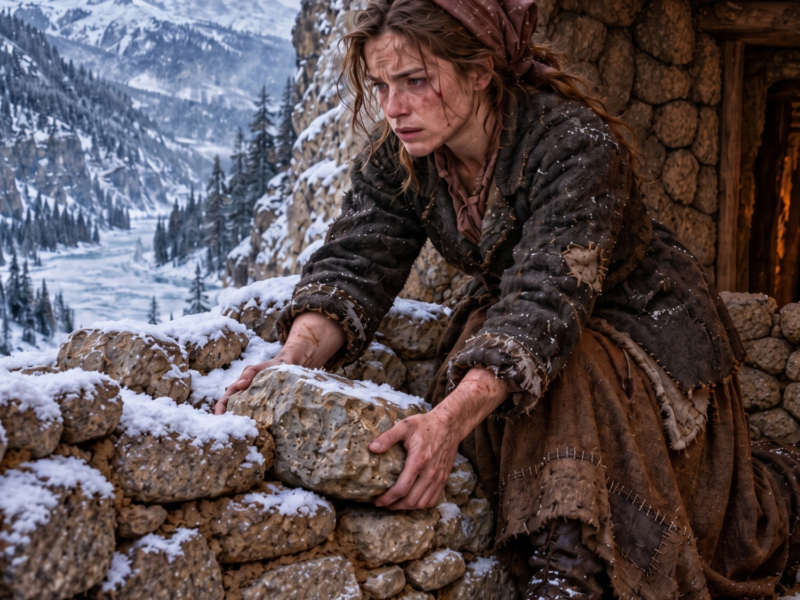
Thrown Out With Nothing, She Built a Home Inside a Mountain — Then Winter Sealed the Entrance
The First Lie of Winter
Millhaven, Montana Territory. November 1885 to the evening of February 16th, 1886.
The winter came in gently. Which was the first, and most dangerous, lie.
November passed with light, picturesque snow flurries and temperatures that never once broke below zero. December was milder still. It was the kind of deceiving, beautiful December that made arrogant newcomers write cheerful, mocking letters back East to their families, boasting about how the frontier’s terrifying reputation for severity had been wildly overstated by weak men.
The sky was a brilliant, crystal blue more days than not. The dirt roads stayed easily passable for wagons. People moved around the valley to church and social calls without the particular, paranoid caution that a hard season demands of survivors.
And that ease worked on them the way ease always works on the human mind: slowly, invisibly, without announcement, actively eroding the crucial margin between what they were prepared for, and what was actually coming for them.
Cornelius Algate hosted a lavish Christmas dinner that was talked about in the Millhaven mercantile for weeks afterward.
He had the long dining table set with fragile, expensive china brought all the way up from St. Louis on a padded train car. The roaring central heating furnace in the basement kept the massive house at a sweltering temperature that had his wealthy guests politely removing their wool coats and dabbing their foreheads before the soup course was even served.
Cornelius generously refilled crystal wine glasses and moved through his own sprawling, brightly lit rooms with the deep satisfaction of a man whose thesis about the world has just been empirically confirmed. The frontier was entirely manageable. It responded predictably to capital, planning, and superior technology. The five-hundred-dollar furnace had been, as he had always loudly maintained to anyone who would listen, entirely justified.
Dorothea sat at the far end of the long table. She was a gracious, flawless, and highly attentive hostess. She asked the exact right questions of the right important people, laughed musically at the right, unfunny moments, and made absolutely sure every single guest felt that their presence at this table, in this house, in this remote, uncivilized valley of the Montana Territory, was not a grueling inconvenience, but a profound pleasure.
She was very, very good at this performance. She had been very good at it for twenty years of marriage.
But twice during the festive evening, Dorothea found herself standing alone at the dark window of the quiet hallway, looking out across the snowy yard toward the dark, unassuming shape of Hazel Voss’s log cabin.
No light showed from the main floor windows. Even the small, flickering iron oil lamp that sometimes glowed in the storage room window was completely dark.
Dorothea knew exactly what that meant.
She had watched her neighbor closely enough through the autumn to understand that when that top window was dark, Hazel was below. She was down in the dark earth, in the room beneath the room, doing whatever mysterious, primitive survival things it was she did down there with her stacked firewood, her cast-iron stove, and her deeply prepared, unsettling silence.
Dorothea stood at the freezing glass for far longer than she meant to, her reflection staring back at her. Then, a loud, drunken guest called her name from the dining room, demanding more wine, and she pasted her smile back on and went back to her table.
Dorothea’s next major piece for the Philadelphia Ladies Gazette was due in the second week of January.
She had been working on the draft since October, and it was nearly finished. It was a careful, well-constructed, and highly persuasive argument that the comforts of refined living were absolutely not incompatible with the brutal frontier. It was heavily illustrated by the specific particulars of her own household: the imported china, the miracle furnace, the wallpapered interior, the ordered, civilized routine they had maintained despite the vast distance from any city of consequence.
She had included Hazel in the piece.
It was just one sentence near the end, offered as a stark contrast that underscored her central thesis of progress. She had described her neighbor as a “curious, eccentric local woman whose primitive homesteader methods provided an amusing, if tragic, illustration of how differently people chose to meet the same challenge.”
She read that sentence again in the second week of January, sitting comfortably at her writing table with the finished manuscript draft in front of her. She had read it a dozen times over the previous months and had found absolutely nothing wrong with it. It was clever. It was sharp.
Now, she read it one more time, and found something deeply wrong with it that she could not immediately name.
Outside her window, in the pale, freezing January morning light, Hazel was on her knees in the snow, meticulously checking the exterior of the trapdoor frame that led to the dugout.
Hazel moved around the perimeter of it with the focused, intense attention of a mechanic looking for a fatal flaw in an engine. She tested the heavy iron hinges, checked the felt weather seal for ice buildup, and precisely measured the clearance on the heavy steel latch.
There was absolutely no performance in her movement. Nobody was watching her, and she did not behave as though anyone might be judging her. She was simply doing what desperately needed to be done, solely because it needed to be done to stay alive.
Dorothea looked down at her handwritten draft. She looked at the arrogant sentence about the “curious local woman with the amusing methods.”
She sat with it for a long time, the pen heavy in her hand.
Then, she picked up the pages and tore them entirely in half. Not violently or in a fit of emotion. She did it deliberately. She did it the exact way an accountant corrects a fatal arithmetic error without drama—because the number is simply wrong, and a wrong number does absolutely nothing except violently mislead everyone who relies on it.
She took a clean, blank sheet of expensive paper and wrote a single line at the top in her own elegant hand. It was not a line for the magazine column, but a question for herself.
What does a woman who has survived know that I do not?
She stared at that terrifying sentence for a while. Then she folded the paper, locked it deep in the drawer of her writing table, and went downstairs to make coffee.
She did not start writing the column again for three days. When she finally did, she wrote something entirely, radically different. It was a somber, beautiful piece about the particular, haunting quality of winter light in the high mountain valleys. It had absolutely nothing to do with expensive furnaces, imported china, or the arrogant confirmation of civilization.
Her editor in Philadelphia wrote back a week later, ecstatic, telling her it was some of her most profound, moving work.
She did not show the letter to Cornelius.









