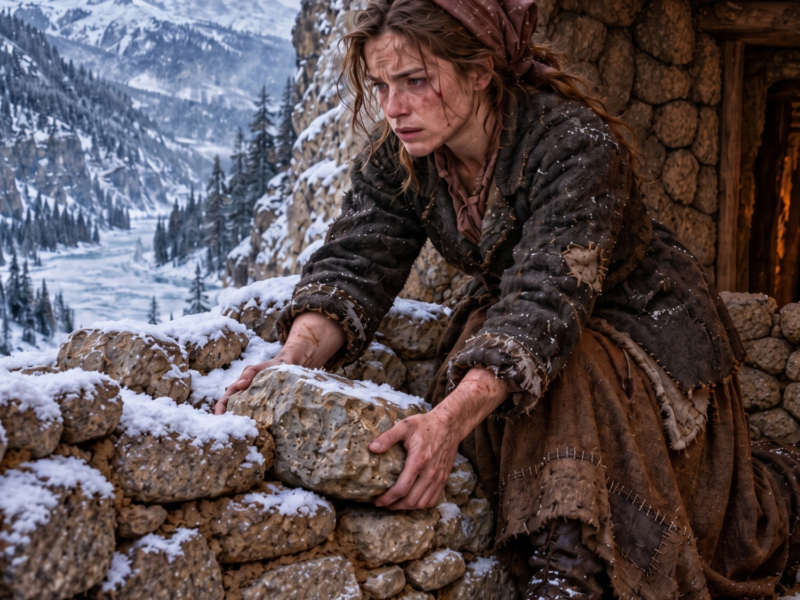
Thrown Out With Nothing, She Built a Home Inside a Mountain — Then Winter Sealed the Entrance
The Confession of the Ridge
It was the Saturday morning immediately after she found Ezra’s journal that Agnes Moorfield knocked on her door for the very first time.
Agnes was sixty-five years old. She had lived in the small, sagging frame house at the far, dead end of Blackwood Road since 1872, when her optimistic husband had brought her out west from Ohio. He had died violently in 1879, his chest crushed under a collapsed silver mine timber.
Agnes had stayed in Millhaven because leaving would have required a specific kind of youthful, hopeful energy she simply no longer possessed. And because Millhaven, despite its brutality and its ghosts, was her home.
She was a very quiet woman. Not from inherent shyness, but from a long, ingrained habit of watching and listening to other people’s mistakes that had settled into her bones like a second nature.
She knocked on Hazel’s door that Saturday morning holding a small, warm cornbread loaf wrapped in a clean flour cloth. She came inside without much fuss or ceremony, and sat down heavily at the kitchen table while Hazel silently poured them both cups of strong, black coffee.
They sat together in the comfortable, heavy silence of two women who have both learned the hard way that the world absolutely does not owe them conversation.
After a while, Agnes set her tin cup down and looked at her weathered hands resting on the table.
“I need to tell you something,” Agnes said, her voice dry and papery. “I have been needing to tell someone for about twenty years. And watching you dig that hole all summer… I think you might be the right person to finally hear it.”
She told Hazel about the Harpers.
They were a family who had lived on the high ridge directly above Blackwood Road in the early, desperate years, long before the railroad, before Agnes had even arrived in the valley. But they existed in the stories of the older, original residents. They weren’t a legend, exactly. They were more of a grim, cautionary warning that the old-timers whispered, and the newer, arrogant settlers like Cornelius Algate did not know to take seriously.
Five of them. A strong husband, a capable wife, and three grown, strapping children. They had built the largest, finest timber house on the ridge. They were well-built, well-stocked, and incredibly well-provisioned for winter.
They were all found dead in the catastrophic blizzard of February 1864.
Agnes had not seen them die. But she had heard the truth from the terrified woman who had lived across the road from them. The woman who had told the story exactly once, in a fit of hysterical guilt, before she completely refused to ever speak of it again until the day she died.
“There had been knocking in the night,” Agnes whispered, staring into her coffee. “In the middle of the absolute worst of the storm. Someone had come out of the Harper house in the dark, in the howling whiteout, and had stumbled across the road. They knocked desperately on the neighbor’s door.”
Agnes paused, her breathing shallow.
“And the neighbor… a woman living alone… she opened the door just a crack. She looked out into the screaming white darkness. She couldn’t see a foot in front of her face. And then… she closed the door again, and locked it. Because the storm was far too violent to step into, and she had no rope. She had no way to follow the sound of the knocking without getting lost and freezing to death herself. She listened to them knock until they stopped.”
Agnes had carried the suffocating weight of that terrible story for twenty-one years. Not because she had been the woman who locked the door, but because she understood, with the particular, devastating understanding of someone who has lived long enough to see the brutal shape of things, that the neighbor’s choice had been made in a split second of pure terror, with absolutely nothing to work with. And that no amount of wanting the past to have been different would have made it different.
What Agnes had never been able to explain to herself, what kept her awake at night, was why the story stayed so incredibly heavy in her own mind. Why it sat in her chest every single February like a physical stone that had been placed there on purpose.
“Because you knew there had to be another way,” Hazel said softly, breaking the silence. “And you didn’t know what it was. You felt the guilt of not having an answer.”
Agnes looked up at her, tears shining in her old eyes. “Yes,” she whispered. “That’s exactly it.”
Hazel was quiet for a long moment, staring out the window at the distant, snow-capped peaks.
“A rope,” Hazel said flatly.
“What?”
“The neighbor needed a heavy rope tied securely to the inside of the doorframe,” Hazel explained, her voice slipping into the clinical, instructional tone of a survival guide. “One end secured permanently inside the house. The other end to uncoil and follow blindly into the storm. You can go sixty, seventy, even eighty feet in absolute zero visibility with a lifeline. Without one, you are entirely disoriented and lost in twenty steps.”
Agnes looked at Hazel as if she were doing complex mathematics in her head.
“Is that what you will do?” Agnes asked. “If something catastrophic happens this winter? If someone out there needs to be reached? Is that part of what you are building down there for?”
“That’s part of it, yes,” Hazel said.
Agnes was quiet for a very long time. Then, she smoothed her skirt. “May I come back to ask you more questions about what you are building, Mrs. Voss?”
“You don’t ever have to ask permission, Agnes,” Hazel said.
After that morning, Agnes came over exactly once a week, always on Wednesday afternoons. She always knocked politely, even though Hazel had explicitly told her she did not need to.
She asked careful, highly practical questions. How many full-grown people would the dugout hold if needed? Whether the trapdoor could be securely opened from both the top and the bottom. What happened to the exhaust flue pipe if heavy snow accumulated rapidly on the stone chimney above the roofline?
Hazel answered each and every question directly, without colorful elaboration, and without making the older woman feel foolish. She answered the exact way she had learned to talk to junior soldiers who were genuinely trying to learn how to stay alive, and did not need to be convinced that the lesson mattered.









