With No Home or Family, a Young Woman Came Looking for Work—The Lonely Old Rancher Gave Her the Keys
THE RECKONING
Spring returned slowly to Painted Creek Basin.
The snow withdrew from the fence lines like a retreating army, revealing the scarred but unbroken earth. Water moved smoothly through the diversion swales Bee had dug, bypassing the springhouse entirely.
Beyond the barn, the repaired windscreen remained standing, its willow slats bent and battered, but defiant.
Victor Calder was in a federal penitentiary in Cheyenne, awaiting trial for the murder of his father and the destruction of the Painted Creek freight station. The syndicate he had built crumbled overnight.
Nolan kept returning to Willow Bend. He never became the perfect son, but he became a man who showed up. He repaired fences, hauled stone, and took orders from Rufus without complaint.
One quiet afternoon in May, Hester called Bee onto the porch.
The cattle rested in the lush, green lot. Copper, older now and sporting a scar on his snout from the gunman’s rifle, slept in the sun beneath the steps.
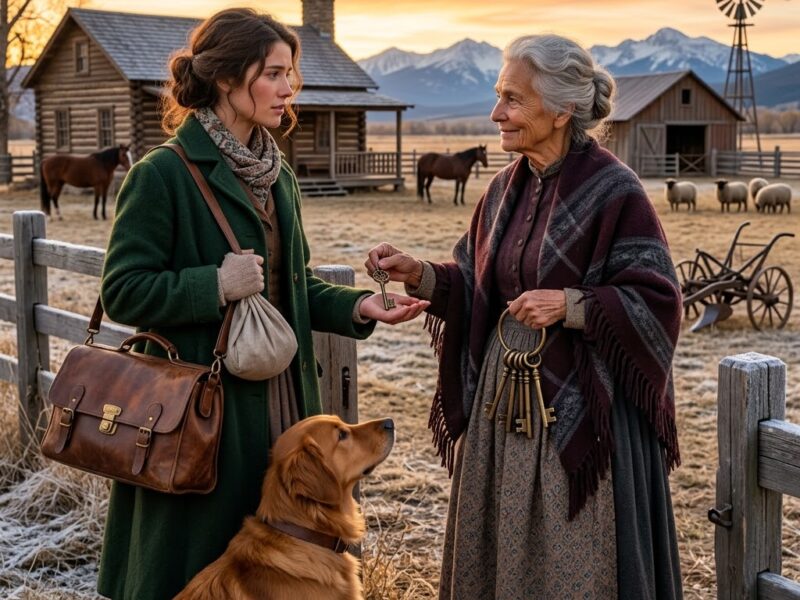
Hester was looking frailer, the brutal winter having taken its toll on her bones. She reached down to her belt and unclipped the heavy, chiming ring of iron keys.
“My hands don’t like carrying this anymore,” Hester said, her voice raspy.
She held the ring out.
Bee looked at the keys. “The papers still say Willow Bend is yours.”
Hester took Bee’s hand, flipped it over, and placed the heavy iron ring directly into her calloused palm. She closed Bee’s fingers around it.
“Paper tells who owns it,” Hester said softly, looking out at the ranch they had fought and bled for. “Work tells who keeps it.”
Bee didn’t answer. She didn’t need to. She looked toward the gate, the barn, the springhouse, and the endless chores waiting for morning. Then she sat down in the rocking chair beside Hester.
Years passed.
Hester eventually rested beside Isaac on the hill overlooking the draw.
Willow Bend remained a working ranch. It never became a charity house, and it never grew into a corporate empire. Cattle still needed feeding. Fences still broke in the spring thaw. Winter still arrived every year to judge every careless decision.
But the main gate stayed open when someone needed a chance. A hired hand between jobs, a widow with a broken wagon, a drifter caught ahead of a storm.
Bee, with her hair turning silver and the heavy key ring always at her hip, would ask them one simple question:
“Can you work?”
If the answer was yes, there was always hot stew, cornbread, and somewhere dry to sleep.
Copper was gone by then, buried near the springhouse. Another ranch dog slept beneath the same porch steps.
And out beyond the barn, the massive windscreen still stood. It had been repaired, reinforced, and rebuilt a dozen times over the years. Because Bee knew the ultimate truth of the frontier.
Wisdom was never proved by lasting untouched. It was proved by knowing exactly what was worth maintaining.









