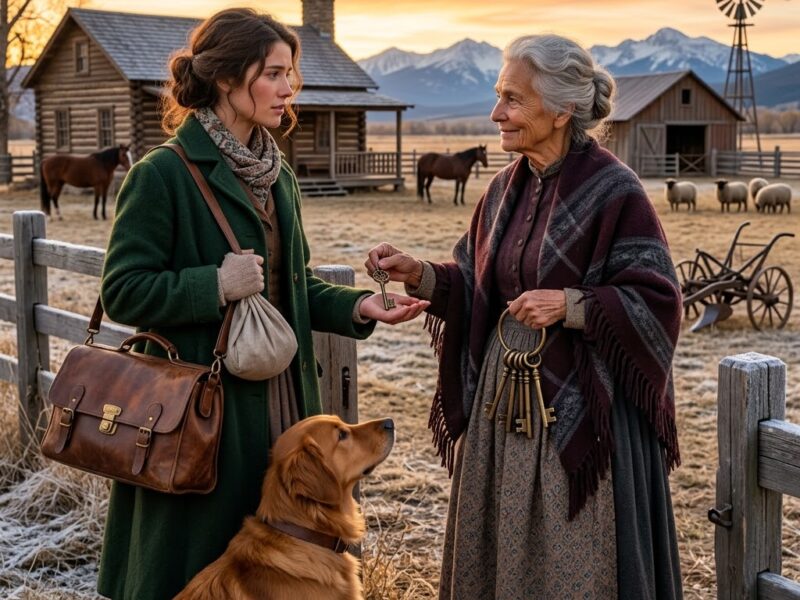
With No Home or Family, a Young Woman Came Looking for Work—The Lonely Old Rancher Gave Her the Keys
THE WEIGHT OF IRON
Bee waited until evening, when the wind rattled the windowpanes like skeletal hands, before laying out the idea.
She didn’t propose tearing down a barn or moving a shed. On the kitchen table, using a piece of charcoal, Bee marked out a windscreen roughly fifty-six feet long, built from the lodgepole pine already felled on the ranch.
“It won’t be solid,” Bee explained, tapping the charcoal against the paper. “Small openings let some air pass through while taking the kinetic strength out of the northwest wind. Behind it, we create a sheltered lane leading toward the barn. We shift the hay access to the lee side.”
Hester listened, her face unreadable. “How much?”
“Mostly labor,” Bee said.
Rufus unfolded a wooden measuring rule, placing it on the table. “And where do you suppose all that snow goes after you stop the wind, girl?”
Bee looked at him. It was the right question. A windbreak didn’t magically remove snow. If a wall was built too tight or too close to the barn, it would slow the air so sharply that snow would pile up exactly where they needed passage, creating a massive, impassable drift.
“It has to go somewhere,” Bee acknowledged.
Hester set her heavy key ring beside the folding rule. The metallic clink sounded like a gavel.
“Use the old lodgepole,” Hester ordered. “Build a piece first, then watch it.” Her eyes locked onto Bee, sharp and unforgiving. “A key lets you open something, Beatrice. It doesn’t make you right.”
The next morning, Bee and Rufus began. They set massive lodgepole posts deep into the frozen ground, fasting willow slats between them, deliberately leaving narrow gaps. The screen was meant to bleed the wind, not trap it.
The first section stood six-feet-eight-inches high. Bee placed it exactly eleven feet from the barn, calculating that the shorter distance would protect the doorway best. Rufus measured it with his folding rule but kept his mouth shut.
They hauled river cobble and coarse gravel, packing it into the icy throat near the springhouse to provide traction. They dug a shallow diversion swale above the path to funnel runoff away before it could freeze.
That night, the temperature fell to seventeen degrees.
By morning, the changes spoke for themselves. The springhouse path was free of black ice. The barn door still rattled, but it no longer violently snapped against Bee’s hands. Copper trotted happily behind the new screen, avoiding the biting wind.
Hester walked across the springhouse approach carrying a full pail, not once needing to reach for the old rail to steady herself. Bee saw her do it and kept working.
But three days later, the trap sprang.
A heavy fall of wet snow crossed Painted Creek Basin, followed by a vicious northwest wind. At first, the screen worked perfectly. Then, the physics of the wind shifted.
The air slowed too drastically behind the screen. Snow began dropping out of the air current like stones. By afternoon, a massive, packed drift had formed perfectly between the barn and the milk room door.
Bee put her shoulder against the door and shoved. It barely moved. An hour later, the passage was entirely buried.
Rufus walked over with a shovel. He didn’t gloat. He didn’t remind Bee of his warning. He cut a vertical slice through the drift, leaving one face standing. The compacted layers told the brutal story.
Bee swallowed hard. She fetched the folding rule. “Eleven feet. Too close.”
“I put it wrong,” she said.
The next morning, in freezing temperatures, they tore their own work apart. Posts came out. Slas were stacked. They moved the entire line outward until the screen stood eighteen feet from the structure. Bee changed the spacing near the end, opened more relief toward the south, and corrected the grade.
It meant repeating back-breaking labor. Blistered hands. Lost daylight.
Hester watched from the porch, offering no blame, and no help.
Near dusk, Bee was using a heavy iron bar, trying to lever out a stubborn, frozen post. Her hands were bleeding through her patched gloves. She gritted her teeth, her muscles burning, refusing to ask for help.
Rufus walked over. He didn’t say a word. He placed his hands over hers on the freezing iron crowbar, and together, they heaved. The post popped free.
Rufus released the bar into her hand. From that moment on, Rufus wasn’t just watching Bee work. He was working for her.









