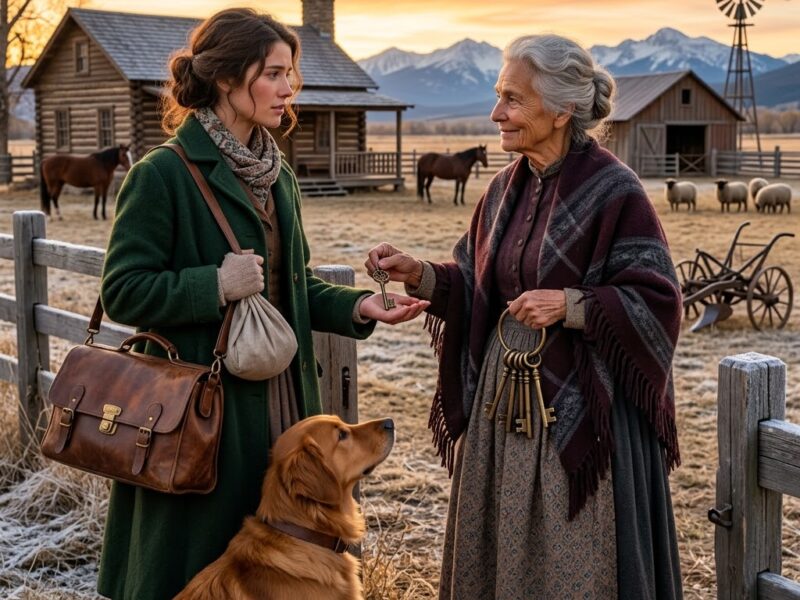
With No Home or Family, a Young Woman Came Looking for Work—The Lonely Old Rancher Gave Her the Keys
THE ARCHITECTURE OF DEFIANCE
A few days later, Bee rode into the Painted Creek settlement for salt, lamp oil, and liniment for Hester’s joints.
The general store was warm, smelling of roasted coffee and wet wool. Lenora Fitch, a 59-year-old storekeeper whose eyes missed absolutely nothing, began filling the order.
As Bee reached for her coin purse, her coat parted. Lenora’s eyes locked onto the small ring of iron keys hanging at Bee’s belt. The store fell silent. Three ranchers near the pot-belly stove stopped talking.
“Mrs. Calder letting you handle things now?” Lenora asked, her voice dripping with casual suspicion.
“Some things,” Bee replied evenly.
“Those changes at the barn hers, too?”
Bee took Hester’s written account note from her pocket and laid it on the counter. “She approved them.”
A man near the stove spat into a brass spittoon. “Victor and Nolan know a stray dog is running their mother’s place?”
Bee folded her receipt, turning her head slowly. She recognized the man. He was the one with the silver-toed boots. The man from the freight station.
Her blood ran ice cold, but her face remained a mask of stone.
“I’m working there,” Bee said quietly. She walked out of the store, her heart hammering against her ribs.
By the time she mounted her horse, the narrative in town had already been written. A young woman had arrived with nothing. Now she lived under Hester’s roof, spent Willow Bend’s credit, and carried its keys.
On the ride home, the iron ring struck Bee’s hip with every step. It felt like a target.
When she walked into the kitchen, she reached to unclip the keys.
“Did the springhouse open when you needed it?” Hester asked without looking up from her tea.
“Yes,” Bee said.
“Feed shed?”
“Yes.”
“Then keep the key.”
That evening, the wind died down to a haunted whisper. Hester brought a polished walnut box to the kitchen table and unlocked it with a key from her own ring.
Inside lay a faded tintype photograph of Isaac Calder, a stern man with a thick beard. Beside it rested his heavy brass pocket watch, several yellowed papers, and a hand-drawn sketch of Willow Bend from its earliest years.
Hester pulled out a stack of recent letters.
“Read them,” Hester commanded.
Bee read. The letters were from Hester’s sons. Victor Calder, 47, a trade magnate in Cheyenne. Nolan Calder, 41, a man whose letters reeked of desperation and unpaid debts.
One letter asked exactly how many head of cattle Willow Bend was carrying. Another inquired about the sale price of neighboring acreage. A third aggressively suggested Hester lease out the pastures to a Cheyenne holding company.
The holding company’s name was the same one stamped on the stolen freight ledger in Bee’s room.
“They don’t ask how you are,” Bee noted quietly.
“Victor is a man who sees the world as a spreadsheet,” Hester said, tracing the edge of Isaac’s brass watch. “And Nolan is a man who owes money to people who don’t ask nicely.”
Hester closed the lid of the box with a sharp clack. “They are coming. Tomorrow.”









