A Cowboy Gave His Bed to Two Wounded Apache Sisters
CHAPTER 5: THE CHOICE AT SUNRISE
Emmett stood frozen. Four years he had wandered — running from the loss of his mother, from the girl he could not save, from the feeling that he belonged nowhere. Now he learned his place had been waiting all along, hidden in a secret his mother died without speaking.
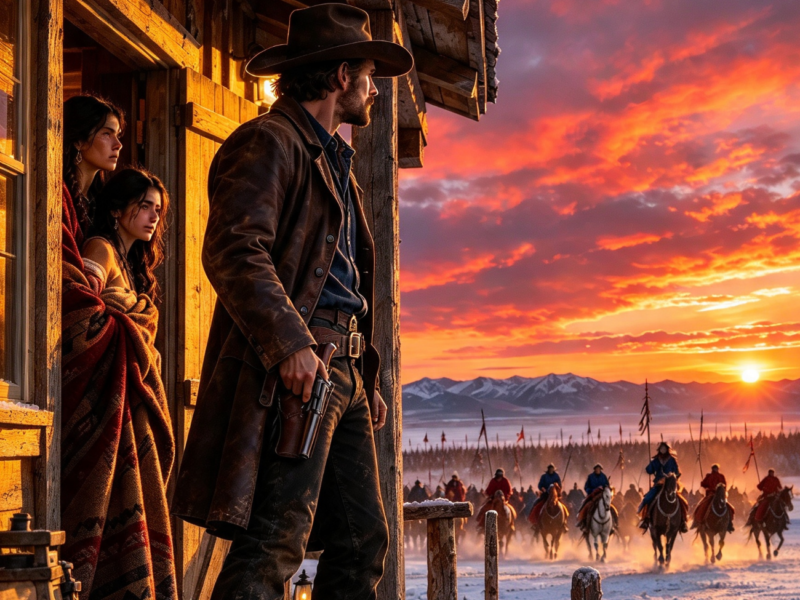
He looked at Ronnie — pale, bandaged, watching him with hope and fear tangled in her eyes. At Desta — fierce, guarded, suddenly family. At the seven hundred warriors, motionless as statues, waiting.
He stepped down from the porch.
"Emmett!" Desta called out.
He did not stop. He walked across the dry grass, past the fence line, into the open space between the ranch and the people. He stopped before the chief — a man with a face carved by wind and sorrow, eyes the same dark shade as his own.
"You knew my mother," Emmett said.
The chief nodded. "She was bright as lightning. She loved a man who could not understand her. She left to protect you — so you would not be torn between two worlds."
"And the law?" Emmett asked. "Does kinship cancel what I did?"
The chief touched the ledger. "The law says no outsider may touch the Biin Fiin. But you are not an outsider. You are blood. You saved your cousin. You saved the sacred. That is not a crime. That is a duty."
A murmur rippled through the ranks.
"Then why the show of force?" Emmett asked.
"Because some among us would not be moved by words alone," the chief said. "They needed to see you stand. To see you choose."
He extended the ledger. Emmett reached out — his hand, calloused, scarred, familiar — and placed it upon the leather cover.
"I choose," he said, "to know where I come from. I choose to stand with my family."
Behind him, on the porch, Ronnie exhaled. Desta smiled — a small, broken, beautiful thing.
The sun cleared the horizon then, flooding the salt flats with gold. The warriors lowered their weapons. They did not cheer. They did not shout. But they shifted — their shoulders relaxed, their hands fell away from their knives.
The chief turned his horse back toward the valley. "Come," he said over his shoulder. "There is much to tell. Much to remember."
Emmett looked back once — at the cabin he had lived in alone, at the bed he had given away, at the two women waiting for him. Then he faced forward.
He was no longer the man who walked past a drop of blood and kept going. He was the man who stopped.
And for the first time in his life, he was going home.
Ronnie stepped out behind him, trembling.
"Emmett," she whispered. "There is something else. The punishment is not what you think. And my father already knows something about you that even you do not know."
Desta grabbed her sister's arm. "Ronnie — don't!"
But Ronnie pulled free.
"He knows," she said, tears spilling over, "that the blood you touched is not only sacred. It is kin."
Emmett stared. "Kin?"
"Your mother," Ronnie said, her voice breaking. "She was Biin Fiin before me. She left the valley. She married a white man. She never told you where she came from."
The world seemed to tilt. The handkerchief in his pocket felt suddenly heavy — the M, the lavender scent he had carried in his bones, the silence she had kept about her childhood.
"That is impossible," he said, but his voice shook.
"She was my mother's younger sister," Ronnie said. "You are my cousin."
Desta looked at him as if seeing him for the first time. "That is why your name was known. That is why the chief did not ride with anger alone. He rode to find the boy his sister abandoned."
The chief stopped fifty paces from the porch. He unwrapped what he carried — a ledger bound in buckskin, pages filled with drawings and names.
"Emmett Cross," he called again. "Son of Maka — who ran from her duty. You have touched the sacred. You have broken the law. But you also carry the blood."
He waited.
"Come forward," the chief said. "Not as a stranger. Not as a criminal. But as one of us. Or stay — and be cast out from both worlds forever."Next