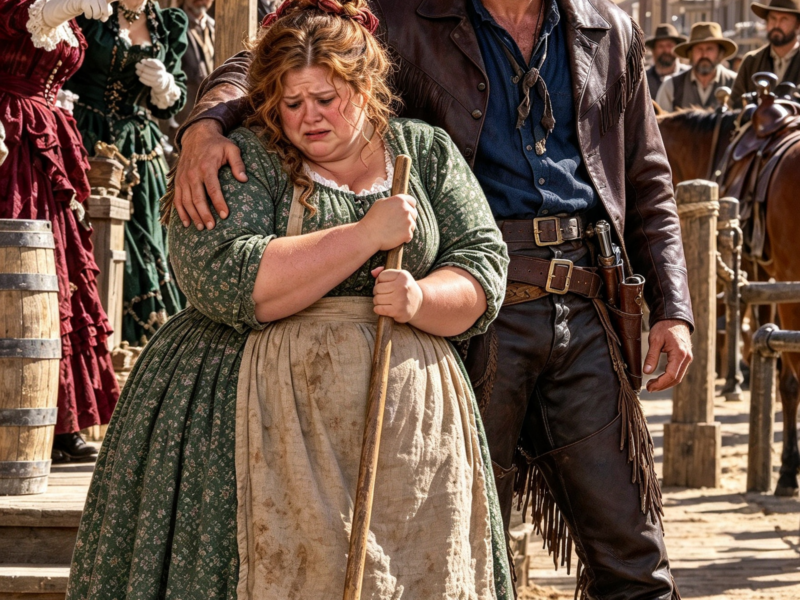
They Laughed When He Married the “Barren Widow” — Years Later, He Rode Back to Make Them Pay
CHAPTER 1: THE MAN WHO SPOKE WITH SILENCE
“She’ll be dead before spring.” The whole town laughed when Boon married the barren widow and took her into the mountains. Years later, when a powerful stranger rode back into Bitterroot asking about old debts, the people who mocked Kora suddenly stopped laughing.
Dust does not forgive, and neither did the town of Bitterroot.
Ten years ago, they watched a rough-hewn mountain trapper walk out of the dry valley with a woman they deemed worthless. She was a widow with an empty womb. A bad bet in a hard land. They spat at his boots. They laughed at his folly. They bet a month’s wages. She will be dead by winter.
Today the laughter is gone. This is how he silenced them all.
Boon came down from the high country only when the coffee ran out and his rifle needed powder. He rode a rangy gelding that looked as raw-boned and mean as he did, leading two mules packed heavy with winter pelts.
The journey down the canyon took three days. The air changed as he descended. The sharp pine-scented bite of the altitude gave way to the heavy, baked alkali stench of the valley. Down here the wind didn’t howl. It just pushed hot dirt around.
Bitterroot was a jagged scar of a town cut into the side of a dry creek bed. It boasted a mercantile, a livery, a bank that looked too heavy for its foundation, and a church that judged everything below it.
Boon hated the place. He hated the noise of it — the clatter of wagon wheels, the barking of stray dogs, the desperate, greedy hustle of folks trying to scrape a fortune out of rocks that had nothing left to give. He preferred the honest brutality of a grizzly over the smiling arithmetic of a town merchant.
He tied his animals at the rail outside Miller’s Provisioning. The wood of the rail was chewed by a hundred anxious horses. Boon dismounted. He was a tall man, wide through the shoulders, wrapped in buckskin and heavy canvas. His beard was thick, his eyes the color of old flint accustomed to tracking movement at five hundred yards. Down here they just looked tired.
As he stepped onto the boardwalk, his boots thudding heavy on the warped planks, he saw her.
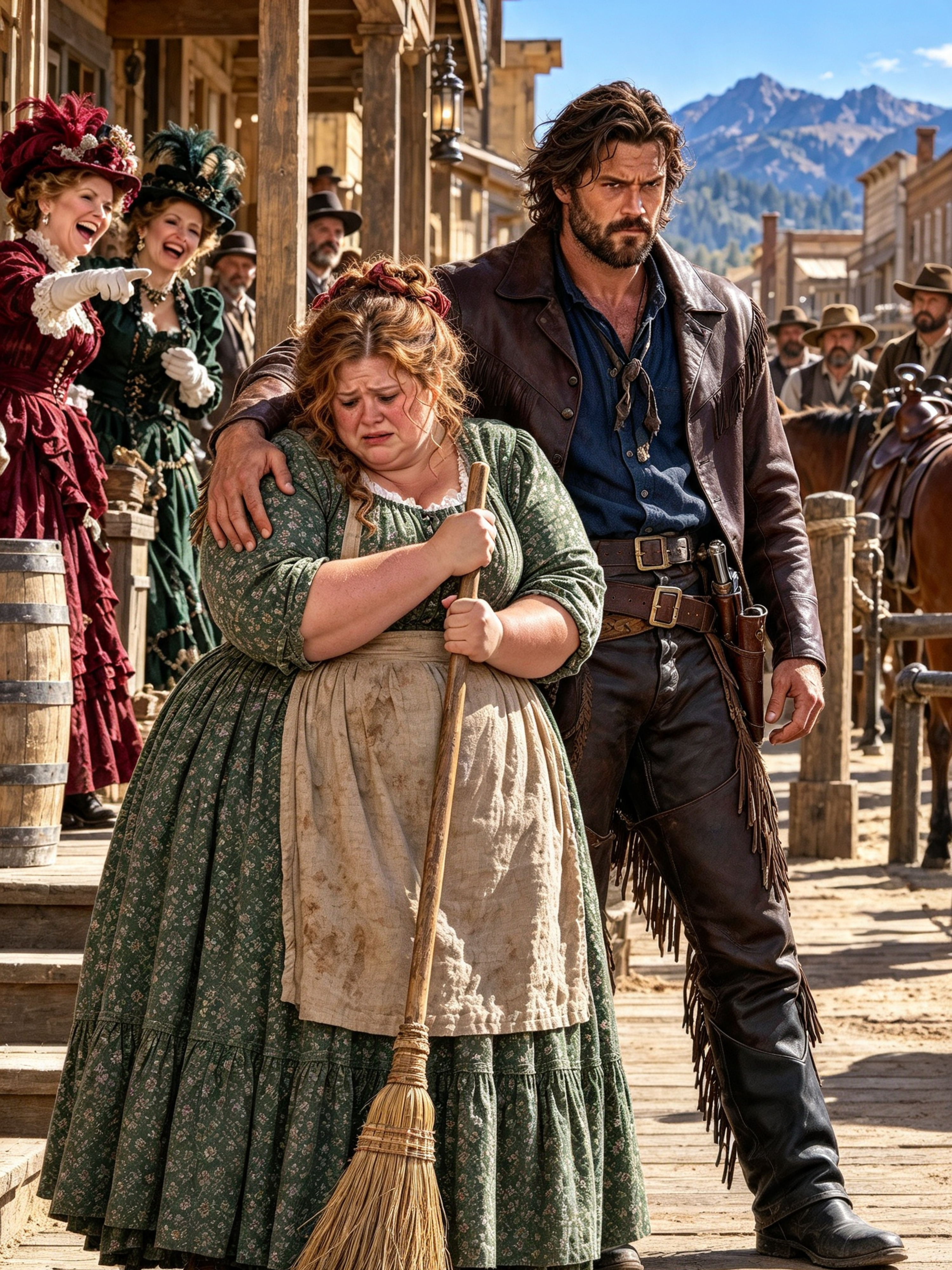
She was sweeping the dirt off the porch of the boarding house across the street. It was a pointless task. The wind just blew the dust right back over the boards, but she swept with a methodical, punishing rhythm.
Her name was Kora. Boon didn’t know that yet. He only knew what he saw.
She wore a faded calico dress that had been washed so many times it had lost its pattern. Her hair — dark, heavy brown — was pinned back severely, though strands had escaped to stick to her sweating neck. She wasn’t frail. There was a wiry strength in her forearms, a stiffness in her spine that spoke of too much labor and too little rest.
Two women in crisp, high-collared dresses stood near the corner watching her. They didn’t lower their voices. They didn’t feel the need to.
“Tragedy, really,” the taller one said, adjusting a parasol to block the afternoon glare. “But what could Caleb expect? The soil was bad from the start. Three years they were married.”
The other agreed, her voice a sharp, nasal whine. “Not so much as a swelling. His mother warned him: ‘A man needs sons.’ He worked himself into an early grave trying to do the labor of four men.”
Kora didn’t look up. The broom scratched against the wood. Scrape, scrape, scrape, scrape.
Boon paused with his hand on the mercantile door. He watched the women. Then he watched the sweeper. He understood the cruelty of animals well enough — a wolf pack would turn on a crippled member to save the rest. But human cruelty was different. It was recreational.
Caleb had been a local prospector, a man who thought blasting powder and blind luck could substitute for sense. A premature fuse had put an end to his dreams, leaving behind a mountain of debt, a repossessed cabin, and a widow. The town had already found her guilty of the ultimate frontier sin. She was barren.
In a place where a woman’s worth was measured in the farmhands she could produce, an empty cradle was a curse.
Kora finished sweeping. She didn’t glare at the gossiping women. She didn’t cry. She just leaned the broom against the post, picked up a small wooden crate from the shadows of the porch, and stepped down into the dusty street, heading straight for the mercantile.
Boon pushed the heavy door open and went inside. The bell above clanged a dull, rusted note.
The interior smelled of kerosene, damp flour, and old leather. Josiah Miller stood behind the counter — a man who looked like he’d been left in a root cellar too long: pale, soft, smelling faintly of rot.
Boon dropped his heavy pack of pelts onto the counter. The wood groaned under the weight. Josiah jumped, his ledger snapping shut. His eyes darted to the heavy knife strapped to the mountain man’s thigh.
“Mr. Boon, didn’t expect you till the first snow.”
“Snow’s early in the pass,” Boon said. His voice was a low rumble, rusty from lack of use. “Coffee, gunpowder, salt, half a barrel of oats.”
“Of course. Let me just…” Josiah started untying the bundle, fingers probing the thick beaver and fox furs. His eyes gleamed. He knew quality — Boon didn’t trap garbage. “I can give you $30 for the lot. Market’s down in St. Louis.”
It was a lie. Boon knew it was a lie. He was about to tell Josiah exactly where he could shove the St. Louis market when the door opened.
Kora walked in. Up close, Boon saw the dark circles under her eyes, the lines of exhaustion bracketing her mouth. She carried the wooden crate with white-knuckled tension.
Josiah looked past Boon. His obsequious merchant smile vanished, replaced by a tight line of annoyance.
“Mrs. Hayes, I told you yesterday — the bank owns the claim now. I can’t extend credit on a dead man’s name.”
“I don’t want credit,” Kora said. Her voice was surprisingly steady — it didn’t shake, though her hands did. She set the crate down, pushing it toward him. “I brought Caleb’s tools — the micrometer, the good block plane, the brass compass. They’re worth $20. I just need enough for a stage ticket to Denver.”
Josiah sighed, a theatrical puff of air meant to show his deep Christian patience. He poked at the tools with a fat finger. “Brass is tarnished. Plane needs sharpening. And nobody in Bitterroot needs a micrometer. Kora, what are they measuring? Dirt?” He chuckled at his own joke. “I’ll give you $3. Take it or leave it.”
“The compass alone cost $10,” she said, her voice dropping an octave, tightening with a desperate edge she was trying desperately to hide. “$3 won’t get me past the county line.”
“Then I suggest you find employment. Mrs. Gable needs someone to scrub out the livery stalls.”
Boon stood to the side, silent. He watched the exchange. He saw the way Kora’s jaw clamped shut. She wasn’t going to beg. She reached out to pull the crate back.
“Hold on,” Boon said.