Thrown Out With Her Daughter as Winter Closed In — Then She Found the Secret Her Dead Husband Had Died Without Telling Her
CHAPTER 1: THE GROUND THAT DID NOT FREEZE
Thrown Out of the Flour Mill With Her Seven-Year-Old Daughter as a Winter Storm Approached, a Widow Followed a Hand-Drawn Map to a Forgotten Canyon—But When She Found Warm Ground Beneath the Snow, She Realized Her Dead Husband Had Known Something the Entire Valley Had Overlooked
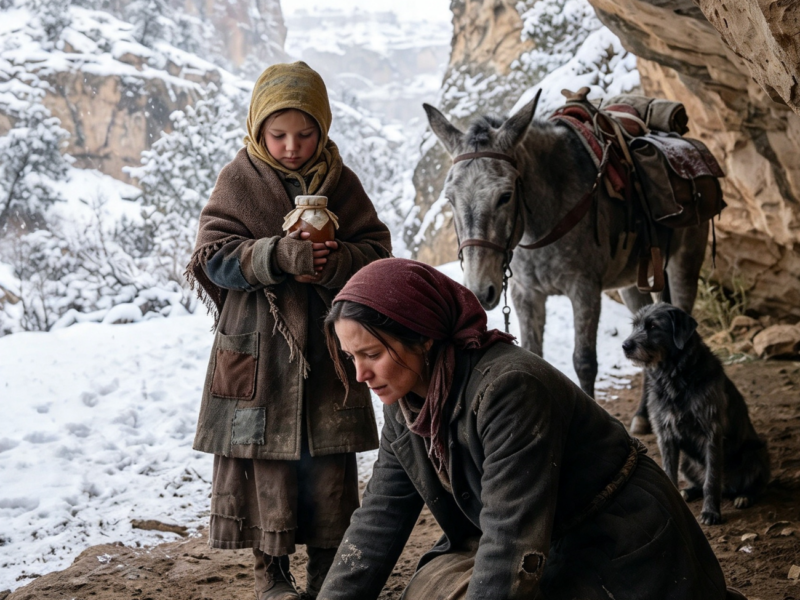
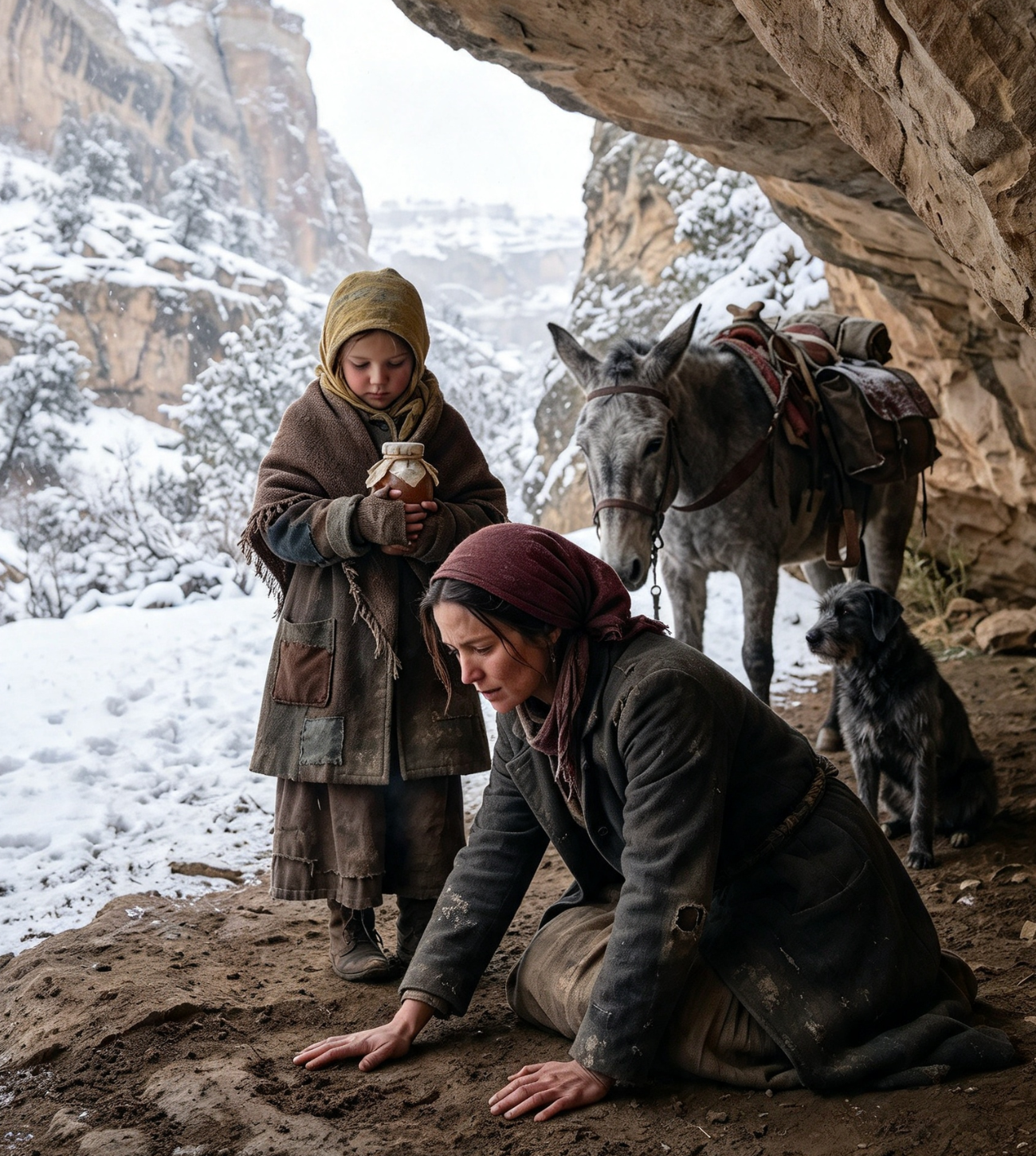
Cordelia Bain dropped to her knees beneath the sandstone ledge and pressed her bare hand into the earth. It should have been frozen solid. Snow had followed her and her seven-year-old daughter nearly all the way up the mountain. The wind had driven ice against their faces, and the trail behind them was already disappearing beneath fresh drifts. Yet here, deep inside a forgotten canyon, the soil yielded beneath her fingers. Not warm like a hearth. Not even comfortable. But soft enough to dig.
Cordelia stared at the dark earth clinging to her fingertips. Then she reached into her coat and unfolded the map a quiet mail carrier had given her that morning. Two words had been written beside the narrow mountain passage. Iron Hollow. And beneath them was a sentence that had troubled her throughout the journey. Owen asked me about this place in August.
Her husband had died in September.
For six weeks, Cordelia had believed everything he left behind could fit inside a mule’s saddlebags. Now, with a storm closing around her daughter, she was beginning to wonder what else Owen had discovered before his death. And why he had never explained it.
Only that morning, Cordelia had still been working in Harlon Puit’s flour mill in Coldstone Creek, New Mexico Territory. She was thirty-four, recently widowed, and responsible for a little girl who had learned to recognize worry before her mother spoke it. Owen had been killed when a survey crew’s equipment cart crushed him on a mountain switchback. There had been no savings large enough to carry them through winter. Harlon, who owned the valley’s only mill, had allowed Cordelia to work for food and occupy a narrow sleeping space behind a wooden partition. She swept floors, repaired grain sacks, and maintained the storage ledger.
She also noticed something Harlon preferred not to discuss. The eastern storage roof was failing. Rain had softened a timber joint directly above rows of flour sacks. Cordelia inspected the damage, recorded every new crack, and warned that heavy snow followed by melting water would ruin everything. Harlon nodded, promised repairs — and did nothing. Reverend Silas Drum, standing there that day, said the roof had served the community well enough for years. Cordelia wrote one more line in her ledger.
Then came November 8, 1886.
The eastern mountains turned that strange, bruised green Owen had taught her meant trouble. A winter storm was rushing down from the peaks. Harlon arrived with the reverend and two men from the upper valley. His voice was firm, his gaze avoiding hers. The mill could no longer feed them both, he said. Flour was scarce. The community had to protect families with established claims.
Cordelia looked at the four men. Not one met her daughter’s eyes.
“How long before the storm reaches us?” she asked quietly.
“Six hours,” one said. “Maybe less.”
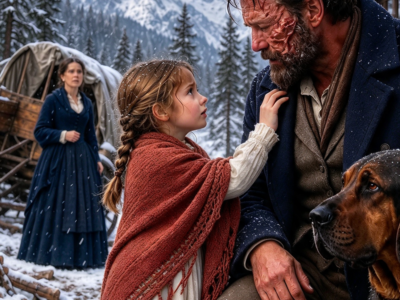
She made no plea. Within forty minutes, she had packed Owen’s seed pouch, his small hand axe, rope, wire, a wool blanket, her father’s sourdough starter — and the ledger she had kept with her own hands. She saddled Cinder, their aging gray mule. Flint, their loyal dog, trotted close behind. May carried the clay jar holding the living culture her grandfather had nurtured for eleven years. It was more than food — it was memory.
Nobody offered them shelter.
Near the post house, Elias Foot stepped into their path. The quiet mail carrier rarely spoke more than necessary. This time he handed her a folded scrap of paper — a map he had drawn himself, showing the northern trail, the upper switchback, and a narrow fork marked Iron Hollow.
“Owen asked me about this place in August,” he said.
Cordelia studied his face. “What did he find there?”
“He was asking about the ground,” Elias said. “Said he’d seen something on a geological chart. Warm earth where it shouldn’t be. Something that might shelter you.”
She remembered then — Owen coming home from a road crew months earlier, talking over supper about heat rising from deep in the rock, about ground that never fully froze. She had listened, nodded, and forgotten. Now it was the only hope anyone gave her.
“Have you been there?”
“Not far enough to promise anything,” he said honestly.
It was not a guarantee. It was a direction.
By afternoon, the storm was upon them. Ice glazed the trail. Snow swallowed the edge. Cinder slipped to one knee, then struggled back up. May’s boots were soaked through. Cordelia could no longer feel two of her fingers.
Then Flint stopped — nose lifted, tail still — beside a shadowed opening beneath a limestone shelf. Cordelia unfolded the map. The fork matched exactly. She led Cinder inside.
The wind died instantly. Ahead lay a wide sandstone overhang and a stretch of ground almost entirely free of snow. That was where she knelt. Where her hand sank into earth that had not frozen. Where Owen’s quiet words suddenly felt like a promise he had tried and failed to keep.
May stepped closer, clutching the clay jar to her chest. “Is this where Papa wanted us?”
Cordelia smoothed the map. “I don’t know, little one. But I think he wanted us safe.”
She gathered dry branches from sheltered rock and struck a flame. The fire caught fast. But then something strange happened — the smoke did not linger or drift back. It bent sideways, drawn steadily toward a darker passage at the hollow’s rear. She held a burning twig near the opening. The flame leaned inward. There was airflow through the rock.
If Owen was right about the ground, that passage might lead somewhere warmer. Safer.
Cordelia lifted the hand axe. “Stay close to Cinder,” she told May.
Flint stepped beside her as she approached the dark. She raised the twig, and reached her free hand into the cool, moving air.