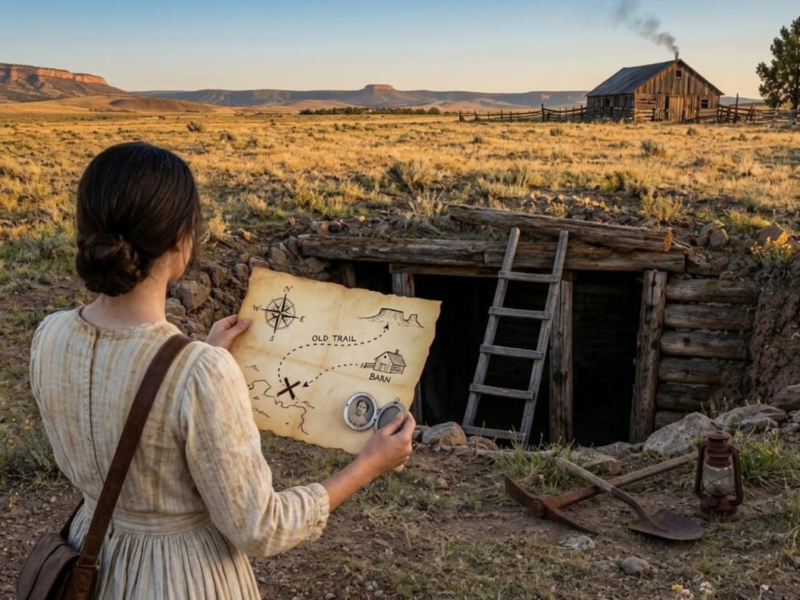
Exiled and Alone, She Bought a Failing Farm for $3—What Was Buried Under the Field Changed Her Life
THE SOD HOUSE AND THE LEDGER
To understand Norah Fenwick, one had to look past the pinched mouth and the graying wool of her coat to the Kansas sod house where she had been born.
Her father, Arthur Fenwick, had come west with a dryland wheat drill, three horses, and a head full of poetry he’d memorized back in Ohio. He had taught Norah that the earth was not an adversary to be whipped into submission, but a stubborn creature that needed coaxing. “You listen to the sod, Nora-girl,” he would tell her, evening after evening, while her mother sat by the tallow dip mending flour sacks with neat, invisible stitches. “The soil talks. It tells you when it’s thirsty, and it tells you when it’s had enough of your nonsense. If you don’t listen, it’ll break your heart just as soon as look at you.”
Her mother had given her books. Not many—a water-stained Bible, a volume of Emerson, and a tattered copy of Jane Eyre traded from a passing wagon. From those pages, Norah had learned that integrity was not something given to you by a church or a husband; it was an internal spine. You either had it stiff, or you folded like damp hay.
Then came the summer she was eleven. The diphtheria didn’t sweep through the county; it struck like lightning in a clear sky. First her little brother, tom-tom silent in his fever bed, then her mother, and three days later, her father, coughing his lungs into a gray rag while the wind howled outside the soddy walls.
Silas Vain had arrived in a black-painted spring wagon two weeks after the graves were filled. He was her mother’s brother, a man who smelled perpetually of stale peppermint and dry wool. He had looked around the meager sod house, calculated the cost of the burial against the value of the three horses, and told Norah to pack her doll.
“You’re coming to Amity Creek,” Silas had said, not unkindly, but with the flat finality of a ledger being closed. “I have a store. You can earn your keep behind the counter. Honest work builds character, child, and God knows you’ll need all the character you can scrape together without a dowry.”
Amity Creek was a young town then—a collection of unpainted clapboards clinging desperately to the banks of a shallow, muddy creek that ran high in April and cracked into alkaline dust by August. Silas owned the general store on the corner of Main and Second. It was the largest building in town, boasting a shingled roof, a real glass storefront, and, tucked safely in the back office behind a six-inch iron door, the town’s communal safe.
The Farmers’ Cooperative was Silas’s crown jewel. Formed during the grasshopper plagues of the mid-seventies, it was a pool of capital—mostly hard-earned silver dollars and grain scrip—contributed by every struggling homestead in a twenty-mile radius. When a farmer lost his seed to a late frost or his mule to the colic, he came to Silas Vain for relief. Silas held the keys, Silas kept the books, and for nearly seven years, Silas was regarded as Amity Creek’s secular saint.
Norah grew up inside that store. She knew the weight of a five-pound sack of salt pork better than she knew the feel of silk. By sixteen, she was keeping the day-books, her handwriting small, neat, and precise as a bird’s footprint in snow.
Yet, as she grew, she began to notice the shadows behind her uncle’s saints-halo.
It started with small things. A ledger entry for “Seed Relief — J. Miller” where the amount crossed out and rewritten was three dollars lighter than the receipt in Miller’s own greasy fist. A line item for “Store Maintenance” that seemed to recur with suspicious regularity every November, just as Silas’s wife, Aunt Martha, took delivery of a new winter mantle from Omaha.
Norah had asked once, her voice small behind the high pine desk.
“Uncle Silas? Mr. Miller says he only got four bushels of oats, but the book says six.”
Silas hadn’t looked up from his tallow-dipping. His pen had scratched across the paper, scritch, scritch, scritch.
“Miller’s memory is full of holes, niece. A man forgets what he takes when his belly’s empty. You stick to the figures I give you. Don’t go borrowing trouble where none’s planted.”
She had stayed silent. She was an orphan living under his roof, eating his salt, wearing his cast-off cottons. To question him was to question her own right to draw breath.
So she kept her head down, folded her napkins, weighed her flour, and watched the ledger accumulate little river-sediment lies, week after dry, miserable week, until the summer of 1879 broke them all.









