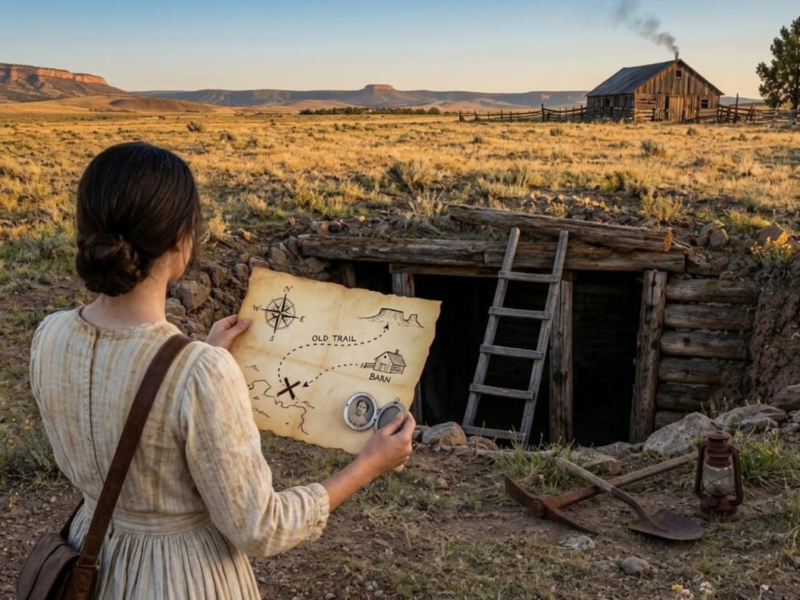
Exiled and Alone, She Bought a Failing Farm for $3—What Was Buried Under the Field Changed Her Life
THE RETURN TO AMITY CREEK
The return was not triumphant. Triumphs belonged to storybooks; reality on the Nebraska frontier was gray, dusty, and smelled of wet wool.
It took Norah four days to walk the valley farms, visiting the men and women whose names were written in Elias Tarant’s cramped, honest hand. She didn’t go to the town square first. She went to old man Halloway—the farmer whose children had gone without seed while Silas blamed the Omaha bankers.
Halloway was sitting on his porch whittling a willow peg when Norah walked up his path. He looked up, his face hardening instantly. He didn’t want trouble with Silas Vain; nobody in Amity Creek wanted trouble with Silas Vain.
“Morning, Miss Fenwick,” Halloway said stiffly. “If you’re looking for work, Mrs. Halloway ain’t got wash to spare this week.”
“I’m not looking for work, Mr. Halloway,” Norah said. She reached into her canvas satchel and pulled out the leather-bound ledger. She laid it open across his knees. “I’m looking for truth.”
Halloway frowned, glancing down. His rough, calloused thumb brushed the page. He read the heading: Amity Creek Founders’ Relief — Winter of 1864. Then he saw the names. His own father’s name was there, alongside a notation in Elias Tarant’s hand detailing a deposit of thirty bushels of rye seed—a deposit Silas Vain’s master ledger claimed had never been made.
“Where’d you get this?” Halloway’s voice dropped an octave, the dry rattle of the plains gone from it.
“Buried under the cottonwood stump on the Tarant place,” Norah said quietly. “My uncle didn’t invent the trick, Mr. Halloway. His father taught him. And my uncle’s been using it to rob every family in this valley since the railway came through.”
By Saturday night, the ledger had passed through six hands. By Sunday morning, the quiet in Amity Creek had the heavy, suffocating feel of air before a prairie fire.
When the cooperative board met at two o’clock in the upstairs room above the general store—the exact same room where Norah had been cast out ten days before—every chair was filled, and men were standing three deep against the unplastered pine walls.
Silas Vain sat at the head of the long oak table. He looked older than he had a week ago; his collar seemed too large for his neck, and his small, pig-like eyes darted nervously toward the stairway every time a floorboard creaked. He had heard the rumors. In a town of three hundred souls, a secret didn’t travel on the wind; it rode lightning.
Norah walked up the stairs alone. She wore her only dress—brushed clean, though the hem still showed the three-dollar seam where her survival had been stitched—and she carried the iron box under one arm like a Bible.
She didn’t wait for Silas to speak. She didn’t ask permission. She walked straight to the table, set the box down with a dull, iron thud, and opened the ledger to the flyleaf where Elias Tarant’s signature was scrawled in faded ink.
“Mr. Chairman,” Norah said, her voice clear and level, carrying easily to the back corners of the crowded room. “I believe there’s an error in the cooperative’s accounts. Several errors, extending back some fifteen years.”
Silas shot to his feet, his face purple, his jowls trembling.
“This is an outrage!” he shouted, his voice cracking slightly on the high notes. “The girl is a confessed thief! She was caught red-handed dipping into the register! Are you men going to listen to the ramblings of a disgraced vagrant who had to buy eleven acres of swampland just to find a roof over her head?”
“Sit down, Silas,” old man Halloway said.
It wasn’t a shout. It was simply the voice of a man who owned six hundred acres of mortgaged dirt and had lost three children to the diphtheria and two to the drought, and who had finally reached the end of his patience with men who smelled of peppermint and stolen wheat.
Silas blinked, his mouth working silently like a landed fish. “Halloway—”
“I said sit down,” Halloway repeated, standing up from his bench. He reached out a hand as broad and rough as a butcher’s block and turned the ledger toward himself. He ran a finger down the column of figures, matching them against the receipts he carried in his own breast pocket—receipts he had saved for a decade because a farmer learns early never to trust a man with clean fingernails.
The room was so quiet you could hear the flies buzzing against the windowpane, fat and lazy in the autumn heat.
For twenty minutes, no one spoke. Halloway turned the pages. Rev. Absalom Cray, the town’s aging Methodist minister, leaned over his shoulder, his spectacles sliding down his nose. Every few seconds, Halloway would look up from the book, his eyes fixing on Silas Vain with a cold, terrifying intensity.
“Silas,” Halloway said finally, his voice terribly quiet. “In eighteen-seventy-five, you recorded a loss of twelve hundred dollars in the rail-link fire. The ledger here says the insurance draft was paid in full to the reserve account three weeks before the fire even touched the warehouse.”
Silas swallowed hard. Sweat was beading on his upper lip, cutting pale tracks through the road dust on his skin.
“That… that’s old paper. Elias Tarant was addled. He hated my father. He hated me. He cooked those books out of spite!”
“Elias Tarant was dead two years before the rail-link fire happened, Silas,” Halloway said softly.
The silence that followed was heavier than the iron box.
They didn’t lynch him. Amity Creek was too small for ropes, and the men of the cooperative were too tired for blood. But when Silas Vain walked out of that room twenty minutes later, he wasn’t the town’s saint anymore. He was just an old man with a greasy ledger and a failing store on a dying corner, walking through a crowd of neighbors who stepped aside as if he carried a contagious rot.
EPILOGUE: THE WHEAT OF TARANT ACRES
The winter of 1879 was long and bitter, but for the first time in her life, Norah Fenwick slept beneath a roof that didn’t leak.
The forty silver dollars went a long way. She bought a sturdy mule named Dolly, a double-shovel plow from the blacksmith, and two sacks of hard winter wheat seed from a German settler down by the Platte.
When spring broke, the old Tarant place looked different. The sagging barn roof had been patched with split cedar shingles; the fence lines were strung tight with new barbed wire that caught the morning light like silver thread. And the eleven acres—the cursed, broken, dead ground that no sane person would touch—were plowed four times deep, until the pale, stubborn clay was turned over to the sun, smelling rich and dark and wet like fresh-baked bread.
People in town stopped crossing the road when Norah drove her wagon into Amity Creek for supplies. Some of them even nodded—tentative at first, then warmer as the months wore on. Silas Vain’s store lost half its custom within a year; people preferred to trade at the new cooperative window that Rev. Cray set up in the church vestry, managed by a committee of farmers who swore never to let another man hold the keys alone.
One afternoon in late June, Norah was standing at the edge of her north field, watching the first green shoots of winter wheat stand tall and straight against the prairie wind. The stalks were thick, the color of young jade, waving in long, rhythmic ripples whenever the breeze swept down from the hills.
A horse’s hoofs crunched on the gravel of her lane.
She turned to see an old man sitting astride a bay gelding, his hat pulled low against the glare. It was Halloway. He didn’t dismount; he just sat there for a long moment, looking out over the green expanse of the field where nothing had grown for ten years.
“Looks like she’s taking, Miss Fenwick,” Halloway said, his voice gruff, hiding whatever sentiment he was too proud to name.
“She’s taking,” Norah agreed, wiping her forearm across her forehead, leaving a smudge of dark loam across her brow. “Father always said the dirt isn’t your enemy, Mr. Halloway. It just wants you to listen before you plant.”
Halloway tipped his hat—a gesture he had never offered Silas Vain in all his born days—and turned his horse toward the road.
Norah stood alone for a moment longer. The sun was warm on her shoulders, sinking low toward the western ridge and turning the sky the color of a healing bruise—purple and gold at the edges.
She reached up, her fingers brushing the silver hairpin that held her hair in place—the one her mother had given her, the one she had once laid on a shop counter to buy flour she couldn’t afford. It felt secure now. Solid. Part of her.
She turned back toward the cabin, where the stove was cold and supper still needed cooking, stepping lightly over the dark, rich earth of Tarant Acres. The town had its name back, the cooperative had its silver, and Norah Fenwick had her ground.
And out here on the Nebraska frontier, where a person could lose everything between one sunrise and the next, a deep, silent root was finally taking hold.









