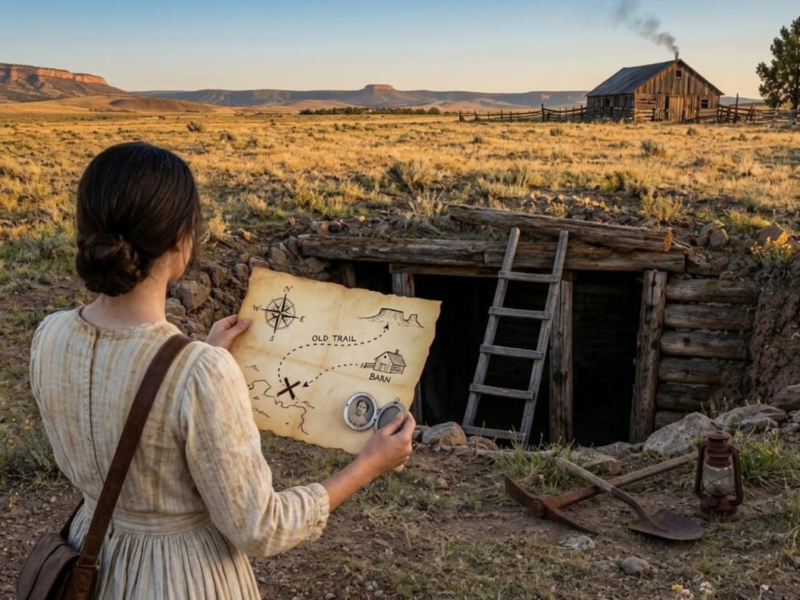
Exiled and Alone, She Bought a Failing Farm for $3—What Was Buried Under the Field Changed Her Life
THE ACCUSATION
The drought of ’79 was not a dry season; it was an executioner.
By August, the cornstalks were twisted like dead fingers, brown and brittle before they ever silked. The wells in the lower bottoms had gone sour, tasting of sulphur and old iron. Farmers came into Silas Vain’s store with hollow eyes and cracked lips, asking for the cooperative draw.
Silas sat behind his desk with his ledger open, his face a mask of ecclesiastical sorrow.
“I’m sorry, brother,” he told a desperate man named Halloway, whose four children were down with the summer ague. “The fund is tapped. Bone dry. Speculators in Omaha took our railway bonds down three points; the eastern banks have tightened their fists. There’s nothing left.”
Halloway had stared at him, uncomprehending. “Nothing? We put three hundred bushels of winter wheat into that cooperative last July, Silas. Where’s the grain money?”
“Gone to paper, Halloway. Gone to paper.”
That night, the store was closed. The street outside was quiet, save for the dry rattle of cottonwood leaves scraping against the clapboards. Norah was sitting by the oil lamp in the small loft above the store, cross-referencing the shipping receipts from the Omaha freight line against Silas’s master ledger.
Something didn’t fit.
The figures didn’t balance by nearly four hundred dollars—a massive sum in a town where a man could buy a milk cow for twelve. She traced the ink lines back through the spring pages. There were erasures. Chemical erasures, done with lemon juice and scrapers, covered over with fresh brown ink that didn’t quite match the old iron-gall.
Silas climbed the stairs, his boots heavy on the pine treads. He stopped at the loft door, his shadow stretching long across the floorboards.
“Working late, niece?” he asked smoothly.
“The columns are off, Uncle,” she said without looking up, her heart beginning to hammer a rapid, foolish tattoo against her ribs. “Here, in May. The seed distribution doesn’t match the bank drafts.”
Silas walked over. He didn’t look at the book. He looked down at her with eyes like slate chips.
“The books are as they should be, Norah.”
“No, they aren’t. There’s four hundred dollars missing from the reserve drawer. I checked the bank receipts from the depot agent. He never cashed those drafts.”
Silas was quiet for a long, heavy moment. The air in the loft seemed to grow dense, smelling of lamp oil and the cold greasy fear rising in the old man’s throat. When he spoke, his voice was no longer Uncle Silas’s voice. It was the voice of a man defending his throat from a knife.
“You’ve always been a clever girl, Norah. Too clever for a woman’s own good. Taking figures into your head that don’t belong there.”
She looked up, alarm finally breaking through her obedience. “What do you mean?”
“I mean,” Silas said softly, “that a man trusts his blood. He brings an orphan girl into his house, feeds her, gives her a clean bed, and how does she repay him? By dipping her fingers into the drawer while his back is turned. Little by little. Pennies. Nickels. Dollar bills slipped into a carpet bag.”
Norah stood up so fast her chair tipped over with a crash. “I never touched a copper! You know I didn’t!”
“I know what the town will believe,” Silas whispered, his face twisting into an expression of profound, theatrical heartbreak. “A girl with no name, no parents to watch her, living under my roof. They’ll see the books. They’ll see the discrepancies in your hand. I tried to cover for you, Norah. I swear before God I did. But the board is meeting tomorrow. I can’t protect a thief.”
He had played his hand with the cold, practiced precision of a cardsharp.
The next morning, when the farmers gathered for the cooperative meeting, Silas didn’t show them the erasures; he showed them a separate sheet of paper—in Norah’s handwriting, meticulously copied over weeks—listing small, systematic withdrawals made under her initials, N.F.
They didn’t look at her with anger. They looked at her with that terrible, flattening pity that is worse than hatred. Old man Halloway wouldn’t even meet her eyes.
Three days later, her willow trunk was sitting in the mud by the horse trough, and Norah Fenwick was walking down Main Street with three dollars sewn into her hem, watching the town she had served for ten years pull its window curtains shut as she passed.









